

functional parameter was estimated to be 7 mg/L. The toxicity of Sr affected
zooplankton consumers, and the activity of phytoplankton decreased at high
concentrations.
7.10.15 Silver Nanoparticles (AgNP)
In recent years, silver nanoparticles (AgNP) have come to be widely used as antibiotics
and sterilizers, but information is not available on the influence these particles may
have on aquatic ecosystems through drainage into river water after use. Though the
metal (Ag) is known to exhibit serious toxicity in aquatic ecosystems that contain
biological interactions, material circulation, and energy flow, the environmental risk
remains poorly understood. The microcosm, which is the model microbial ecosystem
consisting of producers, consumers, and decomposers, is useful for evaluating the
environmental risk to an ecosystem system with complex interactions among organisms, rather than the toxic risk evaluation for single species at an ecosystem level, and
positioning as a standard docimasy becomes important. Here, we conducted an
environmental impact assessment of AgNP on microbial community function and
structure, using the experimental flask-sized microcosm system.
To assess its influence, AgNP was added at several concentrations on the 16th day
after microcosm cultivation began. Plankton observation using an optical microscope was conducted at the start of culturing, on days 0, 2, 4, 7, 14, 16, 18, 20,
23, and 30, and the kinds of changes in a flask for each addition concentration as the
structural parameter were observed. In addition, DO was measured consecutively
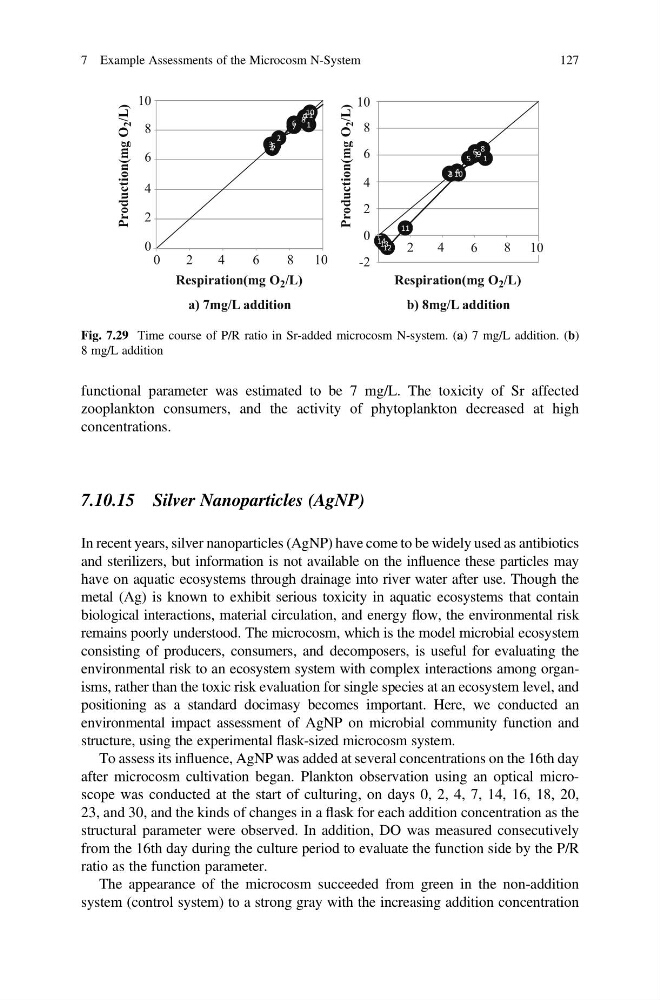
from the 16th day during the culture period to evaluate the function side by the P/R
ratio as the function parameter.
The appearance of the microcosm succeeded from green in the non-addition
system (control system) to a strong gray with the increasing addition concentration
a) 7mg/L addition
b) 8mg/L addition
1
2
3 4 5
6 7
8 9
10
11
1
2 3 4
5
6 7
8
9
10
11
12
13
14
Respiration(mg O 2 /L)
Respiration(mg O 2 /L)
Production(mg O
2 /L)
Production(mg O
2 /L)
0
2
4
6
8
10
0
2
4
6
8
10
-2
0
2
4
6
8
10
2
4
6
8 10
Fig. 7.29 Time course of P/R ratio in Sr-added microcosm N-system. (a) 7 mg/L addition. (b)
8 mg/L addition
7 Example Assessments of the Microcosm N-System
127
zooplankton consumers, and the activity of phytoplankton decreased at high
concentrations.
7.10.15 Silver Nanoparticles (AgNP)
In recent years, silver nanoparticles (AgNP) have come to be widely used as antibiotics
and sterilizers, but information is not available on the influence these particles may
have on aquatic ecosystems through drainage into river water after use. Though the
metal (Ag) is known to exhibit serious toxicity in aquatic ecosystems that contain
biological interactions, material circulation, and energy flow, the environmental risk
remains poorly understood. The microcosm, which is the model microbial ecosystem
consisting of producers, consumers, and decomposers, is useful for evaluating the
environmental risk to an ecosystem system with complex interactions among organisms, rather than the toxic risk evaluation for single species at an ecosystem level, and
positioning as a standard docimasy becomes important. Here, we conducted an
environmental impact assessment of AgNP on microbial community function and
structure, using the experimental flask-sized microcosm system.
To assess its influence, AgNP was added at several concentrations on the 16th day
after microcosm cultivation began. Plankton observation using an optical microscope was conducted at the start of culturing, on days 0, 2, 4, 7, 14, 16, 18, 20,
23, and 30, and the kinds of changes in a flask for each addition concentration as the
structural parameter were observed. In addition, DO was measured consecutively
from the 16th day during the culture period to evaluate the function side by the P/R
ratio as the function parameter.
The appearance of the microcosm succeeded from green in the non-addition
system (control system) to a strong gray with the increasing addition concentration
a) 7mg/L addition
b) 8mg/L addition
1
2
3 4 5
6 7
8 9
10
11
1
2 3 4
5
6 7
8
9
10
11
12
13
14
Respiration(mg O 2 /L)
Respiration(mg O 2 /L)
Production(mg O
2 /L)
Production(mg O
2 /L)
0
2
4
6
8
10
0
2
4
6
8
10
-2
0
2
4
6
8
10
2
4
6
8 10
Fig. 7.29 Time course of P/R ratio in Sr-added microcosm N-system. (a) 7 mg/L addition. (b)
8 mg/L addition
7 Example Assessments of the Microcosm N-System
127