

3.6
Biogas Production
To reduce the change in global climate patterns, specifically the production of
increased level of atmospheric carbon dioxide by the utilization of fossil fuels is a
difficult task for the society. The replacement of fossil fuels with one of the
renewable sources such as biogas is an important step to reduce the greenhouse
gas emission thus preventing the climate change. Aerobic digestion could also
effectively degrade the organic material. However, an aerobic process produces
huge amounts of sludge along with fully treated wastewater, rather than converting
feedstock entirely to methane. Different types of advantages and disadvantages of
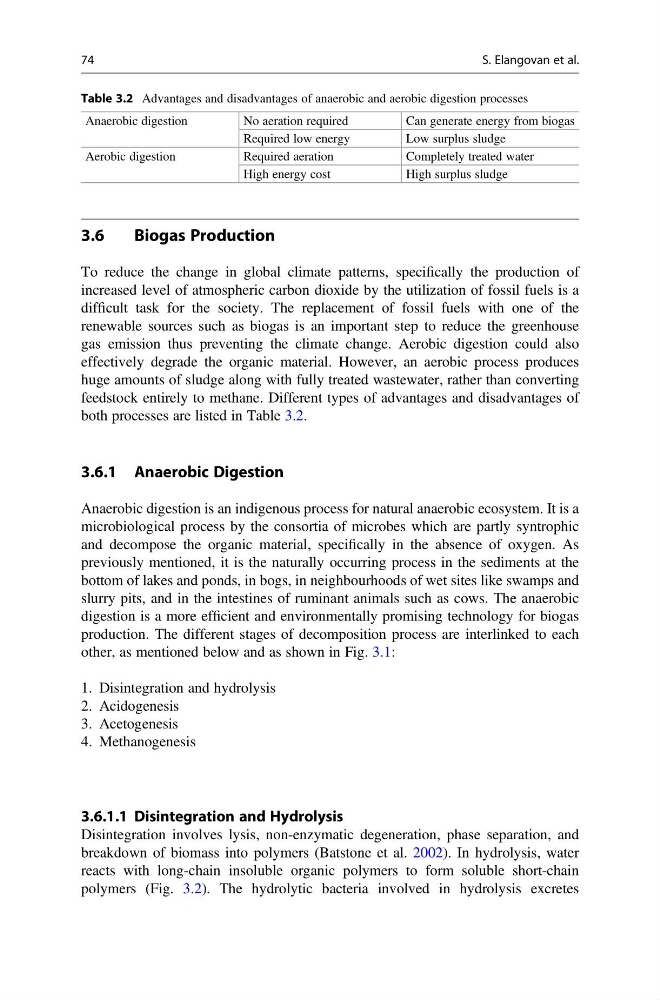
both processes are listed in Table 3.2.
3.6.1 Anaerobic Digestion
Anaerobic digestion is an indigenous process for natural anaerobic ecosystem. It is a
microbiological process by the consortia of microbes which are partly syntrophic
and decompose the organic material, specifically in the absence of oxygen. As
previously mentioned, it is the naturally occurring process in the sediments at the
bottom of lakes and ponds, in bogs, in neighbourhoods of wet sites like swamps and
slurry pits, and in the intestines of ruminant animals such as cows. The anaerobic
digestion is a more efficient and environmentally promising technology for biogas
production. The different stages of decomposition process are interlinked to each
other, as mentioned below and as shown in Fig. 3.1:
1. Disintegration and hydrolysis
2. Acidogenesis
3. Acetogenesis
4. Methanogenesis
3.6.1.1 Disintegration and Hydrolysis
Disintegration involves lysis, non-enzymatic degeneration, phase separation, and
breakdown of biomass into polymers (Batstone et al. 2002). In hydrolysis, water
reacts with long-chain insoluble organic polymers to form soluble short-chain
polymers (Fig. 3.2). The hydrolytic bacteria involved in hydrolysis excretes
Table 3.2 Advantages and disadvantages of anaerobic and aerobic digestion processes
Anaerobic digestion
No aeration required
Can generate energy from biogas
Required low energy
Low surplus sludge
Aerobic digestion
Required aeration
Completely treated water
High energy cost
High surplus sludge
74
S. Elangovan et al.
Biogas Production
To reduce the change in global climate patterns, specifically the production of
increased level of atmospheric carbon dioxide by the utilization of fossil fuels is a
difficult task for the society. The replacement of fossil fuels with one of the
renewable sources such as biogas is an important step to reduce the greenhouse
gas emission thus preventing the climate change. Aerobic digestion could also
effectively degrade the organic material. However, an aerobic process produces
huge amounts of sludge along with fully treated wastewater, rather than converting
feedstock entirely to methane. Different types of advantages and disadvantages of
both processes are listed in Table 3.2.
3.6.1 Anaerobic Digestion
Anaerobic digestion is an indigenous process for natural anaerobic ecosystem. It is a
microbiological process by the consortia of microbes which are partly syntrophic
and decompose the organic material, specifically in the absence of oxygen. As
previously mentioned, it is the naturally occurring process in the sediments at the
bottom of lakes and ponds, in bogs, in neighbourhoods of wet sites like swamps and
slurry pits, and in the intestines of ruminant animals such as cows. The anaerobic
digestion is a more efficient and environmentally promising technology for biogas
production. The different stages of decomposition process are interlinked to each
other, as mentioned below and as shown in Fig. 3.1:
1. Disintegration and hydrolysis
2. Acidogenesis
3. Acetogenesis
4. Methanogenesis
3.6.1.1 Disintegration and Hydrolysis
Disintegration involves lysis, non-enzymatic degeneration, phase separation, and
breakdown of biomass into polymers (Batstone et al. 2002). In hydrolysis, water
reacts with long-chain insoluble organic polymers to form soluble short-chain
polymers (Fig. 3.2). The hydrolytic bacteria involved in hydrolysis excretes
Table 3.2 Advantages and disadvantages of anaerobic and aerobic digestion processes
Anaerobic digestion
No aeration required
Can generate energy from biogas
Required low energy
Low surplus sludge
Aerobic digestion
Required aeration
Completely treated water
High energy cost
High surplus sludge
74
S. Elangovan et al.