

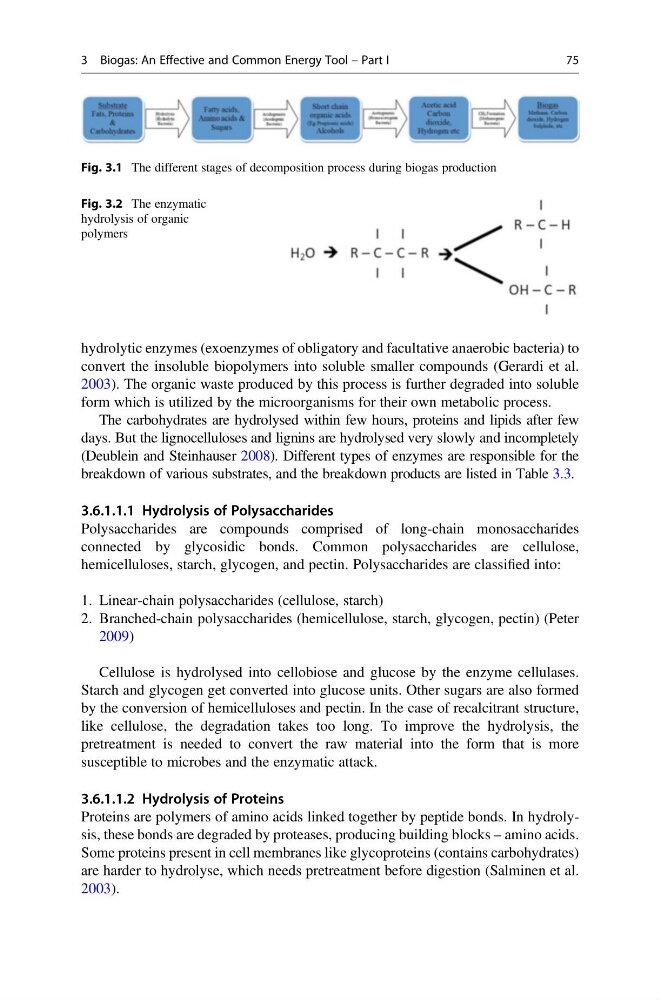
hydrolytic enzymes (exoenzymes of obligatory and facultative anaerobic bacteria) to
convert the insoluble biopolymers into soluble smaller compounds (Gerardi et al.
2003). The organic waste produced by this process is further degraded into soluble
form which is utilized by the microorganisms for their own metabolic process.
The carbohydrates are hydrolysed within few hours, proteins and lipids after few
days. But the lignocelluloses and lignins are hydrolysed very slowly and incompletely
(Deublein and Steinhauser 2008). Different types of enzymes are responsible for the
breakdown of various substrates, and the breakdown products are listed in Table 3.3.
3.6.1.1.1 Hydrolysis of Polysaccharides
Polysaccharides are compounds comprised of long-chain monosaccharides
connected by glycosidic bonds. Common polysaccharides are cellulose,
hemicelluloses, starch, glycogen, and pectin. Polysaccharides are classified into:
1. Linear-chain polysaccharides (cellulose, starch)
2. Branched-chain polysaccharides (hemicellulose, starch, glycogen, pectin) (Peter
2009)
Cellulose is hydrolysed into cellobiose and glucose by the enzyme cellulases.
Starch and glycogen get converted into glucose units. Other sugars are also formed
by the conversion of hemicelluloses and pectin. In the case of recalcitrant structure,
like cellulose, the degradation takes too long. To improve the hydrolysis, the
pretreatment is needed to convert the raw material into the form that is more
susceptible to microbes and the enzymatic attack.
3.6.1.1.2 Hydrolysis of Proteins
Proteins are polymers of amino acids linked together by peptide bonds. In hydrolysis, these bonds are degraded by proteases, producing building blocks – amino acids.
Some proteins present in cell membranes like glycoproteins (contains carbohydrates)
are harder to hydrolyse, which needs pretreatment before digestion (Salminen et al.
2003).
Fig. 3.1 The different stages of decomposition process during biogas production
Fig. 3.2 The enzymatic
hydrolysis of organic
polymers
3 Biogas: An Effective and Common Energy Tool – Part I
75
convert the insoluble biopolymers into soluble smaller compounds (Gerardi et al.
2003). The organic waste produced by this process is further degraded into soluble
form which is utilized by the microorganisms for their own metabolic process.
The carbohydrates are hydrolysed within few hours, proteins and lipids after few
days. But the lignocelluloses and lignins are hydrolysed very slowly and incompletely
(Deublein and Steinhauser 2008). Different types of enzymes are responsible for the
breakdown of various substrates, and the breakdown products are listed in Table 3.3.
3.6.1.1.1 Hydrolysis of Polysaccharides
Polysaccharides are compounds comprised of long-chain monosaccharides
connected by glycosidic bonds. Common polysaccharides are cellulose,
hemicelluloses, starch, glycogen, and pectin. Polysaccharides are classified into:
1. Linear-chain polysaccharides (cellulose, starch)
2. Branched-chain polysaccharides (hemicellulose, starch, glycogen, pectin) (Peter
2009)
Cellulose is hydrolysed into cellobiose and glucose by the enzyme cellulases.
Starch and glycogen get converted into glucose units. Other sugars are also formed
by the conversion of hemicelluloses and pectin. In the case of recalcitrant structure,
like cellulose, the degradation takes too long. To improve the hydrolysis, the
pretreatment is needed to convert the raw material into the form that is more
susceptible to microbes and the enzymatic attack.
3.6.1.1.2 Hydrolysis of Proteins
Proteins are polymers of amino acids linked together by peptide bonds. In hydrolysis, these bonds are degraded by proteases, producing building blocks – amino acids.
Some proteins present in cell membranes like glycoproteins (contains carbohydrates)
are harder to hydrolyse, which needs pretreatment before digestion (Salminen et al.
2003).
Fig. 3.1 The different stages of decomposition process during biogas production
Fig. 3.2 The enzymatic
hydrolysis of organic
polymers
3 Biogas: An Effective and Common Energy Tool – Part I
75