

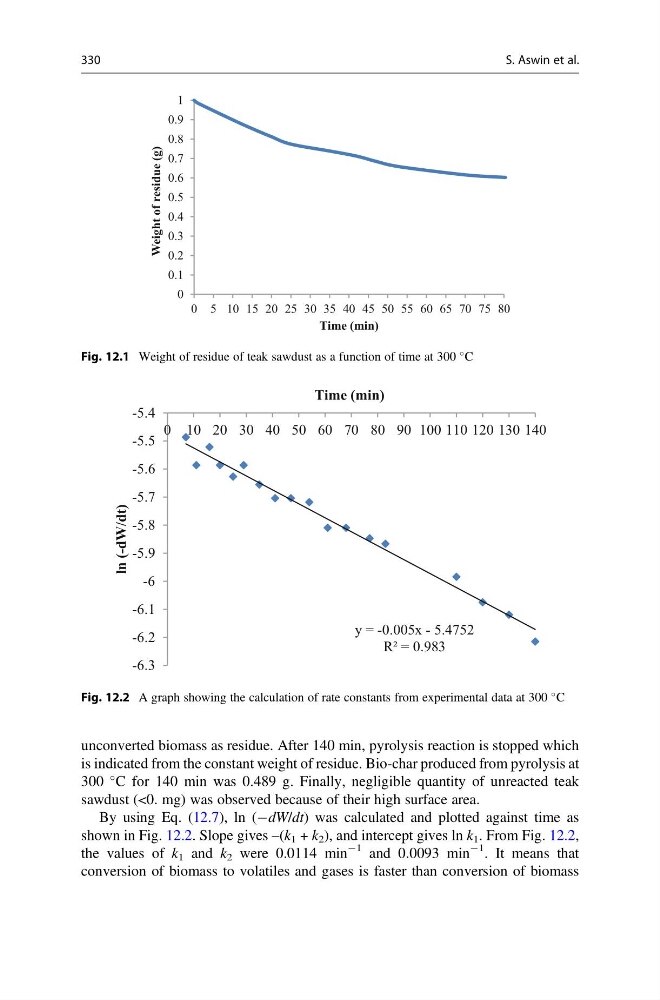
unconverted biomass as residue. After 140 min, pyrolysis reaction is stopped which
is indicated from the constant weight of residue. Bio-char produced from pyrolysis at
300
C for 140 min was 0.489 g. Finally, negligible quantity of unreacted teak
sawdust (<0. mg) was observed because of their high surface area.
By using Eq. (12.7), ln (ÀdW/dt) was calculated and plotted against time as
shown in Fig. 12.2. Slope gives –(k 1 + k 2 ), and intercept gives ln k 1 . From Fig. 12.2,
the values of k 1 and k 2 were 0.0114 min
À1 and 0.0093 min
À1 . It means that
conversion of biomass to volatiles and gases is faster than conversion of biomass
0
0.1
0.2
0.3
0.4
0.5
0.6
0.7
0.8
0.9
1
0 5 10 15 20 25 30 35 40 45 50 55 60 65 70 75 80
)
g
(
e
u
d
i
s
e
r
f
o
t
h
g
i
e
W
Time (min)
Fig. 12.1 Weight of residue of teak sawdust as a function of time at 300
C
y = -0.005x - 5.4752
R² = 0.983
-6.3
-6.2
-6.1
-6
-5.9
-5.8
-5.7
-5.6
-5.5
-5.4
0 10 20 30 40 50 60 70 80 90 100 110 120 130 140
ln (-dW/dt)
Time (min)
Fig. 12.2 A graph showing the calculation of rate constants from experimental data at 300
C
330
S. Aswin et al.
is indicated from the constant weight of residue. Bio-char produced from pyrolysis at
300
C for 140 min was 0.489 g. Finally, negligible quantity of unreacted teak
sawdust (<0. mg) was observed because of their high surface area.
By using Eq. (12.7), ln (ÀdW/dt) was calculated and plotted against time as
shown in Fig. 12.2. Slope gives –(k 1 + k 2 ), and intercept gives ln k 1 . From Fig. 12.2,
the values of k 1 and k 2 were 0.0114 min
À1 and 0.0093 min
À1 . It means that
conversion of biomass to volatiles and gases is faster than conversion of biomass
0
0.1
0.2
0.3
0.4
0.5
0.6
0.7
0.8
0.9
1
0 5 10 15 20 25 30 35 40 45 50 55 60 65 70 75 80
)
g
(
e
u
d
i
s
e
r
f
o
t
h
g
i
e
W
Time (min)
Fig. 12.1 Weight of residue of teak sawdust as a function of time at 300
C
y = -0.005x - 5.4752
R² = 0.983
-6.3
-6.2
-6.1
-6
-5.9
-5.8
-5.7
-5.6
-5.5
-5.4
0 10 20 30 40 50 60 70 80 90 100 110 120 130 140
ln (-dW/dt)
Time (min)
Fig. 12.2 A graph showing the calculation of rate constants from experimental data at 300
C
330
S. Aswin et al.