

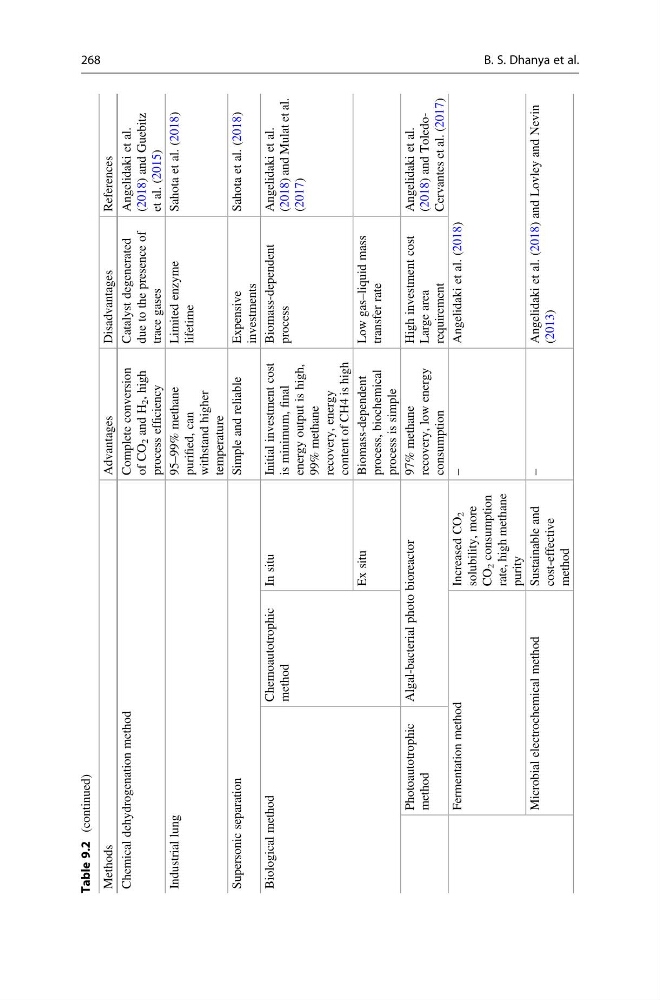
Table 9.2
(continued)
Methods
Advantages
Disadvantages
References
Chemical dehydrogenation method
Complete conversion
of CO
2 and H
2 , high
process efficiency
Catalyst degenerated
due to the presence of
trace gases
Angelidaki et al.
(2018) and Guebitz
et al. (2015)
Industrial lung
95–99% methane
purified, can
withstand higher
temperature
Limited enzyme
lifetime
Sahota et al. (2018)
Supersonic separation
Simple and reliable
Expensive
investments
Sahota et al. (2018)
Biological method
Chemoautotrophic
method
In situ
Initial investment cost
is minimum,
final
energy output is high,
99% methane
recovery, energy
content of CH4 is high
Biomass-dependent
process
Angelidaki et al.
(2018) and Mulat et al.
(2017)
Ex situ
Biomass-dependent
process, biochemical
process is simple
Low gas–liquid mass
transfer rate
Photoautotrophic
method
Algal-bacterial photo bioreactor
97% methane
recovery, low energy
consumption
High investment cost
Large area
requirement
Angelidaki et al.
(2018) and ToledoCervantes et al. (2017)
Fermentation method
Increased CO
2
solubility, more
CO
2 consumption
rate, high methane
purity
–
Angelidaki et al. (2018)
Microbial electrochemical method
Sustainable and
cost-effective
method
–
Angelidaki et al. (2018) and Lovley and Nevin
(2013)
268
B. S. Dhanya et al.
(continued)
Methods
Advantages
Disadvantages
References
Chemical dehydrogenation method
Complete conversion
of CO
2 and H
2 , high
process efficiency
Catalyst degenerated
due to the presence of
trace gases
Angelidaki et al.
(2018) and Guebitz
et al. (2015)
Industrial lung
95–99% methane
purified, can
withstand higher
temperature
Limited enzyme
lifetime
Sahota et al. (2018)
Supersonic separation
Simple and reliable
Expensive
investments
Sahota et al. (2018)
Biological method
Chemoautotrophic
method
In situ
Initial investment cost
is minimum,
final
energy output is high,
99% methane
recovery, energy
content of CH4 is high
Biomass-dependent
process
Angelidaki et al.
(2018) and Mulat et al.
(2017)
Ex situ
Biomass-dependent
process, biochemical
process is simple
Low gas–liquid mass
transfer rate
Photoautotrophic
method
Algal-bacterial photo bioreactor
97% methane
recovery, low energy
consumption
High investment cost
Large area
requirement
Angelidaki et al.
(2018) and ToledoCervantes et al. (2017)
Fermentation method
Increased CO
2
solubility, more
CO
2 consumption
rate, high methane
purity
–
Angelidaki et al. (2018)
Microbial electrochemical method
Sustainable and
cost-effective
method
–
Angelidaki et al. (2018) and Lovley and Nevin
(2013)
268
B. S. Dhanya et al.