

feasible. Also, the operation cost is seven times higher for the conventional type
(Toledo-Cervantes et al. 2017). Further, the investment cost is high for adsorption
method, membrane separation method and water scrubber and low for amine
scrubber method (Bauer et al. 2013a, b).
In addition, the supersonic method is simple and reliable, but the investment cost
is not adaptable (Sahota et al. 2018). The cryogenic method faces an issue of high
operation and maintenance cost. While comparing all the techniques, it can be
predicted that the conventional upgrading technologies are economically feasible.
The hybrid technologies cryogenic/membrane technology and membrane technology/pressurised water scrubbing method need reduced operating cost (Song et al.
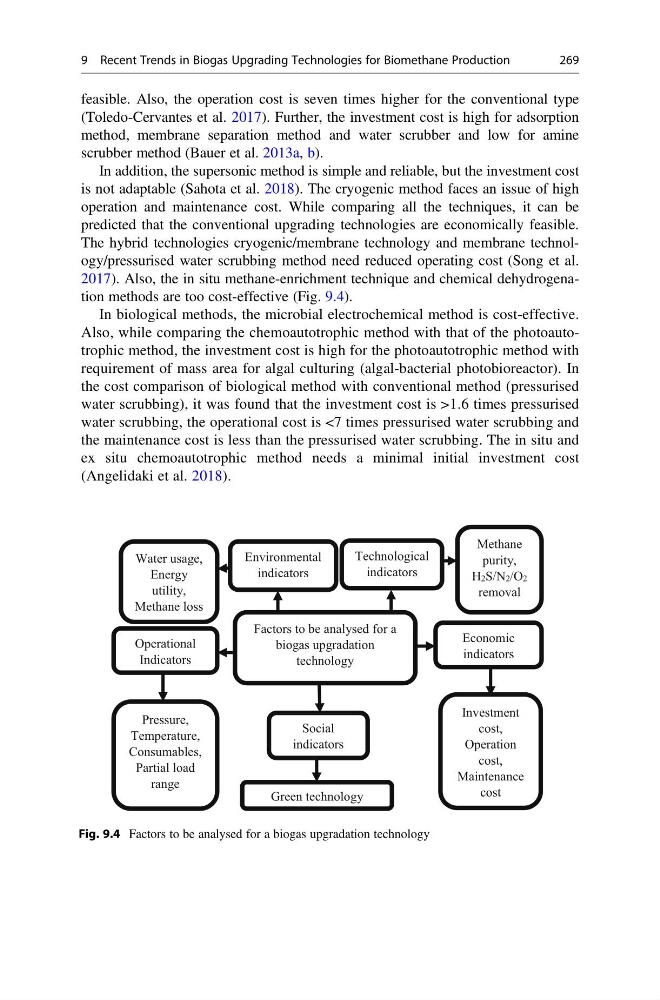
2017). Also, the in situ methane-enrichment technique and chemical dehydrogenation methods are too cost-effective (Fig. 9.4).
In biological methods, the microbial electrochemical method is cost-effective.
Also, while comparing the chemoautotrophic method with that of the photoautotrophic method, the investment cost is high for the photoautotrophic method with
requirement of mass area for algal culturing (algal-bacterial photobioreactor). In
the cost comparison of biological method with conventional method (pressurised
water scrubbing), it was found that the investment cost is >1.6 times pressurised
water scrubbing, the operational cost is <7 times pressurised water scrubbing and
the maintenance cost is less than the pressurised water scrubbing. The in situ and
ex situ chemoautotrophic method needs a minimal initial investment cost
(Angelidaki et al. 2018).
Factors to be analysed for a
biogas upgradation
technology
Technological
indicators
Environmental
indicators
Social
indicators
Economic
indicators
Operational
Indicators
Green technology
Water usage,
Energy
utility,
Methane loss
Investment
cost,
Operation
cost,
Maintenance
cost
Pressure,
Temperature,
Consumables,
Partial load
range
Methane
purity,
H2S/N2/O2
removal
Fig. 9.4 Factors to be analysed for a biogas upgradation technology
9 Recent Trends in Biogas Upgrading Technologies for Biomethane Production
269
(Toledo-Cervantes et al. 2017). Further, the investment cost is high for adsorption
method, membrane separation method and water scrubber and low for amine
scrubber method (Bauer et al. 2013a, b).
In addition, the supersonic method is simple and reliable, but the investment cost
is not adaptable (Sahota et al. 2018). The cryogenic method faces an issue of high
operation and maintenance cost. While comparing all the techniques, it can be
predicted that the conventional upgrading technologies are economically feasible.
The hybrid technologies cryogenic/membrane technology and membrane technology/pressurised water scrubbing method need reduced operating cost (Song et al.
2017). Also, the in situ methane-enrichment technique and chemical dehydrogenation methods are too cost-effective (Fig. 9.4).
In biological methods, the microbial electrochemical method is cost-effective.
Also, while comparing the chemoautotrophic method with that of the photoautotrophic method, the investment cost is high for the photoautotrophic method with
requirement of mass area for algal culturing (algal-bacterial photobioreactor). In
the cost comparison of biological method with conventional method (pressurised
water scrubbing), it was found that the investment cost is >1.6 times pressurised
water scrubbing, the operational cost is <7 times pressurised water scrubbing and
the maintenance cost is less than the pressurised water scrubbing. The in situ and
ex situ chemoautotrophic method needs a minimal initial investment cost
(Angelidaki et al. 2018).
Factors to be analysed for a
biogas upgradation
technology
Technological
indicators
Environmental
indicators
Social
indicators
Economic
indicators
Operational
Indicators
Green technology
Water usage,
Energy
utility,
Methane loss
Investment
cost,
Operation
cost,
Maintenance
cost
Pressure,
Temperature,
Consumables,
Partial load
range
Methane
purity,
H2S/N2/O2
removal
Fig. 9.4 Factors to be analysed for a biogas upgradation technology
9 Recent Trends in Biogas Upgrading Technologies for Biomethane Production
269