

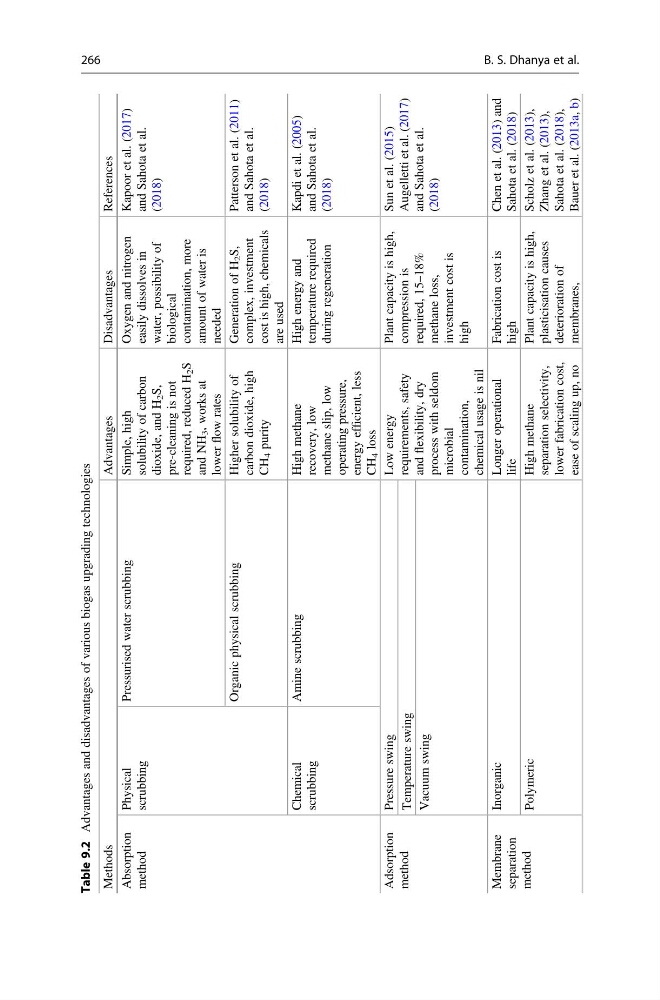
Table 9.2
Advantages and disadvantages of various biogas upgrading technologies
Methods
Advantages
Disadvantages
References
Absorption
method
Physical
scrubbing
Pressurised water scrubbing
Simple, high
solubility of carbon
dioxide, and H
2 S,
pre-cleaning is not
required, reduced H
2 S
and NH
3 , works at
lower
flow rates
Oxygen and nitrogen
easily dissolves in
water, possibility of
biological
contamination, more
amount of water is
needed
Kapoor et al. (2017)
and Sahota et al.
(2018)
Organic physical scrubbing
Higher solubility of
carbon dioxide, high
CH
4 purity
Generation of H
2 S,
complex, investment
cost is high, chemicals
are used
Patterson et al. (2011)
and Sahota et al.
(2018)
Chemical
scrubbing
Amine scrubbing
High methane
recovery, low
methane slip, low
operating pressure,
energy efficient, less
CH
4 loss
High energy and
temperature required
during regeneration
Kapdi et al. (2005)
and Sahota et al.
(2018)
Adsorption
method
Pressure swing
Low energy
requirements, safety
and
flexibility, dry
process with seldom
microbial
contamination,
chemical usage is nil
Plant capacity is high,
compression is
required, 15–18%
methane loss,
investment cost is
high
Sun et al. (2015)
Augelletti et al. (2017)
and Sahota et al.
(2018)
Temperature swing
Vacuum swing
Membrane
separation
method
Inorganic
Longer operational
life
Fabrication cost is
high
Chen et al. (2013) and
Sahota et al. (2018)
Polymeric
High methane
separation selectivity,
lower fabrication cost,
ease of scaling up, no
Plant capacity is high,
plasticisation causes
deterioration of
membranes,
Scholz et al. (2013),
Zhang et al. (2013),
Sahota et al. (2018),
Bauer et al. (2013a, b)
266
B. S. Dhanya et al.
Advantages and disadvantages of various biogas upgrading technologies
Methods
Advantages
Disadvantages
References
Absorption
method
Physical
scrubbing
Pressurised water scrubbing
Simple, high
solubility of carbon
dioxide, and H
2 S,
pre-cleaning is not
required, reduced H
2 S
and NH
3 , works at
lower
flow rates
Oxygen and nitrogen
easily dissolves in
water, possibility of
biological
contamination, more
amount of water is
needed
Kapoor et al. (2017)
and Sahota et al.
(2018)
Organic physical scrubbing
Higher solubility of
carbon dioxide, high
CH
4 purity
Generation of H
2 S,
complex, investment
cost is high, chemicals
are used
Patterson et al. (2011)
and Sahota et al.
(2018)
Chemical
scrubbing
Amine scrubbing
High methane
recovery, low
methane slip, low
operating pressure,
energy efficient, less
CH
4 loss
High energy and
temperature required
during regeneration
Kapdi et al. (2005)
and Sahota et al.
(2018)
Adsorption
method
Pressure swing
Low energy
requirements, safety
and
flexibility, dry
process with seldom
microbial
contamination,
chemical usage is nil
Plant capacity is high,
compression is
required, 15–18%
methane loss,
investment cost is
high
Sun et al. (2015)
Augelletti et al. (2017)
and Sahota et al.
(2018)
Temperature swing
Vacuum swing
Membrane
separation
method
Inorganic
Longer operational
life
Fabrication cost is
high
Chen et al. (2013) and
Sahota et al. (2018)
Polymeric
High methane
separation selectivity,
lower fabrication cost,
ease of scaling up, no
Plant capacity is high,
plasticisation causes
deterioration of
membranes,
Scholz et al. (2013),
Zhang et al. (2013),
Sahota et al. (2018),
Bauer et al. (2013a, b)
266
B. S. Dhanya et al.