

8.2.1 Photoautotrophic Cultivation System of Microalgae
The phototrophic cultures (PTC) store the energy obtained from light in the form of
ATP or NADPH, which further enter the Calvin cycle for glucose production.
However, this process is restricted by the amount of available light and the carbon
dioxide supply (Suali and Sarbatly 2012). The reliability of the phototrophic cultures
depends on light and results in less lipid production in comparison to the heterotrophic cultures (Brennan and Owende 2010). However, the PTC depending on the
algae strain, land and water cost, and climatic conditions can be cultivated by three
different methods (i.e., natural, artificial, and hybrid).
8.2.1.1 Natural System
Natural system is also called as the outdoor system (OS) or the open pond cultivation
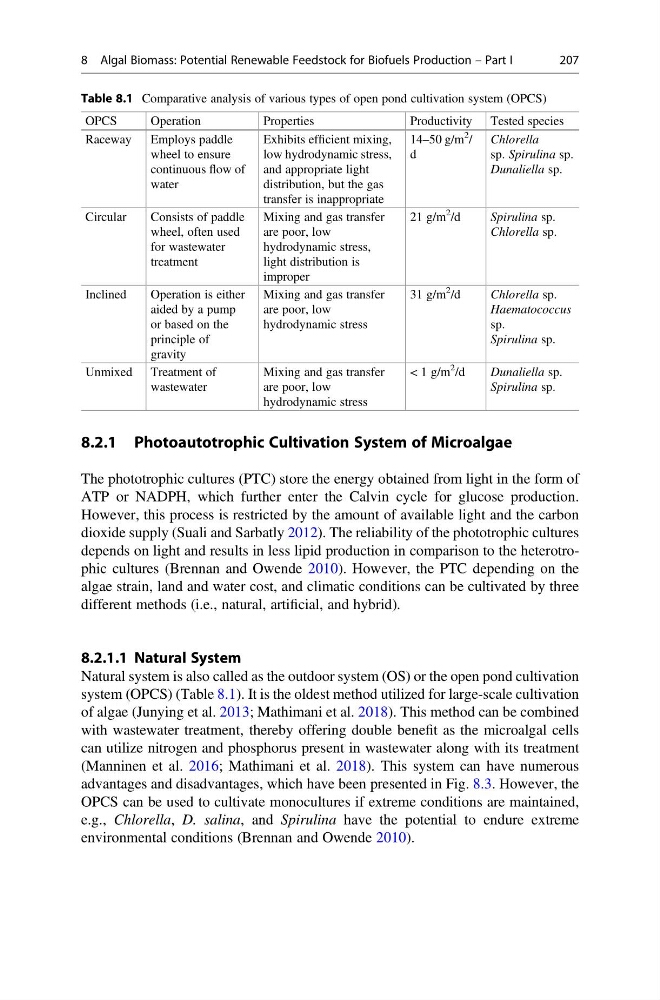
system (OPCS) (Table 8.1). It is the oldest method utilized for large-scale cultivation
of algae (Junying et al. 2013; Mathimani et al. 2018). This method can be combined
with wastewater treatment, thereby offering double benefit as the microalgal cells
can utilize nitrogen and phosphorus present in wastewater along with its treatment
(Manninen et al. 2016; Mathimani et al. 2018). This system can have numerous
advantages and disadvantages, which have been presented in Fig. 8.3. However, the
OPCS can be used to cultivate monocultures if extreme conditions are maintained,
e.g., Chlorella, D. salina, and Spirulina have the potential to endure extreme
environmental conditions (Brennan and Owende 2010).
Table 8.1 Comparative analysis of various types of open pond cultivation system (OPCS)
OPCS
Operation
Properties
Productivity Tested species
Raceway
Employs paddle
wheel to ensure
continuous flow of
water
Exhibits efficient mixing,
low hydrodynamic stress,
and appropriate light
distribution, but the gas
transfer is inappropriate
14–50 g/m
2
/
d
Chlorella
sp. Spirulina sp.
Dunaliella sp.
Circular
Consists of paddle
wheel, often used
for wastewater
treatment
Mixing and gas transfer
are poor, low
hydrodynamic stress,
light distribution is
improper
21 g/m
2
/d
Spirulina sp.
Chlorella sp.
Inclined
Operation is either
aided by a pump
or based on the
principle of
gravity
Mixing and gas transfer
are poor, low
hydrodynamic stress
31 g/m
2
/d
Chlorella sp.
Haematococcus
sp.
Spirulina sp.
Unmixed Treatment of
wastewater
Mixing and gas transfer
are poor, low
hydrodynamic stress
< 1 g/m
2 /d
Dunaliella sp.
Spirulina sp.
8 Algal Biomass: Potential Renewable Feedstock for Biofuels Production – Part I
207
The phototrophic cultures (PTC) store the energy obtained from light in the form of
ATP or NADPH, which further enter the Calvin cycle for glucose production.
However, this process is restricted by the amount of available light and the carbon
dioxide supply (Suali and Sarbatly 2012). The reliability of the phototrophic cultures
depends on light and results in less lipid production in comparison to the heterotrophic cultures (Brennan and Owende 2010). However, the PTC depending on the
algae strain, land and water cost, and climatic conditions can be cultivated by three
different methods (i.e., natural, artificial, and hybrid).
8.2.1.1 Natural System
Natural system is also called as the outdoor system (OS) or the open pond cultivation
system (OPCS) (Table 8.1). It is the oldest method utilized for large-scale cultivation
of algae (Junying et al. 2013; Mathimani et al. 2018). This method can be combined
with wastewater treatment, thereby offering double benefit as the microalgal cells
can utilize nitrogen and phosphorus present in wastewater along with its treatment
(Manninen et al. 2016; Mathimani et al. 2018). This system can have numerous
advantages and disadvantages, which have been presented in Fig. 8.3. However, the
OPCS can be used to cultivate monocultures if extreme conditions are maintained,
e.g., Chlorella, D. salina, and Spirulina have the potential to endure extreme
environmental conditions (Brennan and Owende 2010).
Table 8.1 Comparative analysis of various types of open pond cultivation system (OPCS)
OPCS
Operation
Properties
Productivity Tested species
Raceway
Employs paddle
wheel to ensure
continuous flow of
water
Exhibits efficient mixing,
low hydrodynamic stress,
and appropriate light
distribution, but the gas
transfer is inappropriate
14–50 g/m
2
/
d
Chlorella
sp. Spirulina sp.
Dunaliella sp.
Circular
Consists of paddle
wheel, often used
for wastewater
treatment
Mixing and gas transfer
are poor, low
hydrodynamic stress,
light distribution is
improper
21 g/m
2
/d
Spirulina sp.
Chlorella sp.
Inclined
Operation is either
aided by a pump
or based on the
principle of
gravity
Mixing and gas transfer
are poor, low
hydrodynamic stress
31 g/m
2
/d
Chlorella sp.
Haematococcus
sp.
Spirulina sp.
Unmixed Treatment of
wastewater
Mixing and gas transfer
are poor, low
hydrodynamic stress
< 1 g/m
2 /d
Dunaliella sp.
Spirulina sp.
8 Algal Biomass: Potential Renewable Feedstock for Biofuels Production – Part I
207