

directly generate 10–20 times more biofuel end products (Chisti 2007; Gouveia and
Oliveira 2009; Posten and Schaub 2009).
8.1.4 Fourth-Generation Biofuel (F
th GB) Photosynthetic Biofuel
(PCB)
The concept of F
th
GB is new and has been recently introduced; T
rd GB and F
th GB
have photosynthetic microorganisms in common, but the former uses algae biomass
for the production of biofuel, while the latter is dedicated to the metabolic engineering of algae in order to produce biofuels from oxygenic photosynthetic organisms
(Kagan 2010; Lu et al. 2011). It involves the use of recombinant DNA and bioengineering techniques to enhance biofuel production (Lu et al. 2011). The main
advantage associated with F
th
GB is that the product will be secreted out of the
cells and will thus completely reduce the cost of fermentation/processing steps
involved in biofuel production (Lu et al. 2011), and it also enhances biofuel
production from algal strains (Anandarajah et al. 2012; Daroch et al. 2013).
Therefore, the present chapter discusses various methods for the cultivation,
harvesting, and utilization of algal biosystem as an effective feedstock to produce
biofuel. Further, the application, limitations, and future prospect of the algal system
are discussed in detail in the chapter.
8.2
The Cultivation System of Microalgae
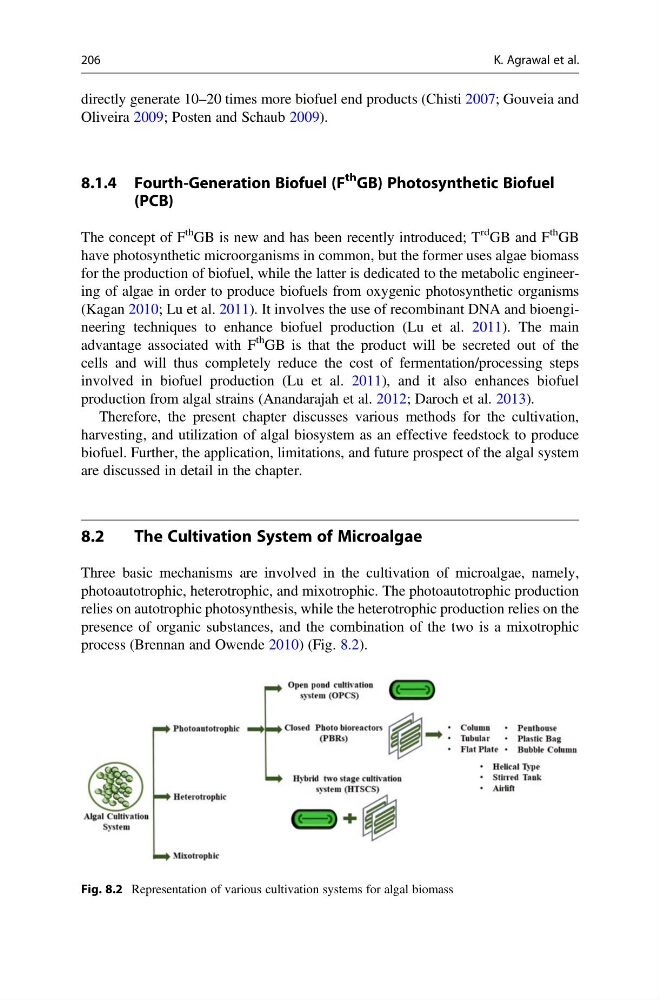
Three basic mechanisms are involved in the cultivation of microalgae, namely,
photoautotrophic, heterotrophic, and mixotrophic. The photoautotrophic production
relies on autotrophic photosynthesis, while the heterotrophic production relies on the
presence of organic substances, and the combination of the two is a mixotrophic
process (Brennan and Owende 2010) (Fig. 8.2).
Fig. 8.2 Representation of various cultivation systems for algal biomass
206
K. Agrawal et al.
Oliveira 2009; Posten and Schaub 2009).
8.1.4 Fourth-Generation Biofuel (F
th GB) Photosynthetic Biofuel
(PCB)
The concept of F
th
GB is new and has been recently introduced; T
rd GB and F
th GB
have photosynthetic microorganisms in common, but the former uses algae biomass
for the production of biofuel, while the latter is dedicated to the metabolic engineering of algae in order to produce biofuels from oxygenic photosynthetic organisms
(Kagan 2010; Lu et al. 2011). It involves the use of recombinant DNA and bioengineering techniques to enhance biofuel production (Lu et al. 2011). The main
advantage associated with F
th
GB is that the product will be secreted out of the
cells and will thus completely reduce the cost of fermentation/processing steps
involved in biofuel production (Lu et al. 2011), and it also enhances biofuel
production from algal strains (Anandarajah et al. 2012; Daroch et al. 2013).
Therefore, the present chapter discusses various methods for the cultivation,
harvesting, and utilization of algal biosystem as an effective feedstock to produce
biofuel. Further, the application, limitations, and future prospect of the algal system
are discussed in detail in the chapter.
8.2
The Cultivation System of Microalgae
Three basic mechanisms are involved in the cultivation of microalgae, namely,
photoautotrophic, heterotrophic, and mixotrophic. The photoautotrophic production
relies on autotrophic photosynthesis, while the heterotrophic production relies on the
presence of organic substances, and the combination of the two is a mixotrophic
process (Brennan and Owende 2010) (Fig. 8.2).
Fig. 8.2 Representation of various cultivation systems for algal biomass
206
K. Agrawal et al.