

production technology is already developed and been implemented at the commercial level. Then also with the growing population, the food vs feed conflict is very
serious, and therefore the shift to lignocellulosic biomass as feedstock is much
needed. The lignocellulosic bioethanol is the most promising technology available
at the current time but is limited to the recalcitrance nature of the biomass. Therefore,
there is an urgent need to develop a universal pretreatment technology for biochemically and morphologically different wide range of potential 2G feedstock. Algal
biomass has also grabbed the attention of the scientific community due to its
potential to store lipids along with carbohydrate as building block of the algal
biomass. The carbohydrate part can be used for bioethanol production, and lipid
can be transesterified to biodiesel. The major limitations associated with this technique are the cost involved with the algal biomass production. The 3G approaches
uses wastewater as substrate and value-added products are generated, thus compensating the cost associated with pretreatment and production of algal biomass. The
biotechnological advances have led to the development of modified organism
utilizing recombinant technology or developing an entirely new organism, and
also the development of photovoltaic cells for generation of electricity has given
rise to another approach called fourth-generation feedstock-based biofuel
production.
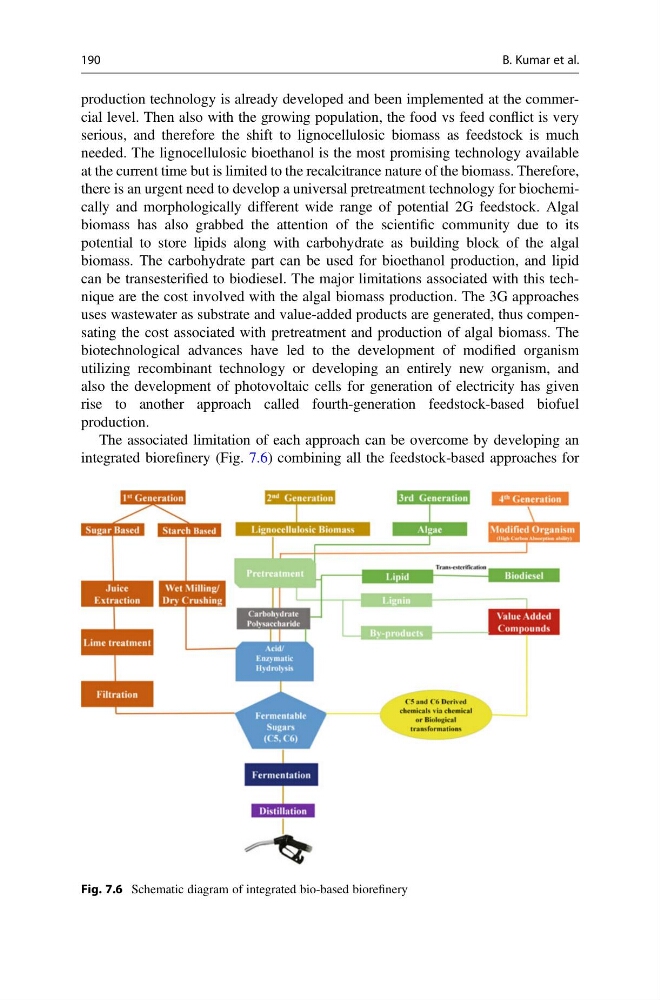
The associated limitation of each approach can be overcome by developing an
integrated biorefinery (Fig. 7.6) combining all the feedstock-based approaches for
Fig. 7.6 Schematic diagram of integrated bio-based biorefinery
190
B. Kumar et al.
serious, and therefore the shift to lignocellulosic biomass as feedstock is much
needed. The lignocellulosic bioethanol is the most promising technology available
at the current time but is limited to the recalcitrance nature of the biomass. Therefore,
there is an urgent need to develop a universal pretreatment technology for biochemically and morphologically different wide range of potential 2G feedstock. Algal
biomass has also grabbed the attention of the scientific community due to its
potential to store lipids along with carbohydrate as building block of the algal
biomass. The carbohydrate part can be used for bioethanol production, and lipid
can be transesterified to biodiesel. The major limitations associated with this technique are the cost involved with the algal biomass production. The 3G approaches
uses wastewater as substrate and value-added products are generated, thus compensating the cost associated with pretreatment and production of algal biomass. The
biotechnological advances have led to the development of modified organism
utilizing recombinant technology or developing an entirely new organism, and
also the development of photovoltaic cells for generation of electricity has given
rise to another approach called fourth-generation feedstock-based biofuel
production.
The associated limitation of each approach can be overcome by developing an
integrated biorefinery (Fig. 7.6) combining all the feedstock-based approaches for
Fig. 7.6 Schematic diagram of integrated bio-based biorefinery
190
B. Kumar et al.