

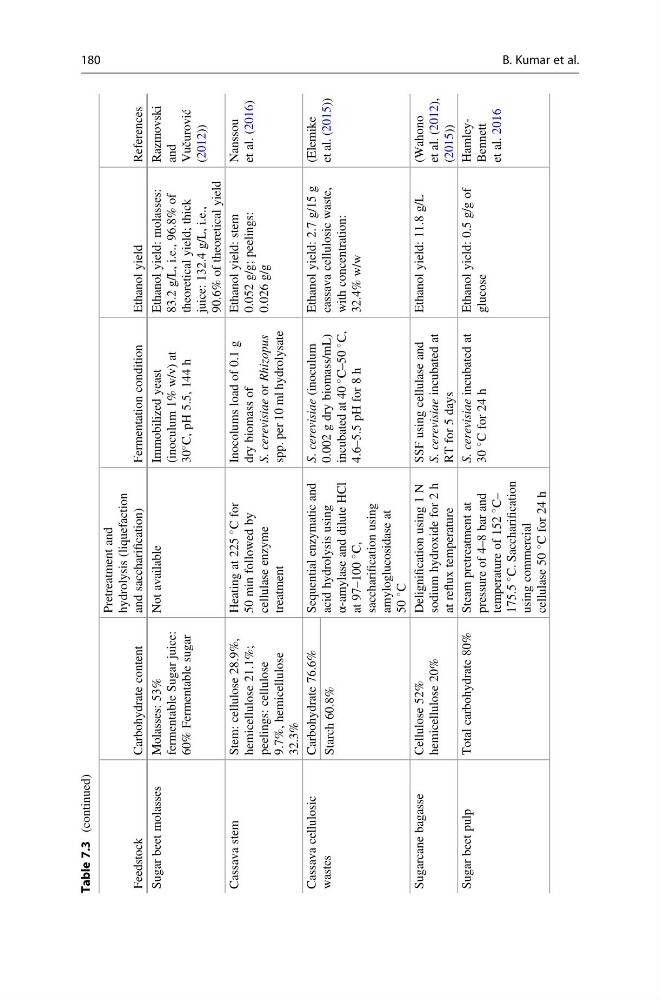
Table 7.3
(continued)
Feedstock
Carbohydrate content
Pretreatment and
hydrolysis (liquefaction
and saccharification)
Fermentation condition
Ethanol yield
References
Sugar beet molasses
Molasses: 53%
fermentable Sugar juice:
60% Fermentable sugar
Not available
Immobilized yeast
(inoculum 1% w/v) at
30
C, pH 5.5, 144 h
Ethanol yield: molasses:
83.2 g/L, i.e., 96.8% of
theoretical yield; thick
juice: 132.4 g/L, i.e.,
90.6% of theoretical yield
Razmovski
and
Vučurović
(2012))
Cassava stem
Stem: cellulose 28.9%,
hemicellulose 21.1%;
peelings: cellulose
9.7%, hemicellulose
32.3%
Heating at 225
C for
50 min followed by
cellulase enzyme
treatment
Inocolums load of 0.1 g
dry biomass of
S. cerevisiae
or Rhizopus
spp. per 10 ml hydrolysate
Ethanol yield: stem
0.052 g/g; peelings:
0.026 g/g
Nanssou
et al. (2016)
Cassava cellulosic
wastes
Carbohydrate 76.6%
Sequential enzymatic and
acid hydrolysis using
α-amylase and dilute HCl
at 97–100
C,
saccharification using
amyloglucosidase at
50
C
S. cerevisiae
(inoculum
0.002 g dry biomass/mL)
incubated at 40
C–50
C,
4.6–5.5 pH for 8 h
Ethanol yield: 2.7 g/15 g
cassava cellulosic waste,
with concentration:
32.4% w/w
(Elemike
et al. (2015))
Starch 60.8%
Sugarcane bagasse
Cellulose 52%
hemicellulose 20%
Delignification using 1 N
sodium hydroxide for 2 h
at reflux temperature
SSF using cellulase and
S. cerevisiae
incubated at
RT for 5 days
Ethanol yield: 11.8 g/L
(Wahono
et al. (2012),
(2015))
Sugar beet pulp
Total carbohydrate 80%
Steam pretreatment at
pressure of 4–8 bar and
temperature of 152
C–
175.5
C. Saccharification
using commercial
cellulase 50
C for 24 h
S. cerevisiae
incubated at
30
C for 24 h
Ethanol yield: 0.5 g/g of
glucose
HamleyBennett
et al. 2016
180
B. Kumar et al.
(continued)
Feedstock
Carbohydrate content
Pretreatment and
hydrolysis (liquefaction
and saccharification)
Fermentation condition
Ethanol yield
References
Sugar beet molasses
Molasses: 53%
fermentable Sugar juice:
60% Fermentable sugar
Not available
Immobilized yeast
(inoculum 1% w/v) at
30
C, pH 5.5, 144 h
Ethanol yield: molasses:
83.2 g/L, i.e., 96.8% of
theoretical yield; thick
juice: 132.4 g/L, i.e.,
90.6% of theoretical yield
Razmovski
and
Vučurović
(2012))
Cassava stem
Stem: cellulose 28.9%,
hemicellulose 21.1%;
peelings: cellulose
9.7%, hemicellulose
32.3%
Heating at 225
C for
50 min followed by
cellulase enzyme
treatment
Inocolums load of 0.1 g
dry biomass of
S. cerevisiae
or Rhizopus
spp. per 10 ml hydrolysate
Ethanol yield: stem
0.052 g/g; peelings:
0.026 g/g
Nanssou
et al. (2016)
Cassava cellulosic
wastes
Carbohydrate 76.6%
Sequential enzymatic and
acid hydrolysis using
α-amylase and dilute HCl
at 97–100
C,
saccharification using
amyloglucosidase at
50
C
S. cerevisiae
(inoculum
0.002 g dry biomass/mL)
incubated at 40
C–50
C,
4.6–5.5 pH for 8 h
Ethanol yield: 2.7 g/15 g
cassava cellulosic waste,
with concentration:
32.4% w/w
(Elemike
et al. (2015))
Starch 60.8%
Sugarcane bagasse
Cellulose 52%
hemicellulose 20%
Delignification using 1 N
sodium hydroxide for 2 h
at reflux temperature
SSF using cellulase and
S. cerevisiae
incubated at
RT for 5 days
Ethanol yield: 11.8 g/L
(Wahono
et al. (2012),
(2015))
Sugar beet pulp
Total carbohydrate 80%
Steam pretreatment at
pressure of 4–8 bar and
temperature of 152
C–
175.5
C. Saccharification
using commercial
cellulase 50
C for 24 h
S. cerevisiae
incubated at
30
C for 24 h
Ethanol yield: 0.5 g/g of
glucose
HamleyBennett
et al. 2016
180
B. Kumar et al.