

The level of biogas dissemination in urban regions is small, and the proportion of
biogas in private homes in the petrol blend is small. Around five million household
biogas plants (40%) were built under the biogas development program against the
complete capacity of 12 million national biogas plants assessed by the MNRE (CSO
2014). Besides, biogas plants for family, four hundred biogas off-grid authority
plants have been set up with about 5.5 MW power generation capacities (MNRE
2015). In urban areas, the part of anaerobic digestion in organic wastewater treatment is currently very low compared to other competitive waste treatment
techniques due to low revenue growth and capital cost prospects. At present in
India, there are only 56 equipped biogas-based power plants; most of them are
situated in three states, i.e., Maharashtra, Karnataka, and Kerala (CPCB 2013).
4.3
Overview of Successful Commercial Biogas Tool
4.3.1 India
It is said that the first anaerobic digestion (AD) plant in Bombay, India, in 1859
produced biogas from a therapy facility and was used for street lighting. India began
programs to encourage biogas in the nation in the 1970s (Ahammad and
Sreekrishnan 2016). Sensing the need to value agricultural disposal, animal manure,
and other forms of biomass, India has launched programs such as the National
Biogas and Manure Management Program and the Off-Grid Biogas Power
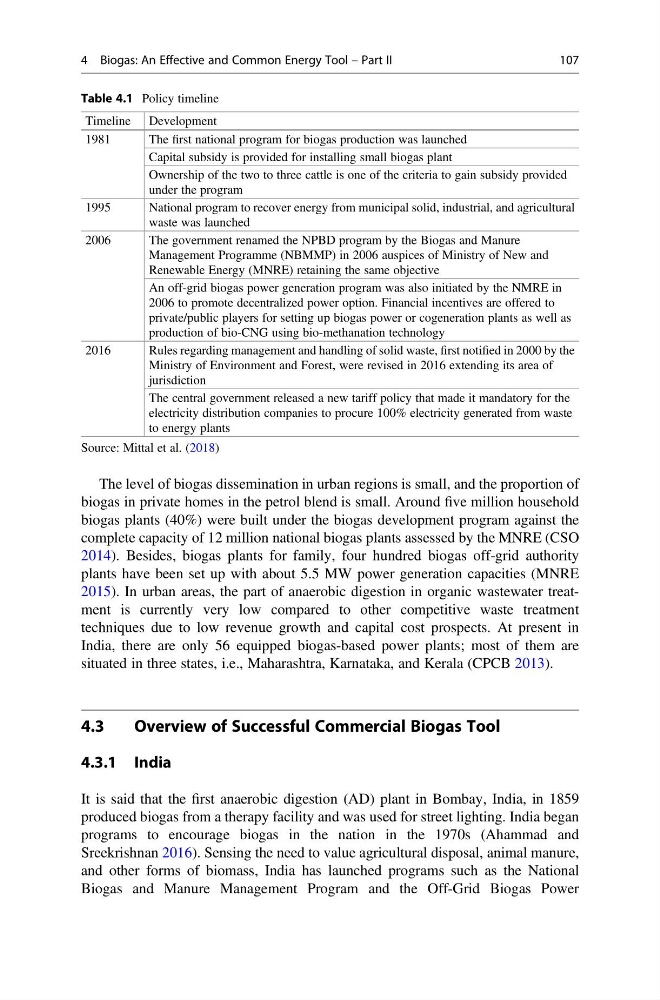
Table 4.1 Policy timeline
Timeline Development
1981
The first national program for biogas production was launched
Capital subsidy is provided for installing small biogas plant
Ownership of the two to three cattle is one of the criteria to gain subsidy provided
under the program
1995
National program to recover energy from municipal solid, industrial, and agricultural
waste was launched
2006
The government renamed the NPBD program by the Biogas and Manure
Management Programme (NBMMP) in 2006 auspices of Ministry of New and
Renewable Energy (MNRE) retaining the same objective
An off-grid biogas power generation program was also initiated by the NMRE in
2006 to promote decentralized power option. Financial incentives are offered to
private/public players for setting up biogas power or cogeneration plants as well as
production of bio-CNG using bio-methanation technology
2016
Rules regarding management and handling of solid waste, first notified in 2000 by the
Ministry of Environment and Forest, were revised in 2016 extending its area of
jurisdiction
The central government released a new tariff policy that made it mandatory for the
electricity distribution companies to procure 100% electricity generated from waste
to energy plants
Source: Mittal et al. (2018)
4 Biogas: An Effective and Common Energy Tool – Part II
107
biogas in private homes in the petrol blend is small. Around five million household
biogas plants (40%) were built under the biogas development program against the
complete capacity of 12 million national biogas plants assessed by the MNRE (CSO
2014). Besides, biogas plants for family, four hundred biogas off-grid authority
plants have been set up with about 5.5 MW power generation capacities (MNRE
2015). In urban areas, the part of anaerobic digestion in organic wastewater treatment is currently very low compared to other competitive waste treatment
techniques due to low revenue growth and capital cost prospects. At present in
India, there are only 56 equipped biogas-based power plants; most of them are
situated in three states, i.e., Maharashtra, Karnataka, and Kerala (CPCB 2013).
4.3
Overview of Successful Commercial Biogas Tool
4.3.1 India
It is said that the first anaerobic digestion (AD) plant in Bombay, India, in 1859
produced biogas from a therapy facility and was used for street lighting. India began
programs to encourage biogas in the nation in the 1970s (Ahammad and
Sreekrishnan 2016). Sensing the need to value agricultural disposal, animal manure,
and other forms of biomass, India has launched programs such as the National
Biogas and Manure Management Program and the Off-Grid Biogas Power
Table 4.1 Policy timeline
Timeline Development
1981
The first national program for biogas production was launched
Capital subsidy is provided for installing small biogas plant
Ownership of the two to three cattle is one of the criteria to gain subsidy provided
under the program
1995
National program to recover energy from municipal solid, industrial, and agricultural
waste was launched
2006
The government renamed the NPBD program by the Biogas and Manure
Management Programme (NBMMP) in 2006 auspices of Ministry of New and
Renewable Energy (MNRE) retaining the same objective
An off-grid biogas power generation program was also initiated by the NMRE in
2006 to promote decentralized power option. Financial incentives are offered to
private/public players for setting up biogas power or cogeneration plants as well as
production of bio-CNG using bio-methanation technology
2016
Rules regarding management and handling of solid waste, first notified in 2000 by the
Ministry of Environment and Forest, were revised in 2016 extending its area of
jurisdiction
The central government released a new tariff policy that made it mandatory for the
electricity distribution companies to procure 100% electricity generated from waste
to energy plants
Source: Mittal et al. (2018)
4 Biogas: An Effective and Common Energy Tool – Part II
107