

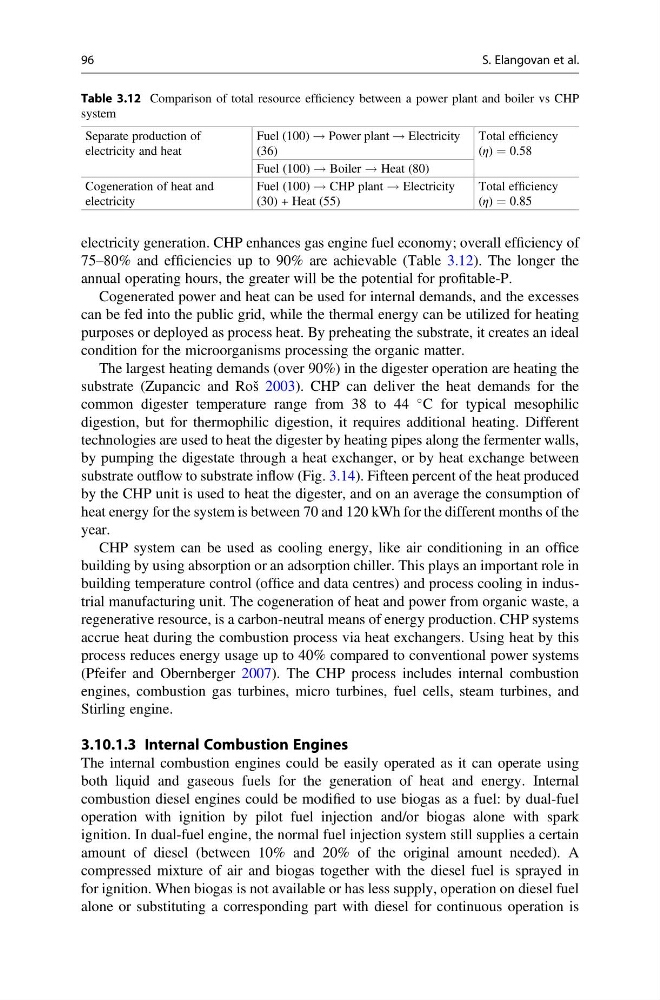
electricity generation. CHP enhances gas engine fuel economy; overall efficiency of
75–80% and efficiencies up to 90% are achievable (Table 3.12). The longer the
annual operating hours, the greater will be the potential for profitable-P.
Cogenerated power and heat can be used for internal demands, and the excesses
can be fed into the public grid, while the thermal energy can be utilized for heating
purposes or deployed as process heat. By preheating the substrate, it creates an ideal
condition for the microorganisms processing the organic matter.
The largest heating demands (over 90%) in the digester operation are heating the
substrate (Zupancic and Roš 2003). CHP can deliver the heat demands for the
common digester temperature range from 38 to 44
C for typical mesophilic
digestion, but for thermophilic digestion, it requires additional heating. Different
technologies are used to heat the digester by heating pipes along the fermenter walls,
by pumping the digestate through a heat exchanger, or by heat exchange between
substrate outflow to substrate inflow (Fig. 3.14). Fifteen percent of the heat produced
by the CHP unit is used to heat the digester, and on an average the consumption of
heat energy for the system is between 70 and 120 kWh for the different months of the
year.
CHP system can be used as cooling energy, like air conditioning in an office
building by using absorption or an adsorption chiller. This plays an important role in
building temperature control (office and data centres) and process cooling in industrial manufacturing unit. The cogeneration of heat and power from organic waste, a
regenerative resource, is a carbon-neutral means of energy production. CHP systems
accrue heat during the combustion process via heat exchangers. Using heat by this
process reduces energy usage up to 40% compared to conventional power systems
(Pfeifer and Obernberger 2007). The CHP process includes internal combustion
engines, combustion gas turbines, micro turbines, fuel cells, steam turbines, and
Stirling engine.
3.10.1.3 Internal Combustion Engines
The internal combustion engines could be easily operated as it can operate using
both liquid and gaseous fuels for the generation of heat and energy. Internal
combustion diesel engines could be modified to use biogas as a fuel: by dual-fuel
operation with ignition by pilot fuel injection and/or biogas alone with spark
ignition. In dual-fuel engine, the normal fuel injection system still supplies a certain
amount of diesel (between 10% and 20% of the original amount needed). A
compressed mixture of air and biogas together with the diesel fuel is sprayed in
for ignition. When biogas is not available or has less supply, operation on diesel fuel
alone or substituting a corresponding part with diesel for continuous operation is
Table 3.12 Comparison of total resource efficiency between a power plant and boiler vs CHP
system
Separate production of
electricity and heat
Fuel (100) ! Power plant ! Electricity
(36)
Total efficiency
(η) ¼ 0.58
Fuel (100) ! Boiler ! Heat (80)
Cogeneration of heat and
electricity
Fuel (100) ! CHP plant ! Electricity
(30) + Heat (55)
Total efficiency
(η) ¼ 0.85
96
S. Elangovan et al.
75–80% and efficiencies up to 90% are achievable (Table 3.12). The longer the
annual operating hours, the greater will be the potential for profitable-P.
Cogenerated power and heat can be used for internal demands, and the excesses
can be fed into the public grid, while the thermal energy can be utilized for heating
purposes or deployed as process heat. By preheating the substrate, it creates an ideal
condition for the microorganisms processing the organic matter.
The largest heating demands (over 90%) in the digester operation are heating the
substrate (Zupancic and Roš 2003). CHP can deliver the heat demands for the
common digester temperature range from 38 to 44
C for typical mesophilic
digestion, but for thermophilic digestion, it requires additional heating. Different
technologies are used to heat the digester by heating pipes along the fermenter walls,
by pumping the digestate through a heat exchanger, or by heat exchange between
substrate outflow to substrate inflow (Fig. 3.14). Fifteen percent of the heat produced
by the CHP unit is used to heat the digester, and on an average the consumption of
heat energy for the system is between 70 and 120 kWh for the different months of the
year.
CHP system can be used as cooling energy, like air conditioning in an office
building by using absorption or an adsorption chiller. This plays an important role in
building temperature control (office and data centres) and process cooling in industrial manufacturing unit. The cogeneration of heat and power from organic waste, a
regenerative resource, is a carbon-neutral means of energy production. CHP systems
accrue heat during the combustion process via heat exchangers. Using heat by this
process reduces energy usage up to 40% compared to conventional power systems
(Pfeifer and Obernberger 2007). The CHP process includes internal combustion
engines, combustion gas turbines, micro turbines, fuel cells, steam turbines, and
Stirling engine.
3.10.1.3 Internal Combustion Engines
The internal combustion engines could be easily operated as it can operate using
both liquid and gaseous fuels for the generation of heat and energy. Internal
combustion diesel engines could be modified to use biogas as a fuel: by dual-fuel
operation with ignition by pilot fuel injection and/or biogas alone with spark
ignition. In dual-fuel engine, the normal fuel injection system still supplies a certain
amount of diesel (between 10% and 20% of the original amount needed). A
compressed mixture of air and biogas together with the diesel fuel is sprayed in
for ignition. When biogas is not available or has less supply, operation on diesel fuel
alone or substituting a corresponding part with diesel for continuous operation is
Table 3.12 Comparison of total resource efficiency between a power plant and boiler vs CHP
system
Separate production of
electricity and heat
Fuel (100) ! Power plant ! Electricity
(36)
Total efficiency
(η) ¼ 0.58
Fuel (100) ! Boiler ! Heat (80)
Cogeneration of heat and
electricity
Fuel (100) ! CHP plant ! Electricity
(30) + Heat (55)
Total efficiency
(η) ¼ 0.85
96
S. Elangovan et al.