

available, the burning efficiency will be drastically reduced and considerable amount
of the unused gas will be wasted. Biogas stoves with cyclone burner are more
efficient than the usual burner of biogas stove. The biggest power generated is
equal to 1.52488 kW for cyclone burner. The highest efficiency is equal to
58.42% for cyclone-shaped burner (Syamsuri and Yustia 2015). Thermal proficiency
for the biogas stoves ranges between 50% and 60% (Clean Energy Solutions
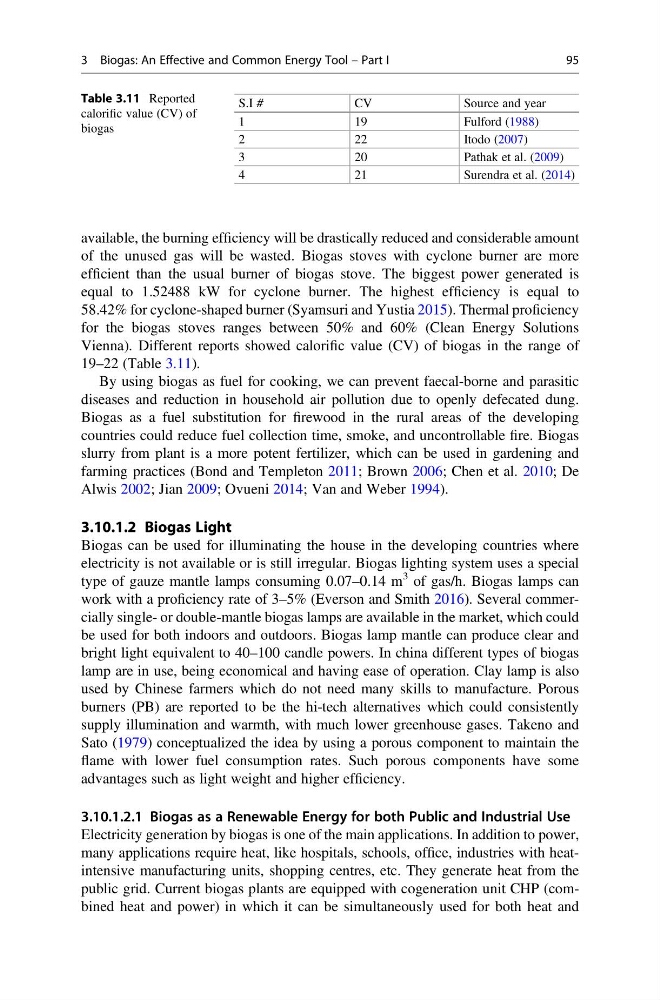
Vienna). Different reports showed calorific value (CV) of biogas in the range of
19–22 (Table 3.11).
By using biogas as fuel for cooking, we can prevent faecal-borne and parasitic
diseases and reduction in household air pollution due to openly defecated dung.
Biogas as a fuel substitution for firewood in the rural areas of the developing
countries could reduce fuel collection time, smoke, and uncontrollable fire. Biogas
slurry from plant is a more potent fertilizer, which can be used in gardening and
farming practices (Bond and Templeton 2011; Brown 2006; Chen et al. 2010; De
Alwis 2002; Jian 2009; Ovueni 2014; Van and Weber 1994).
3.10.1.2 Biogas Light
Biogas can be used for illuminating the house in the developing countries where
electricity is not available or is still irregular. Biogas lighting system uses a special
type of gauze mantle lamps consuming 0.07–0.14 m
3 of gas/h. Biogas lamps can
work with a proficiency rate of 3–5% (Everson and Smith 2016). Several commercially single- or double-mantle biogas lamps are available in the market, which could
be used for both indoors and outdoors. Biogas lamp mantle can produce clear and
bright light equivalent to 40–100 candle powers. In china different types of biogas
lamp are in use, being economical and having ease of operation. Clay lamp is also
used by Chinese farmers which do not need many skills to manufacture. Porous
burners (PB) are reported to be the hi-tech alternatives which could consistently
supply illumination and warmth, with much lower greenhouse gases. Takeno and
Sato (1979) conceptualized the idea by using a porous component to maintain the
flame with lower fuel consumption rates. Such porous components have some
advantages such as light weight and higher efficiency.
3.10.1.2.1 Biogas as a Renewable Energy for both Public and Industrial Use
Electricity generation by biogas is one of the main applications. In addition to power,
many applications require heat, like hospitals, schools, office, industries with heatintensive manufacturing units, shopping centres, etc. They generate heat from the
public grid. Current biogas plants are equipped with cogeneration unit CHP (combined heat and power) in which it can be simultaneously used for both heat and
Table 3.11 Reported
calorific value (CV) of
biogas
S.I #
CV
Source and year
1
19
Fulford (1988)
2
22
Itodo (2007)
3
20
Pathak et al. (2009)
4
21
Surendra et al. (2014)
3 Biogas: An Effective and Common Energy Tool – Part I
95
of the unused gas will be wasted. Biogas stoves with cyclone burner are more
efficient than the usual burner of biogas stove. The biggest power generated is
equal to 1.52488 kW for cyclone burner. The highest efficiency is equal to
58.42% for cyclone-shaped burner (Syamsuri and Yustia 2015). Thermal proficiency
for the biogas stoves ranges between 50% and 60% (Clean Energy Solutions
Vienna). Different reports showed calorific value (CV) of biogas in the range of
19–22 (Table 3.11).
By using biogas as fuel for cooking, we can prevent faecal-borne and parasitic
diseases and reduction in household air pollution due to openly defecated dung.
Biogas as a fuel substitution for firewood in the rural areas of the developing
countries could reduce fuel collection time, smoke, and uncontrollable fire. Biogas
slurry from plant is a more potent fertilizer, which can be used in gardening and
farming practices (Bond and Templeton 2011; Brown 2006; Chen et al. 2010; De
Alwis 2002; Jian 2009; Ovueni 2014; Van and Weber 1994).
3.10.1.2 Biogas Light
Biogas can be used for illuminating the house in the developing countries where
electricity is not available or is still irregular. Biogas lighting system uses a special
type of gauze mantle lamps consuming 0.07–0.14 m
3 of gas/h. Biogas lamps can
work with a proficiency rate of 3–5% (Everson and Smith 2016). Several commercially single- or double-mantle biogas lamps are available in the market, which could
be used for both indoors and outdoors. Biogas lamp mantle can produce clear and
bright light equivalent to 40–100 candle powers. In china different types of biogas
lamp are in use, being economical and having ease of operation. Clay lamp is also
used by Chinese farmers which do not need many skills to manufacture. Porous
burners (PB) are reported to be the hi-tech alternatives which could consistently
supply illumination and warmth, with much lower greenhouse gases. Takeno and
Sato (1979) conceptualized the idea by using a porous component to maintain the
flame with lower fuel consumption rates. Such porous components have some
advantages such as light weight and higher efficiency.
3.10.1.2.1 Biogas as a Renewable Energy for both Public and Industrial Use
Electricity generation by biogas is one of the main applications. In addition to power,
many applications require heat, like hospitals, schools, office, industries with heatintensive manufacturing units, shopping centres, etc. They generate heat from the
public grid. Current biogas plants are equipped with cogeneration unit CHP (combined heat and power) in which it can be simultaneously used for both heat and
Table 3.11 Reported
calorific value (CV) of
biogas
S.I #
CV
Source and year
1
19
Fulford (1988)
2
22
Itodo (2007)
3
20
Pathak et al. (2009)
4
21
Surendra et al. (2014)
3 Biogas: An Effective and Common Energy Tool – Part I
95