

3.10 Biogas Applications in Day-to-Day Life and Industries
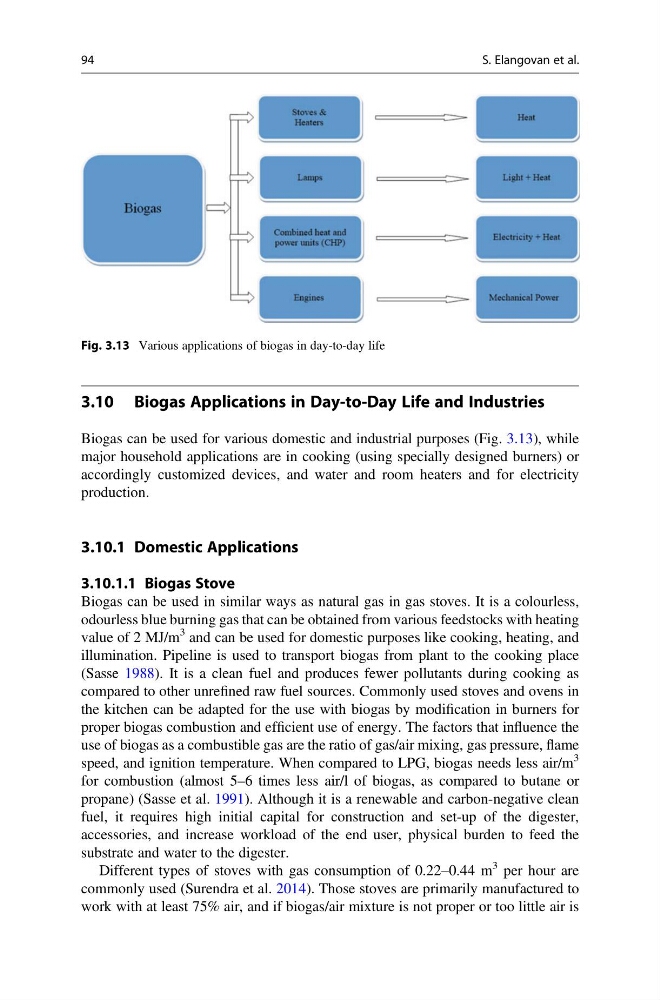
Biogas can be used for various domestic and industrial purposes (Fig. 3.13), while
major household applications are in cooking (using specially designed burners) or
accordingly customized devices, and water and room heaters and for electricity
production.
3.10.1 Domestic Applications
3.10.1.1 Biogas Stove
Biogas can be used in similar ways as natural gas in gas stoves. It is a colourless,
odourless blue burning gas that can be obtained from various feedstocks with heating
value of 2 MJ/m
3 and can be used for domestic purposes like cooking, heating, and
illumination. Pipeline is used to transport biogas from plant to the cooking place
(Sasse 1988). It is a clean fuel and produces fewer pollutants during cooking as
compared to other unrefined raw fuel sources. Commonly used stoves and ovens in
the kitchen can be adapted for the use with biogas by modification in burners for
proper biogas combustion and efficient use of energy. The factors that influence the
use of biogas as a combustible gas are the ratio of gas/air mixing, gas pressure, flame
speed, and ignition temperature. When compared to LPG, biogas needs less air/m
3
for combustion (almost 5–6 times less air/l of biogas, as compared to butane or
propane) (Sasse et al. 1991). Although it is a renewable and carbon-negative clean
fuel, it requires high initial capital for construction and set-up of the digester,
accessories, and increase workload of the end user, physical burden to feed the
substrate and water to the digester.
Different types of stoves with gas consumption of 0.22–0.44 m
3 per hour are
commonly used (Surendra et al. 2014). Those stoves are primarily manufactured to
work with at least 75% air, and if biogas/air mixture is not proper or too little air is
Fig. 3.13 Various applications of biogas in day-to-day life
94
S. Elangovan et al.
Biogas can be used for various domestic and industrial purposes (Fig. 3.13), while
major household applications are in cooking (using specially designed burners) or
accordingly customized devices, and water and room heaters and for electricity
production.
3.10.1 Domestic Applications
3.10.1.1 Biogas Stove
Biogas can be used in similar ways as natural gas in gas stoves. It is a colourless,
odourless blue burning gas that can be obtained from various feedstocks with heating
value of 2 MJ/m
3 and can be used for domestic purposes like cooking, heating, and
illumination. Pipeline is used to transport biogas from plant to the cooking place
(Sasse 1988). It is a clean fuel and produces fewer pollutants during cooking as
compared to other unrefined raw fuel sources. Commonly used stoves and ovens in
the kitchen can be adapted for the use with biogas by modification in burners for
proper biogas combustion and efficient use of energy. The factors that influence the
use of biogas as a combustible gas are the ratio of gas/air mixing, gas pressure, flame
speed, and ignition temperature. When compared to LPG, biogas needs less air/m
3
for combustion (almost 5–6 times less air/l of biogas, as compared to butane or
propane) (Sasse et al. 1991). Although it is a renewable and carbon-negative clean
fuel, it requires high initial capital for construction and set-up of the digester,
accessories, and increase workload of the end user, physical burden to feed the
substrate and water to the digester.
Different types of stoves with gas consumption of 0.22–0.44 m
3 per hour are
commonly used (Surendra et al. 2014). Those stoves are primarily manufactured to
work with at least 75% air, and if biogas/air mixture is not proper or too little air is
Fig. 3.13 Various applications of biogas in day-to-day life
94
S. Elangovan et al.