

Teacher’s Approach on Climate Change …
625
4 Results and Discussions
The results of this research emphasize the importance of studies towards sustainability and education. According to UNESCO (1996), education is capable of developing
a society for peace, freedom and social justice.
4.1 Education and Sustainability Describing Their
Connections and Commitments
Education has the main objective of transforming different realities positively
(UNESCO 1996). However, Lobino (2007) in his studies emphasizes that knowledge
about issues involving the environment is necessary. However, it is also necessary to
develop actions and practices in favor of it.
In this sense, practices are concrete examples of the transformation and contribution of each person to a better future. And, every type of education (environmental,
sustainable development or climate change) aims to stimulate behavior change in
order to increase the quality of life of people on the planet.
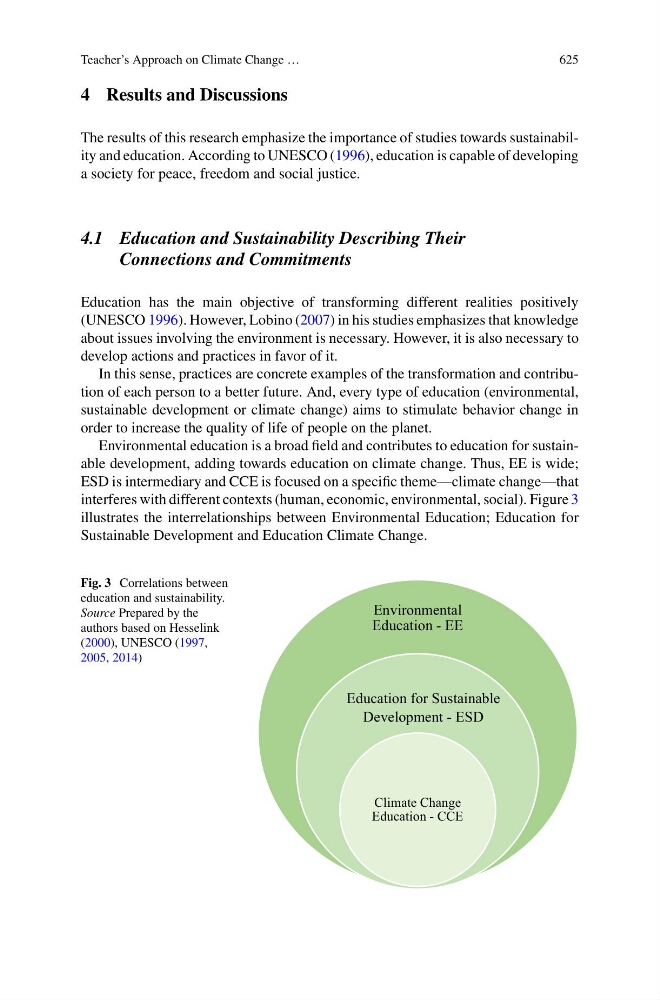
Environmental education is a broad field and contributes to education for sustainable development, adding towards education on climate change. Thus, EE is wide;
ESD is intermediary and CCE is focused on a specific theme—climate change—that
interferes with different contexts (human, economic, environmental, social). Figure 3
illustrates the interrelationships between Environmental Education; Education for
Sustainable Development and Education Climate Change.
Fig. 3 Correlations between
education and sustainability.
Source Prepared by the
authors based on Hesselink
(2000), UNESCO (1997,
2005, 2014)
Environmental
Education - EE
Climate Change
Education - CCE
Education for Sustainable
Development - ESD
625
4 Results and Discussions
The results of this research emphasize the importance of studies towards sustainability and education. According to UNESCO (1996), education is capable of developing
a society for peace, freedom and social justice.
4.1 Education and Sustainability Describing Their
Connections and Commitments
Education has the main objective of transforming different realities positively
(UNESCO 1996). However, Lobino (2007) in his studies emphasizes that knowledge
about issues involving the environment is necessary. However, it is also necessary to
develop actions and practices in favor of it.
In this sense, practices are concrete examples of the transformation and contribution of each person to a better future. And, every type of education (environmental,
sustainable development or climate change) aims to stimulate behavior change in
order to increase the quality of life of people on the planet.
Environmental education is a broad field and contributes to education for sustainable development, adding towards education on climate change. Thus, EE is wide;
ESD is intermediary and CCE is focused on a specific theme—climate change—that
interferes with different contexts (human, economic, environmental, social). Figure 3
illustrates the interrelationships between Environmental Education; Education for
Sustainable Development and Education Climate Change.
Fig. 3 Correlations between
education and sustainability.
Source Prepared by the
authors based on Hesselink
(2000), UNESCO (1997,
2005, 2014)
Environmental
Education - EE
Climate Change
Education - CCE
Education for Sustainable
Development - ESD