

152
carbon contents in the topsoil soil layer and increases in the subsoil layers are
expected in the short, medium and long term. However, intensity of these changes
will depend on the land use type and the results suggested that agricultural land uses
relying on irrigation will be particularly vulnerable to losses of soil organic carbon stocks.
7.7.2 Effect of Climate Change on Cultivated Area
The effect of climate change on the cultivated area of Egypt has been studied. Fawaz
and Soliman (2016) calculated the loss in the total cultivated area of Egypt in 2030
to be 8%, compared to the current cultivated area. Furthermore, Ouda and Zohry
(2018) calculated the loss of the cultivated area of several winter and summer crops,
as affected by the increase in water requirements of these cultivated crops and the
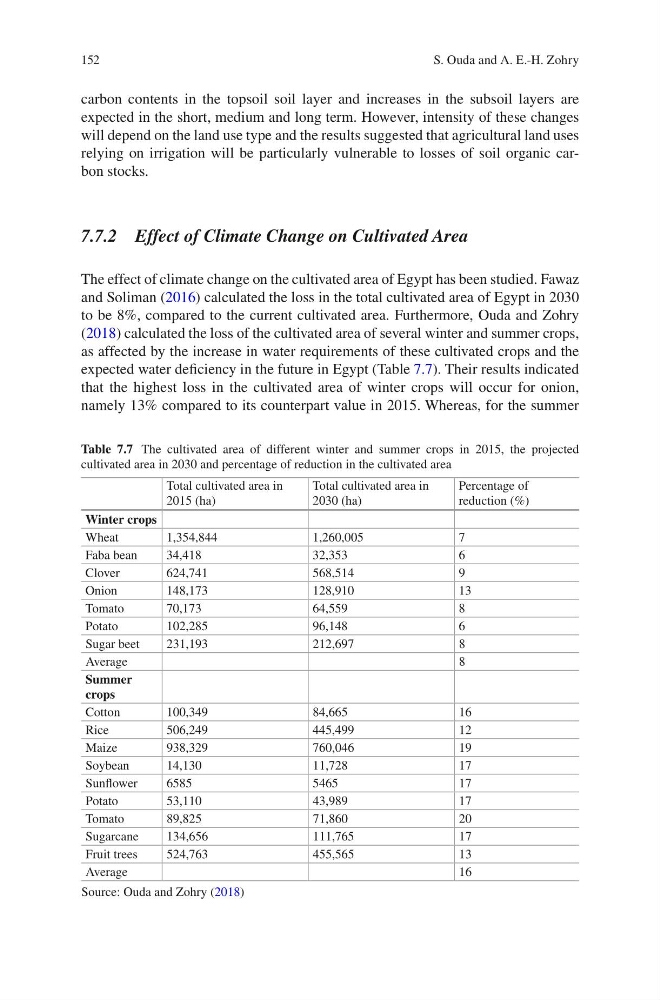
expected water deficiency in the future in Egypt (Table 7.7). Their results indicated
that the highest loss in the cultivated area of winter crops will occur for onion,
namely 13% compared to its counterpart value in 2015. Whereas, for the summer
Table 7.7 The cultivated area of different winter and summer crops in 2015, the projected
cultivated area in 2030 and percentage of reduction in the cultivated area
Total cultivated area in
2015 (ha)
Total cultivated area in
2030 (ha)
Percentage of
reduction (%)
Winter crops
Wheat
1,354,844
1,260,005
7
Faba bean
34,418
32,353
6
Clover
624,741
568,514
9
Onion
148,173
128,910
13
Tomato
70,173
64,559
8
Potato
102,285
96,148
6
Sugar beet
231,193
212,697
8
Average
8
Summer
crops
Cotton
100,349
84,665
16
Rice
506,249
445,499
12
Maize
938,329
760,046
19
Soybean
14,130
11,728
17
Sunflower
6585
5465
17
Potato
53,110
43,989
17
Tomato
89,825
71,860
20
Sugarcane
134,656
111,765
17
Fruit trees
524,763
455,565
13
Average
16
Source: Ouda and Zohry (2018)
S. Ouda and A. E.-H. Zohry
carbon contents in the topsoil soil layer and increases in the subsoil layers are
expected in the short, medium and long term. However, intensity of these changes
will depend on the land use type and the results suggested that agricultural land uses
relying on irrigation will be particularly vulnerable to losses of soil organic carbon stocks.
7.7.2 Effect of Climate Change on Cultivated Area
The effect of climate change on the cultivated area of Egypt has been studied. Fawaz
and Soliman (2016) calculated the loss in the total cultivated area of Egypt in 2030
to be 8%, compared to the current cultivated area. Furthermore, Ouda and Zohry
(2018) calculated the loss of the cultivated area of several winter and summer crops,
as affected by the increase in water requirements of these cultivated crops and the
expected water deficiency in the future in Egypt (Table 7.7). Their results indicated
that the highest loss in the cultivated area of winter crops will occur for onion,
namely 13% compared to its counterpart value in 2015. Whereas, for the summer
Table 7.7 The cultivated area of different winter and summer crops in 2015, the projected
cultivated area in 2030 and percentage of reduction in the cultivated area
Total cultivated area in
2015 (ha)
Total cultivated area in
2030 (ha)
Percentage of
reduction (%)
Winter crops
Wheat
1,354,844
1,260,005
7
Faba bean
34,418
32,353
6
Clover
624,741
568,514
9
Onion
148,173
128,910
13
Tomato
70,173
64,559
8
Potato
102,285
96,148
6
Sugar beet
231,193
212,697
8
Average
8
Summer
crops
Cotton
100,349
84,665
16
Rice
506,249
445,499
12
Maize
938,329
760,046
19
Soybean
14,130
11,728
17
Sunflower
6585
5465
17
Potato
53,110
43,989
17
Tomato
89,825
71,860
20
Sugarcane
134,656
111,765
17
Fruit trees
524,763
455,565
13
Average
16
Source: Ouda and Zohry (2018)
S. Ouda and A. E.-H. Zohry