

151
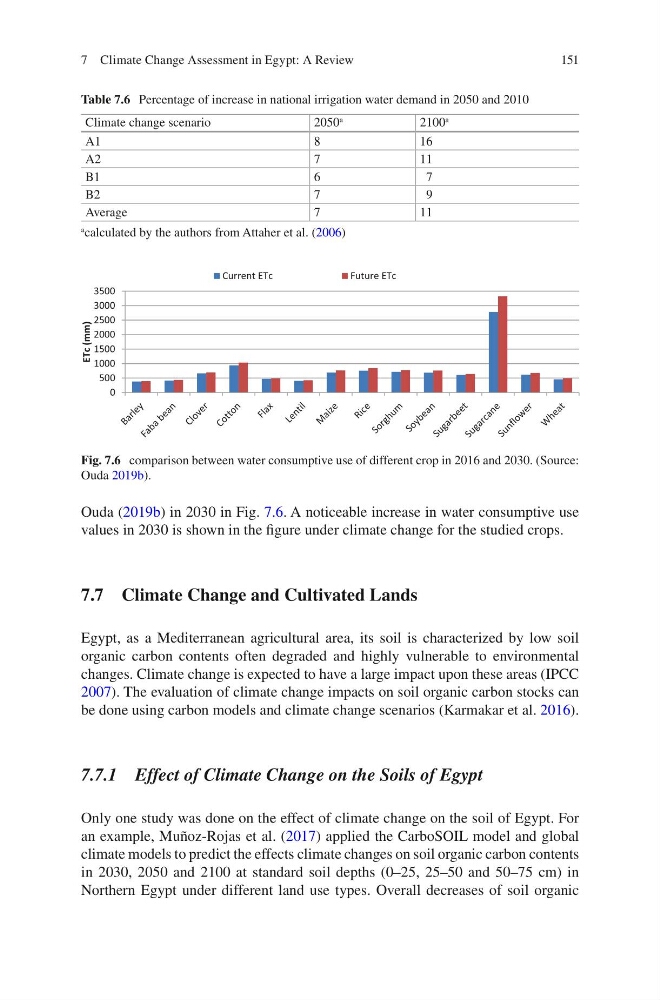
Ouda (2019b) in 2030 in Fig. 7.6. A noticeable increase in water consumptive use
values in 2030 is shown in the figure under climate change for the studied crops.
7.7 Climate Change and Cultivated Lands
Egypt, as a Mediterranean agricultural area, its soil is characterized by low soil
organic carbon contents often degraded and highly vulnerable to environmental
changes. Climate change is expected to have a large impact upon these areas (IPCC
2007). The evaluation of climate change impacts on soil organic carbon stocks can
be done using carbon models and climate change scenarios (Karmakar et al. 2016).
7.7.1 Effect of Climate Change on the Soils of Egypt
Only one study was done on the effect of climate change on the soil of Egypt. For
an example, Muñoz-Rojas et al. (2017) applied the CarboSOIL model and global
climate models to predict the effects climate changes on soil organic carbon contents
in 2030, 2050 and 2100 at standard soil depths (0–25, 25–50 and 50–75 cm) in
Northern Egypt under different land use types. Overall decreases of soil organic
Table 7.6 Percentage of increase in national irrigation water demand in 2050 and 2010
Climate change scenario
2050
a
2100
a
A1
8
16
A2
7
11
B1
6
7
B2
7
9
Average
7
11
a
calculated by the authors from Attaher et al. (2006)
0
500
1000
1500
2000
2500
3000
3500
ETc (mm)
Current ETc
Future ETc
Fig. 7.6 comparison between water consumptive use of different crop in 2016 and 2030. (Source:
Ouda 2019b).
7 Climate Change Assessment in Egypt: A Review
Ouda (2019b) in 2030 in Fig. 7.6. A noticeable increase in water consumptive use
values in 2030 is shown in the figure under climate change for the studied crops.
7.7 Climate Change and Cultivated Lands
Egypt, as a Mediterranean agricultural area, its soil is characterized by low soil
organic carbon contents often degraded and highly vulnerable to environmental
changes. Climate change is expected to have a large impact upon these areas (IPCC
2007). The evaluation of climate change impacts on soil organic carbon stocks can
be done using carbon models and climate change scenarios (Karmakar et al. 2016).
7.7.1 Effect of Climate Change on the Soils of Egypt
Only one study was done on the effect of climate change on the soil of Egypt. For
an example, Muñoz-Rojas et al. (2017) applied the CarboSOIL model and global
climate models to predict the effects climate changes on soil organic carbon contents
in 2030, 2050 and 2100 at standard soil depths (0–25, 25–50 and 50–75 cm) in
Northern Egypt under different land use types. Overall decreases of soil organic
Table 7.6 Percentage of increase in national irrigation water demand in 2050 and 2010
Climate change scenario
2050
a
2100
a
A1
8
16
A2
7
11
B1
6
7
B2
7
9
Average
7
11
a
calculated by the authors from Attaher et al. (2006)
0
500
1000
1500
2000
2500
3000
3500
ETc (mm)
Current ETc
Future ETc
Fig. 7.6 comparison between water consumptive use of different crop in 2016 and 2030. (Source:
Ouda 2019b).
7 Climate Change Assessment in Egypt: A Review