

147
ture is expected to rise by 1.8, 2.4 and 2.8 °C, respectively by the end of twenty-first
century. These scenarios are also known as AR4 climate change scenarios.
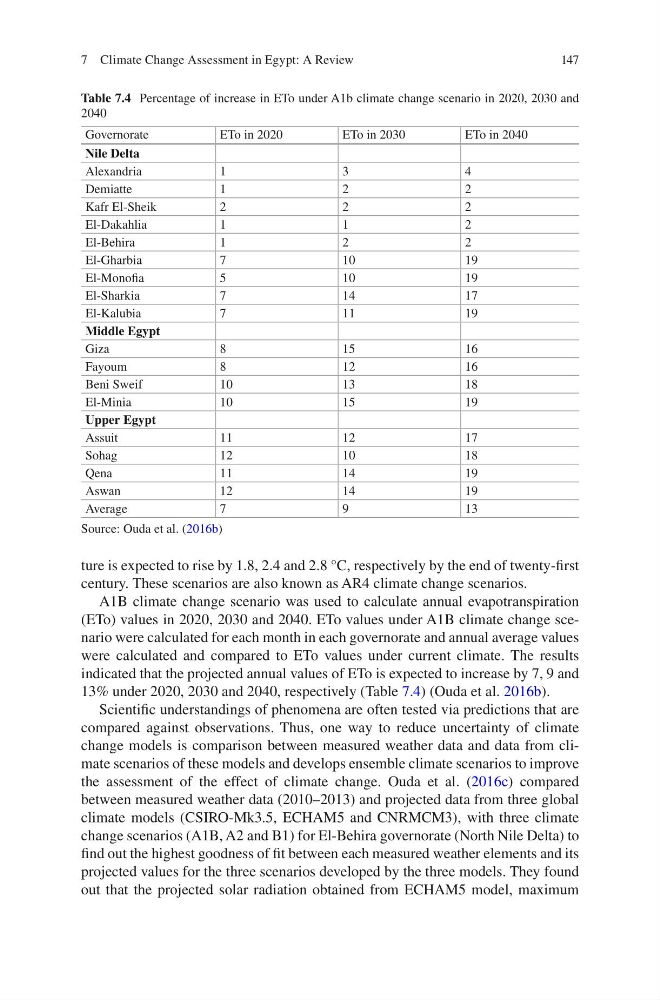
A1B climate change scenario was used to calculate annual evapotranspiration
(ETo) values in 2020, 2030 and 2040. ETo values under A1B climate change scenario were calculated for each month in each governorate and annual average values
were calculated and compared to ETo values under current climate. The results
indicated that the projected annual values of ETo is expected to increase by 7, 9 and
13% under 2020, 2030 and 2040, respectively (Table 7.4) (Ouda et al. 2016b).
Scientific understandings of phenomena are often tested via predictions that are
compared against observations. Thus, one way to reduce uncertainty of climate
change models is comparison between measured weather data and data from climate scenarios of these models and develops ensemble climate scenarios to improve
the assessment of the effect of climate change. Ouda et al. (2016c) compared
between measured weather data (2010–2013) and projected data from three global
climate models (CSIRO-Mk3.5, ECHAM5 and CNRMCM3), with three climate
change scenarios (A1B, A2 and B1) for El-Behira governorate (North Nile Delta) to
find out the highest goodness of fit between each measured weather elements and its
projected values for the three scenarios developed by the three models. They found
out that the projected solar radiation obtained from ECHAM5 model, maximum
Table 7.4 Percentage of increase in ETo under A1b climate change scenario in 2020, 2030 and
2040
Governorate
ETo in 2020
ETo in 2030
ETo in 2040
Nile Delta
Alexandria
1
3
4
Demiatte
1
2
2
Kafr El-Sheik
2
2
2
El-Dakahlia
1
1
2
El-Behira
1
2
2
El-Gharbia
7
10
19
El-Monofia
5
10
19
El-Sharkia
7
14
17
El-Kalubia
7
11
19
Middle Egypt
Giza
8
15
16
Fayoum
8
12
16
Beni Sweif
10
13
18
El-Minia
10
15
19
Upper Egypt
Assuit
11
12
17
Sohag
12
10
18
Qena
11
14
19
Aswan
12
14
19
Average
7
9
13
Source: Ouda et al. (2016b)
7 Climate Change Assessment in Egypt: A Review
ture is expected to rise by 1.8, 2.4 and 2.8 °C, respectively by the end of twenty-first
century. These scenarios are also known as AR4 climate change scenarios.
A1B climate change scenario was used to calculate annual evapotranspiration
(ETo) values in 2020, 2030 and 2040. ETo values under A1B climate change scenario were calculated for each month in each governorate and annual average values
were calculated and compared to ETo values under current climate. The results
indicated that the projected annual values of ETo is expected to increase by 7, 9 and
13% under 2020, 2030 and 2040, respectively (Table 7.4) (Ouda et al. 2016b).
Scientific understandings of phenomena are often tested via predictions that are
compared against observations. Thus, one way to reduce uncertainty of climate
change models is comparison between measured weather data and data from climate scenarios of these models and develops ensemble climate scenarios to improve
the assessment of the effect of climate change. Ouda et al. (2016c) compared
between measured weather data (2010–2013) and projected data from three global
climate models (CSIRO-Mk3.5, ECHAM5 and CNRMCM3), with three climate
change scenarios (A1B, A2 and B1) for El-Behira governorate (North Nile Delta) to
find out the highest goodness of fit between each measured weather elements and its
projected values for the three scenarios developed by the three models. They found
out that the projected solar radiation obtained from ECHAM5 model, maximum
Table 7.4 Percentage of increase in ETo under A1b climate change scenario in 2020, 2030 and
2040
Governorate
ETo in 2020
ETo in 2030
ETo in 2040
Nile Delta
Alexandria
1
3
4
Demiatte
1
2
2
Kafr El-Sheik
2
2
2
El-Dakahlia
1
1
2
El-Behira
1
2
2
El-Gharbia
7
10
19
El-Monofia
5
10
19
El-Sharkia
7
14
17
El-Kalubia
7
11
19
Middle Egypt
Giza
8
15
16
Fayoum
8
12
16
Beni Sweif
10
13
18
El-Minia
10
15
19
Upper Egypt
Assuit
11
12
17
Sohag
12
10
18
Qena
11
14
19
Aswan
12
14
19
Average
7
9
13
Source: Ouda et al. (2016b)
7 Climate Change Assessment in Egypt: A Review