

146
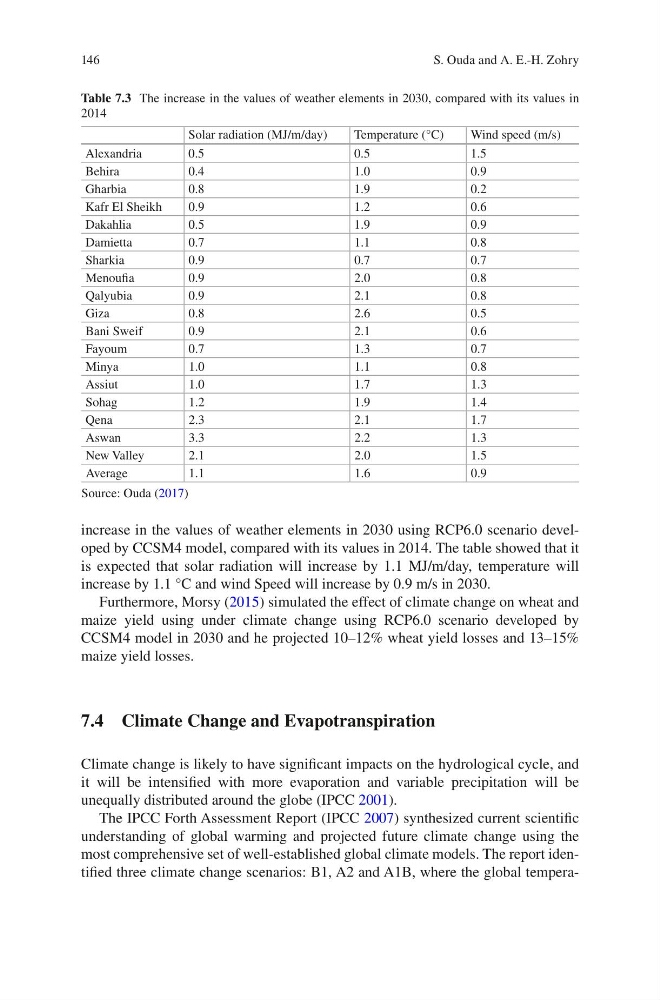
increase in the values of weather elements in 2030 using RCP6.0 scenario developed by CCSM4 model, compared with its values in 2014. The table showed that it
is expected that solar radiation will increase by 1.1 MJ/m/day, temperature will
increase by 1.1 °C and wind Speed will increase by 0.9 m/s in 2030.
Furthermore, Morsy (2015) simulated the effect of climate change on wheat and
maize yield using under climate change using RCP6.0 scenario developed by
CCSM4 model in 2030 and he projected 10–12% wheat yield losses and 13–15%
maize yield losses.
7.4 Climate Change and Evapotranspiration
Climate change is likely to have significant impacts on the hydrological cycle, and
it will be intensified with more evaporation and variable precipitation will be
unequally distributed around the globe (IPCC 2001).
The IPCC Forth Assessment Report (IPCC 2007) synthesized current scientific
understanding of global warming and projected future climate change using the
most comprehensive set of well-established global climate models. The report identified three climate change scenarios: B1, A2 and A1B, where the global temperaTable 7.3 The increase in the values of weather elements in 2030, compared with its values in
2014
Solar radiation (MJ/m/day)
Temperature (°C)
Wind speed (m/s)
Alexandria
0.5
0.5
1.5
Behira
0.4
1.0
0.9
Gharbia
0.8
1.9
0.2
Kafr El Sheikh
0.9
1.2
0.6
Dakahlia
0.5
1.9
0.9
Damietta
0.7
1.1
0.8
Sharkia
0.9
0.7
0.7
Menoufia
0.9
2.0
0.8
Qalyubia
0.9
2.1
0.8
Giza
0.8
2.6
0.5
Bani Sweif
0.9
2.1
0.6
Fayoum
0.7
1.3
0.7
Minya
1.0
1.1
0.8
Assiut
1.0
1.7
1.3
Sohag
1.2
1.9
1.4
Qena
2.3
2.1
1.7
Aswan
3.3
2.2
1.3
New Valley
2.1
2.0
1.5
Average
1.1
1.6
0.9
Source: Ouda (2017)
S. Ouda and A. E.-H. Zohry
increase in the values of weather elements in 2030 using RCP6.0 scenario developed by CCSM4 model, compared with its values in 2014. The table showed that it
is expected that solar radiation will increase by 1.1 MJ/m/day, temperature will
increase by 1.1 °C and wind Speed will increase by 0.9 m/s in 2030.
Furthermore, Morsy (2015) simulated the effect of climate change on wheat and
maize yield using under climate change using RCP6.0 scenario developed by
CCSM4 model in 2030 and he projected 10–12% wheat yield losses and 13–15%
maize yield losses.
7.4 Climate Change and Evapotranspiration
Climate change is likely to have significant impacts on the hydrological cycle, and
it will be intensified with more evaporation and variable precipitation will be
unequally distributed around the globe (IPCC 2001).
The IPCC Forth Assessment Report (IPCC 2007) synthesized current scientific
understanding of global warming and projected future climate change using the
most comprehensive set of well-established global climate models. The report identified three climate change scenarios: B1, A2 and A1B, where the global temperaTable 7.3 The increase in the values of weather elements in 2030, compared with its values in
2014
Solar radiation (MJ/m/day)
Temperature (°C)
Wind speed (m/s)
Alexandria
0.5
0.5
1.5
Behira
0.4
1.0
0.9
Gharbia
0.8
1.9
0.2
Kafr El Sheikh
0.9
1.2
0.6
Dakahlia
0.5
1.9
0.9
Damietta
0.7
1.1
0.8
Sharkia
0.9
0.7
0.7
Menoufia
0.9
2.0
0.8
Qalyubia
0.9
2.1
0.8
Giza
0.8
2.6
0.5
Bani Sweif
0.9
2.1
0.6
Fayoum
0.7
1.3
0.7
Minya
1.0
1.1
0.8
Assiut
1.0
1.7
1.3
Sohag
1.2
1.9
1.4
Qena
2.3
2.1
1.7
Aswan
3.3
2.2
1.3
New Valley
2.1
2.0
1.5
Average
1.1
1.6
0.9
Source: Ouda (2017)
S. Ouda and A. E.-H. Zohry