

142
7.3 Projection of Climate Change Impacts on Crops
Production
7.3.1 Using IPCC Report (1990)
Global models of the climate system of the world are an important tool in climate
research. Climate change impact on crops in Egypt started as early as in the 1990c,
where the late Prof. Helmy Eid and others assessed its consequences on the production of the crops grown in clay soil under surface irrigation. In his early work, he
used MAGICC/SCENGEN model to calculate the annual mean global surface air
temperature and global-mean Sea-level implications of emissions scenarios for
greenhouse gases. SCENGEN model was run using CSIRO-GCM model and climatic data were extracted using regression model for year 2000 and 2050. The
results of this methodology indicated that the increase in annual temperature of
Egypt will be 0.9–1.9 °C with an average of 1.4 °C, in addition to sea level rise averaged by 20 cm in the year 2050, compared to the current conditions (Eid et al. 1992).
Furthermore, climate change scenarios created by combining the daily climate
data for each site with the output of three equilibrium General Circulation Models
(GCMs): the Geophysical Fluid Dynamics Laboratory (GFDL), Goddard Institute
for Space Studies (GISS), and United Kingdom Meteorological Office (UKMO)
models. Under these scenarios, projected precipitation changes are more uncertain,
and solar radiation changes are projected to be small (El-Shaer et al. 1996).
To simulate the effect of climate change, DSSAT3 model (Jones et al. 2003) was
used to project the yield of several crops on the national level in 2050, namely
wheat, barely, maize, sorghum, rice and soybean under increased CO 2 concentration
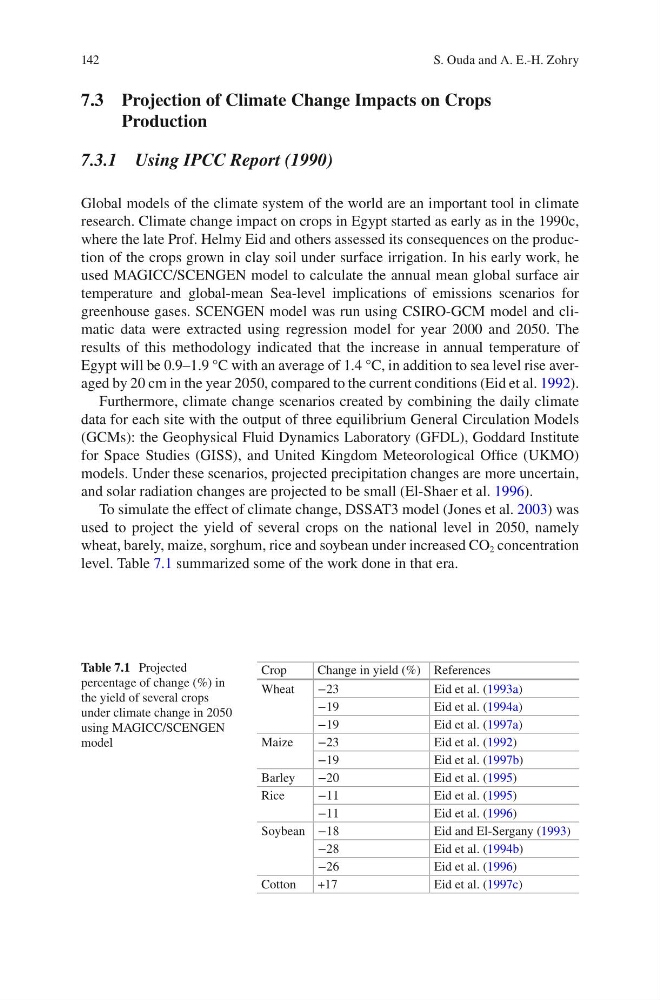
level. Table 7.1 summarized some of the work done in that era.
Table 7.1 Projected
percentage of change (%) in
the yield of several crops
under climate change in 2050
using MAGICC/SCENGEN
model
Crop
Change in yield (%) References
Wheat
−23
Eid et al. (1993a)
−19
Eid et al. (1994a)
−19
Eid et al. (1997a)
Maize
−23
Eid et al. (1992)
−19
Eid et al. (1997b)
Barley
−20
Eid et al. (1995)
Rice
−11
Eid et al. (1995)
−11
Eid et al. (1996)
Soybean −18
Eid and El-Sergany (1993)
−28
Eid et al. (1994b)
−26
Eid et al. (1996)
Cotton
+17
Eid et al. (1997c)
S. Ouda and A. E.-H. Zohry
7.3 Projection of Climate Change Impacts on Crops
Production
7.3.1 Using IPCC Report (1990)
Global models of the climate system of the world are an important tool in climate
research. Climate change impact on crops in Egypt started as early as in the 1990c,
where the late Prof. Helmy Eid and others assessed its consequences on the production of the crops grown in clay soil under surface irrigation. In his early work, he
used MAGICC/SCENGEN model to calculate the annual mean global surface air
temperature and global-mean Sea-level implications of emissions scenarios for
greenhouse gases. SCENGEN model was run using CSIRO-GCM model and climatic data were extracted using regression model for year 2000 and 2050. The
results of this methodology indicated that the increase in annual temperature of
Egypt will be 0.9–1.9 °C with an average of 1.4 °C, in addition to sea level rise averaged by 20 cm in the year 2050, compared to the current conditions (Eid et al. 1992).
Furthermore, climate change scenarios created by combining the daily climate
data for each site with the output of three equilibrium General Circulation Models
(GCMs): the Geophysical Fluid Dynamics Laboratory (GFDL), Goddard Institute
for Space Studies (GISS), and United Kingdom Meteorological Office (UKMO)
models. Under these scenarios, projected precipitation changes are more uncertain,
and solar radiation changes are projected to be small (El-Shaer et al. 1996).
To simulate the effect of climate change, DSSAT3 model (Jones et al. 2003) was
used to project the yield of several crops on the national level in 2050, namely
wheat, barely, maize, sorghum, rice and soybean under increased CO 2 concentration
level. Table 7.1 summarized some of the work done in that era.
Table 7.1 Projected
percentage of change (%) in
the yield of several crops
under climate change in 2050
using MAGICC/SCENGEN
model
Crop
Change in yield (%) References
Wheat
−23
Eid et al. (1993a)
−19
Eid et al. (1994a)
−19
Eid et al. (1997a)
Maize
−23
Eid et al. (1992)
−19
Eid et al. (1997b)
Barley
−20
Eid et al. (1995)
Rice
−11
Eid et al. (1995)
−11
Eid et al. (1996)
Soybean −18
Eid and El-Sergany (1993)
−28
Eid et al. (1994b)
−26
Eid et al. (1996)
Cotton
+17
Eid et al. (1997c)
S. Ouda and A. E.-H. Zohry