

143
7.3.2 Using IPCC Report (2001)
Other researches depended on the Special Report on Emissions Scenarios (SRES)
developed by the IPCC (2001) to generate climate change scenarios, namely A1,
A2, B1 and B2. The SRES scenarios combined two sets of divergent tendencies;
one set varies between strong economic values and strong environmental values,
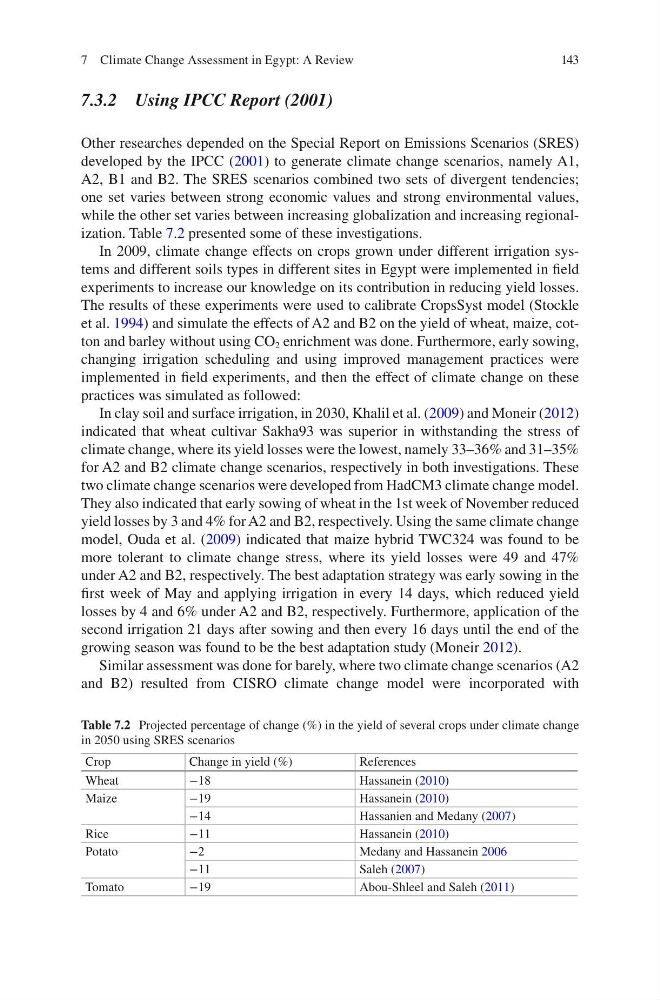
while the other set varies between increasing globalization and increasing regionalization. Table 7.2 presented some of these investigations.
In 2009, climate change effects on crops grown under different irrigation systems and different soils types in different sites in Egypt were implemented in field
experiments to increase our knowledge on its contribution in reducing yield losses.
The results of these experiments were used to calibrate CropsSyst model (Stockle
et al. 1994) and simulate the effects of A2 and B2 on the yield of wheat, maize, cotton and barley without using CO 2 enrichment was done. Furthermore, early sowing,
changing irrigation scheduling and using improved management practices were
implemented in field experiments, and then the effect of climate change on these
practices was simulated as followed:
In clay soil and surface irrigation, in 2030, Khalil et al. (2009) and Moneir (2012)
indicated that wheat cultivar Sakha93 was superior in withstanding the stress of
climate change, where its yield losses were the lowest, namely 33–36% and 31–35%
for A2 and B2 climate change scenarios, respectively in both investigations. These
two climate change scenarios were developed from HadCM3 climate change model.
They also indicated that early sowing of wheat in the 1st week of November reduced
yield losses by 3 and 4% for A2 and B2, respectively. Using the same climate change
model, Ouda et al. (2009) indicated that maize hybrid TWC324 was found to be
more tolerant to climate change stress, where its yield losses were 49 and 47%
under A2 and B2, respectively. The best adaptation strategy was early sowing in the
first week of May and applying irrigation in every 14 days, which reduced yield
losses by 4 and 6% under A2 and B2, respectively. Furthermore, application of the
second irrigation 21 days after sowing and then every 16 days until the end of the
growing season was found to be the best adaptation study (Moneir 2012).
Similar assessment was done for barely, where two climate change scenarios (A2
and B2) resulted from CISRO climate change model were incorporated with
Table 7.2 Projected percentage of change (%) in the yield of several crops under climate change
in 2050 using SRES scenarios
Crop
Change in yield (%)
References
Wheat
−18
Hassanein (2010)
Maize
−19
Hassanein (2010)
−14
Hassanien and Medany (2007)
Rice
−11
Hassanein (2010)
Potato
−2
Medany and Hassanein 2006
−11
Saleh (2007)
Tomato
−19
Abou-Shleel and Saleh (2011)
7 Climate Change Assessment in Egypt: A Review
7.3.2 Using IPCC Report (2001)
Other researches depended on the Special Report on Emissions Scenarios (SRES)
developed by the IPCC (2001) to generate climate change scenarios, namely A1,
A2, B1 and B2. The SRES scenarios combined two sets of divergent tendencies;
one set varies between strong economic values and strong environmental values,
while the other set varies between increasing globalization and increasing regionalization. Table 7.2 presented some of these investigations.
In 2009, climate change effects on crops grown under different irrigation systems and different soils types in different sites in Egypt were implemented in field
experiments to increase our knowledge on its contribution in reducing yield losses.
The results of these experiments were used to calibrate CropsSyst model (Stockle
et al. 1994) and simulate the effects of A2 and B2 on the yield of wheat, maize, cotton and barley without using CO 2 enrichment was done. Furthermore, early sowing,
changing irrigation scheduling and using improved management practices were
implemented in field experiments, and then the effect of climate change on these
practices was simulated as followed:
In clay soil and surface irrigation, in 2030, Khalil et al. (2009) and Moneir (2012)
indicated that wheat cultivar Sakha93 was superior in withstanding the stress of
climate change, where its yield losses were the lowest, namely 33–36% and 31–35%
for A2 and B2 climate change scenarios, respectively in both investigations. These
two climate change scenarios were developed from HadCM3 climate change model.
They also indicated that early sowing of wheat in the 1st week of November reduced
yield losses by 3 and 4% for A2 and B2, respectively. Using the same climate change
model, Ouda et al. (2009) indicated that maize hybrid TWC324 was found to be
more tolerant to climate change stress, where its yield losses were 49 and 47%
under A2 and B2, respectively. The best adaptation strategy was early sowing in the
first week of May and applying irrigation in every 14 days, which reduced yield
losses by 4 and 6% under A2 and B2, respectively. Furthermore, application of the
second irrigation 21 days after sowing and then every 16 days until the end of the
growing season was found to be the best adaptation study (Moneir 2012).
Similar assessment was done for barely, where two climate change scenarios (A2
and B2) resulted from CISRO climate change model were incorporated with
Table 7.2 Projected percentage of change (%) in the yield of several crops under climate change
in 2050 using SRES scenarios
Crop
Change in yield (%)
References
Wheat
−18
Hassanein (2010)
Maize
−19
Hassanein (2010)
−14
Hassanien and Medany (2007)
Rice
−11
Hassanein (2010)
Potato
−2
Medany and Hassanein 2006
−11
Saleh (2007)
Tomato
−19
Abou-Shleel and Saleh (2011)
7 Climate Change Assessment in Egypt: A Review