

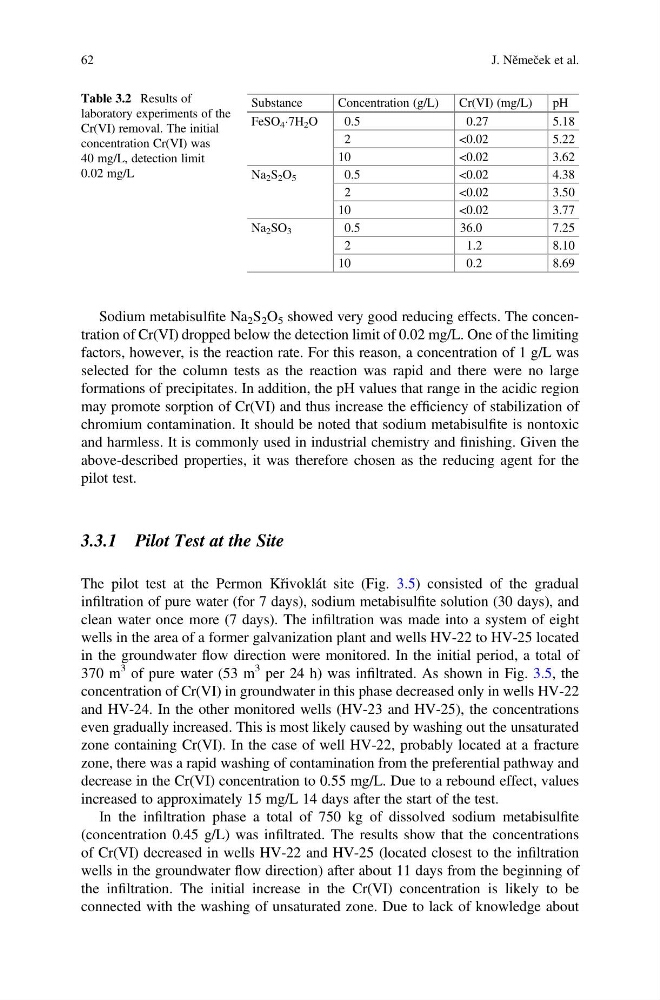
Sodium metabisulfite Na 2 S 2 O 5 showed very good reducing effects. The concentration of Cr(VI) dropped below the detection limit of 0.02 mg/L. One of the limiting
factors, however, is the reaction rate. For this reason, a concentration of 1 g/L was
selected for the column tests as the reaction was rapid and there were no large
formations of precipitates. In addition, the pH values that range in the acidic region
may promote sorption of Cr(VI) and thus increase the efficiency of stabilization of
chromium contamination. It should be noted that sodium metabisulfite is nontoxic
and harmless. It is commonly used in industrial chemistry and finishing. Given the
above-described properties, it was therefore chosen as the reducing agent for the
pilot test.
3.3.1 Pilot Test at the Site
The pilot test at the Permon Křivoklát site (Fig. 3.5) consisted of the gradual
infiltration of pure water (for 7 days), sodium metabisulfite solution (30 days), and
clean water once more (7 days). The infiltration was made into a system of eight
wells in the area of a former galvanization plant and wells HV-22 to HV-25 located
in the groundwater flow direction were monitored. In the initial period, a total of
370 m
3 of pure water (53 m
3 per 24 h) was infiltrated. As shown in Fig. 3.5, the
concentration of Cr(VI) in groundwater in this phase decreased only in wells HV-22
and HV-24. In the other monitored wells (HV-23 and HV-25), the concentrations
even gradually increased. This is most likely caused by washing out the unsaturated
zone containing Cr(VI). In the case of well HV-22, probably located at a fracture
zone, there was a rapid washing of contamination from the preferential pathway and
decrease in the Cr(VI) concentration to 0.55 mg/L. Due to a rebound effect, values
increased to approximately 15 mg/L 14 days after the start of the test.
In the infiltration phase a total of 750 kg of dissolved sodium metabisulfite
(concentration 0.45 g/L) was infiltrated. The results show that the concentrations
of Cr(VI) decreased in wells HV-22 and HV-25 (located closest to the infiltration
wells in the groundwater flow direction) after about 11 days from the beginning of
the infiltration. The initial increase in the Cr(VI) concentration is likely to be
connected with the washing of unsaturated zone. Due to lack of knowledge about
Table 3.2 Results of
laboratory experiments of the
Cr(VI) removal. The initial
concentration Cr(VI) was
40 mg/L, detection limit
0.02 mg/L
Substance
Concentration (g/L)
Cr(VI) (mg/L)
pH
FeSO 4 Á7H 2 O
0.5
0.27
5.18
2
<0.02
5.22
10
<0.02
3.62
Na 2 S 2 O 5
0.5
<0.02
4.38
2
<0.02
3.50
10
<0.02
3.77
Na 2 SO 3
0.5
36.0
7.25
2
1.2
8.10
10
0.2
8.69
62
J. Němeček et al.
factors, however, is the reaction rate. For this reason, a concentration of 1 g/L was
selected for the column tests as the reaction was rapid and there were no large
formations of precipitates. In addition, the pH values that range in the acidic region
may promote sorption of Cr(VI) and thus increase the efficiency of stabilization of
chromium contamination. It should be noted that sodium metabisulfite is nontoxic
and harmless. It is commonly used in industrial chemistry and finishing. Given the
above-described properties, it was therefore chosen as the reducing agent for the
pilot test.
3.3.1 Pilot Test at the Site
The pilot test at the Permon Křivoklát site (Fig. 3.5) consisted of the gradual
infiltration of pure water (for 7 days), sodium metabisulfite solution (30 days), and
clean water once more (7 days). The infiltration was made into a system of eight
wells in the area of a former galvanization plant and wells HV-22 to HV-25 located
in the groundwater flow direction were monitored. In the initial period, a total of
370 m
3 of pure water (53 m
3 per 24 h) was infiltrated. As shown in Fig. 3.5, the
concentration of Cr(VI) in groundwater in this phase decreased only in wells HV-22
and HV-24. In the other monitored wells (HV-23 and HV-25), the concentrations
even gradually increased. This is most likely caused by washing out the unsaturated
zone containing Cr(VI). In the case of well HV-22, probably located at a fracture
zone, there was a rapid washing of contamination from the preferential pathway and
decrease in the Cr(VI) concentration to 0.55 mg/L. Due to a rebound effect, values
increased to approximately 15 mg/L 14 days after the start of the test.
In the infiltration phase a total of 750 kg of dissolved sodium metabisulfite
(concentration 0.45 g/L) was infiltrated. The results show that the concentrations
of Cr(VI) decreased in wells HV-22 and HV-25 (located closest to the infiltration
wells in the groundwater flow direction) after about 11 days from the beginning of
the infiltration. The initial increase in the Cr(VI) concentration is likely to be
connected with the washing of unsaturated zone. Due to lack of knowledge about
Table 3.2 Results of
laboratory experiments of the
Cr(VI) removal. The initial
concentration Cr(VI) was
40 mg/L, detection limit
0.02 mg/L
Substance
Concentration (g/L)
Cr(VI) (mg/L)
pH
FeSO 4 Á7H 2 O
0.5
0.27
5.18
2
<0.02
5.22
10
<0.02
3.62
Na 2 S 2 O 5
0.5
<0.02
4.38
2
<0.02
3.50
10
<0.02
3.77
Na 2 SO 3
0.5
36.0
7.25
2
1.2
8.10
10
0.2
8.69
62
J. Němeček et al.