

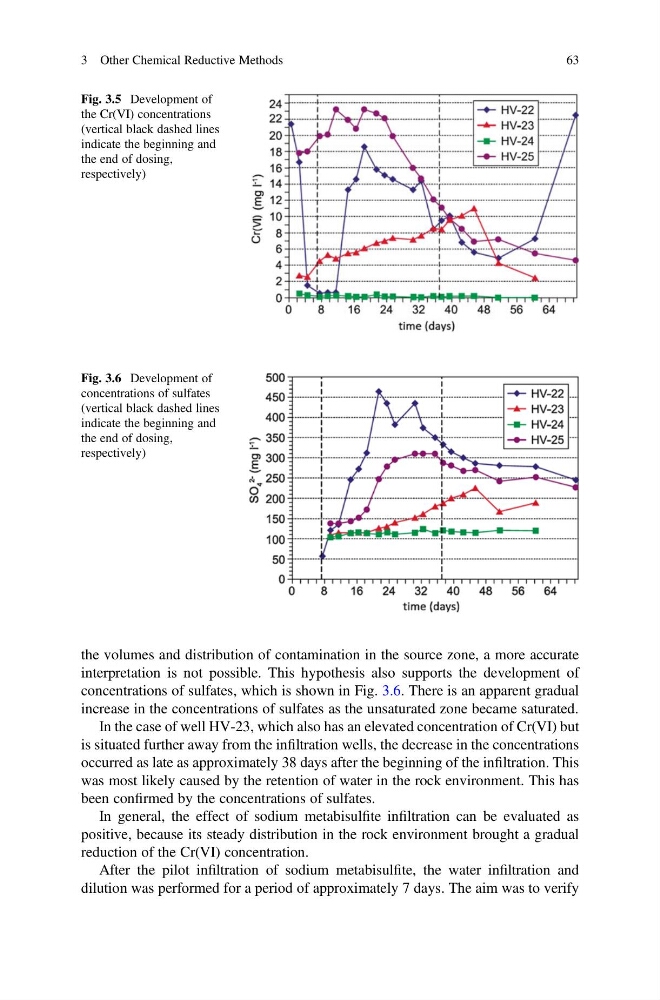
the volumes and distribution of contamination in the source zone, a more accurate
interpretation is not possible. This hypothesis also supports the development of
concentrations of sulfates, which is shown in Fig. 3.6. There is an apparent gradual
increase in the concentrations of sulfates as the unsaturated zone became saturated.
In the case of well HV-23, which also has an elevated concentration of Cr(VI) but
is situated further away from the infiltration wells, the decrease in the concentrations
occurred as late as approximately 38 days after the beginning of the infiltration. This
was most likely caused by the retention of water in the rock environment. This has
been confirmed by the concentrations of sulfates.
In general, the effect of sodium metabisulfite infiltration can be evaluated as
positive, because its steady distribution in the rock environment brought a gradual
reduction of the Cr(VI) concentration.
After the pilot infiltration of sodium metabisulfite, the water infiltration and
dilution was performed for a period of approximately 7 days. The aim was to verify
Fig. 3.6 Development of
concentrations of sulfates
(vertical black dashed lines
indicate the beginning and
the end of dosing,
respectively)
Fig. 3.5 Development of
the Cr(VI) concentrations
(vertical black dashed lines
indicate the beginning and
the end of dosing,
respectively)
3 Other Chemical Reductive Methods
63
interpretation is not possible. This hypothesis also supports the development of
concentrations of sulfates, which is shown in Fig. 3.6. There is an apparent gradual
increase in the concentrations of sulfates as the unsaturated zone became saturated.
In the case of well HV-23, which also has an elevated concentration of Cr(VI) but
is situated further away from the infiltration wells, the decrease in the concentrations
occurred as late as approximately 38 days after the beginning of the infiltration. This
was most likely caused by the retention of water in the rock environment. This has
been confirmed by the concentrations of sulfates.
In general, the effect of sodium metabisulfite infiltration can be evaluated as
positive, because its steady distribution in the rock environment brought a gradual
reduction of the Cr(VI) concentration.
After the pilot infiltration of sodium metabisulfite, the water infiltration and
dilution was performed for a period of approximately 7 days. The aim was to verify
Fig. 3.6 Development of
concentrations of sulfates
(vertical black dashed lines
indicate the beginning and
the end of dosing,
respectively)
Fig. 3.5 Development of
the Cr(VI) concentrations
(vertical black dashed lines
indicate the beginning and
the end of dosing,
respectively)
3 Other Chemical Reductive Methods
63