

water, and sodium metabisulfite solution and whitewash. The number of pore
volumes needed to achieve the remedial limit for Cr(VI) of 20 mg/L are as follows:
• sodium dithionite: 3.4 pore volumes;
• sodium metabisulfite: 7 pore volumes;
• distilled water: 9.4 pore volumes;
• sodium metabisulfite solution and whitewash: 11.8 pore volumes.
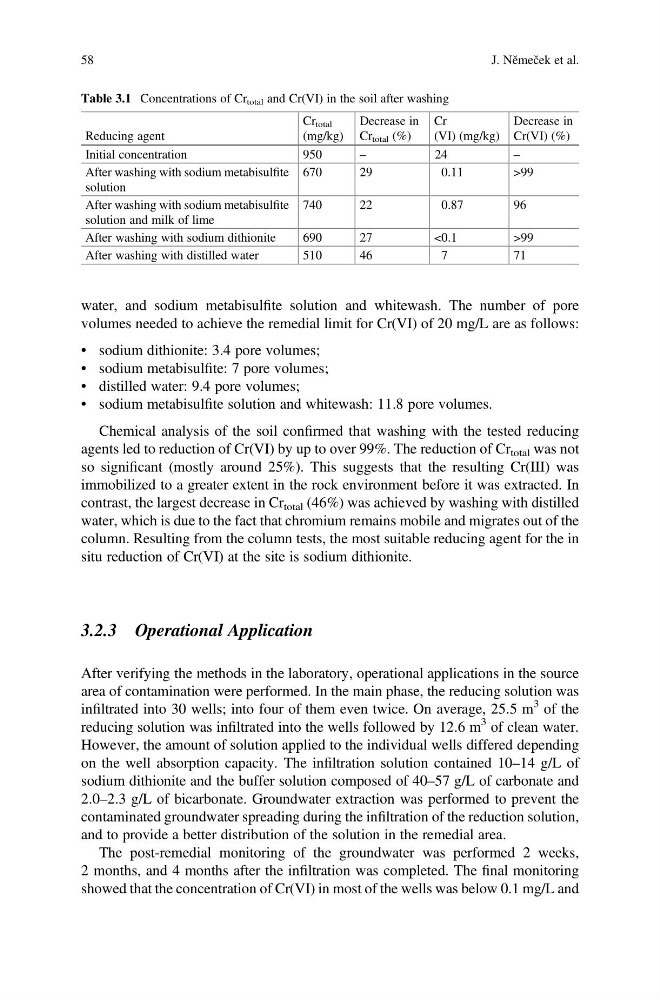
Chemical analysis of the soil confirmed that washing with the tested reducing
agents led to reduction of Cr(VI) by up to over 99%. The reduction of Cr total was not
so significant (mostly around 25%). This suggests that the resulting Cr(III) was
immobilized to a greater extent in the rock environment before it was extracted. In
contrast, the largest decrease in Cr total (46%) was achieved by washing with distilled
water, which is due to the fact that chromium remains mobile and migrates out of the
column. Resulting from the column tests, the most suitable reducing agent for the in
situ reduction of Cr(VI) at the site is sodium dithionite.
3.2.3 Operational Application
After verifying the methods in the laboratory, operational applications in the source
area of contamination were performed. In the main phase, the reducing solution was
infiltrated into 30 wells; into four of them even twice. On average, 25.5 m
3 of the
reducing solution was infiltrated into the wells followed by 12.6 m
3 of clean water.
However, the amount of solution applied to the individual wells differed depending
on the well absorption capacity. The infiltration solution contained 10–14 g/L of
sodium dithionite and the buffer solution composed of 40–57 g/L of carbonate and
2.0–2.3 g/L of bicarbonate. Groundwater extraction was performed to prevent the
contaminated groundwater spreading during the infiltration of the reduction solution,
and to provide a better distribution of the solution in the remedial area.
The post-remedial monitoring of the groundwater was performed 2 weeks,
2 months, and 4 months after the infiltration was completed. The final monitoring
showed that the concentration of Cr(VI) in most of the wells was below 0.1 mg/L and
Table 3.1 Concentrations of Cr total and Cr(VI) in the soil after washing
Reducing agent
Cr total
(mg/kg)
Decrease in
Cr total (%)
Cr
(VI) (mg/kg)
Decrease in
Cr(VI) (%)
Initial concentration
950
–
24
–
After washing with sodium metabisulfite
solution
670
29
0.11
>99
After washing with sodium metabisulfite
solution and milk of lime
740
22
0.87
96
After washing with sodium dithionite
690
27
<0.1
>99
After washing with distilled water
510
46
7
71
58
J. Němeček et al.
volumes needed to achieve the remedial limit for Cr(VI) of 20 mg/L are as follows:
• sodium dithionite: 3.4 pore volumes;
• sodium metabisulfite: 7 pore volumes;
• distilled water: 9.4 pore volumes;
• sodium metabisulfite solution and whitewash: 11.8 pore volumes.
Chemical analysis of the soil confirmed that washing with the tested reducing
agents led to reduction of Cr(VI) by up to over 99%. The reduction of Cr total was not
so significant (mostly around 25%). This suggests that the resulting Cr(III) was
immobilized to a greater extent in the rock environment before it was extracted. In
contrast, the largest decrease in Cr total (46%) was achieved by washing with distilled
water, which is due to the fact that chromium remains mobile and migrates out of the
column. Resulting from the column tests, the most suitable reducing agent for the in
situ reduction of Cr(VI) at the site is sodium dithionite.
3.2.3 Operational Application
After verifying the methods in the laboratory, operational applications in the source
area of contamination were performed. In the main phase, the reducing solution was
infiltrated into 30 wells; into four of them even twice. On average, 25.5 m
3 of the
reducing solution was infiltrated into the wells followed by 12.6 m
3 of clean water.
However, the amount of solution applied to the individual wells differed depending
on the well absorption capacity. The infiltration solution contained 10–14 g/L of
sodium dithionite and the buffer solution composed of 40–57 g/L of carbonate and
2.0–2.3 g/L of bicarbonate. Groundwater extraction was performed to prevent the
contaminated groundwater spreading during the infiltration of the reduction solution,
and to provide a better distribution of the solution in the remedial area.
The post-remedial monitoring of the groundwater was performed 2 weeks,
2 months, and 4 months after the infiltration was completed. The final monitoring
showed that the concentration of Cr(VI) in most of the wells was below 0.1 mg/L and
Table 3.1 Concentrations of Cr total and Cr(VI) in the soil after washing
Reducing agent
Cr total
(mg/kg)
Decrease in
Cr total (%)
Cr
(VI) (mg/kg)
Decrease in
Cr(VI) (%)
Initial concentration
950
–
24
–
After washing with sodium metabisulfite
solution
670
29
0.11
>99
After washing with sodium metabisulfite
solution and milk of lime
740
22
0.87
96
After washing with sodium dithionite
690
27
<0.1
>99
After washing with distilled water
510
46
7
71
58
J. Němeček et al.