

pumping decreased the levels of Cr(VI) to 29% of the initial levels of the contamination, this representing an average value for the wells located in the source area.
The concentrations, however, decreased very slowly or stagnated at the level of
hundreds of mg/L, which is significantly higher than the preliminarily set remediation target level for this area (20 mg/L). It was therefore necessary to proceed with in
situ chemical reduction of Cr(VI).
3.2.2 Laboratory Tests
In order to select the optimal reductive agent, laboratory column tests of chemical
reduction were conducted with two potentially suitable reducing agents—sodium
metabisulfite (Na 2 S 2 O 5 ) and sodium dithionite (Na 2 S 2 O 4 ). Four parallel columns
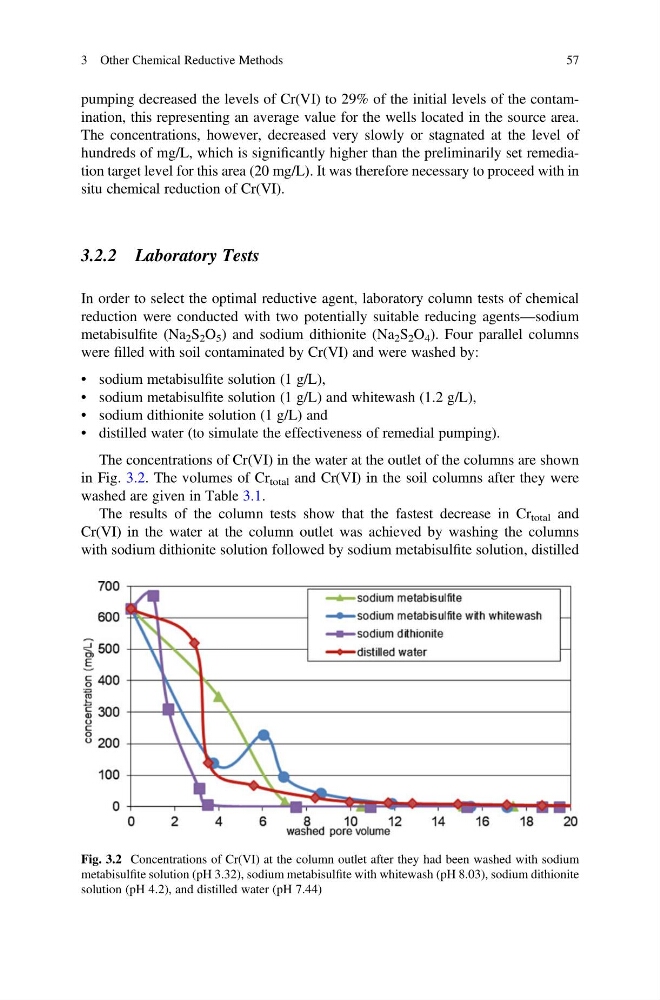
were filled with soil contaminated by Cr(VI) and were washed by:
• sodium metabisulfite solution (1 g/L),
• sodium metabisulfite solution (1 g/L) and whitewash (1.2 g/L),
• sodium dithionite solution (1 g/L) and
• distilled water (to simulate the effectiveness of remedial pumping).
The concentrations of Cr(VI) in the water at the outlet of the columns are shown
in Fig. 3.2. The volumes of Cr total and Cr(VI) in the soil columns after they were
washed are given in Table 3.1.
The results of the column tests show that the fastest decrease in Cr total and
Cr(VI) in the water at the column outlet was achieved by washing the columns
with sodium dithionite solution followed by sodium metabisulfite solution, distilled
Fig. 3.2 Concentrations of Cr(VI) at the column outlet after they had been washed with sodium
metabisulfite solution (pH 3.32), sodium metabisulfite with whitewash (pH 8.03), sodium dithionite
solution (pH 4.2), and distilled water (pH 7.44)
3 Other Chemical Reductive Methods
57
The concentrations, however, decreased very slowly or stagnated at the level of
hundreds of mg/L, which is significantly higher than the preliminarily set remediation target level for this area (20 mg/L). It was therefore necessary to proceed with in
situ chemical reduction of Cr(VI).
3.2.2 Laboratory Tests
In order to select the optimal reductive agent, laboratory column tests of chemical
reduction were conducted with two potentially suitable reducing agents—sodium
metabisulfite (Na 2 S 2 O 5 ) and sodium dithionite (Na 2 S 2 O 4 ). Four parallel columns
were filled with soil contaminated by Cr(VI) and were washed by:
• sodium metabisulfite solution (1 g/L),
• sodium metabisulfite solution (1 g/L) and whitewash (1.2 g/L),
• sodium dithionite solution (1 g/L) and
• distilled water (to simulate the effectiveness of remedial pumping).
The concentrations of Cr(VI) in the water at the outlet of the columns are shown
in Fig. 3.2. The volumes of Cr total and Cr(VI) in the soil columns after they were
washed are given in Table 3.1.
The results of the column tests show that the fastest decrease in Cr total and
Cr(VI) in the water at the column outlet was achieved by washing the columns
with sodium dithionite solution followed by sodium metabisulfite solution, distilled
Fig. 3.2 Concentrations of Cr(VI) at the column outlet after they had been washed with sodium
metabisulfite solution (pH 3.32), sodium metabisulfite with whitewash (pH 8.03), sodium dithionite
solution (pH 4.2), and distilled water (pH 7.44)
3 Other Chemical Reductive Methods
57