

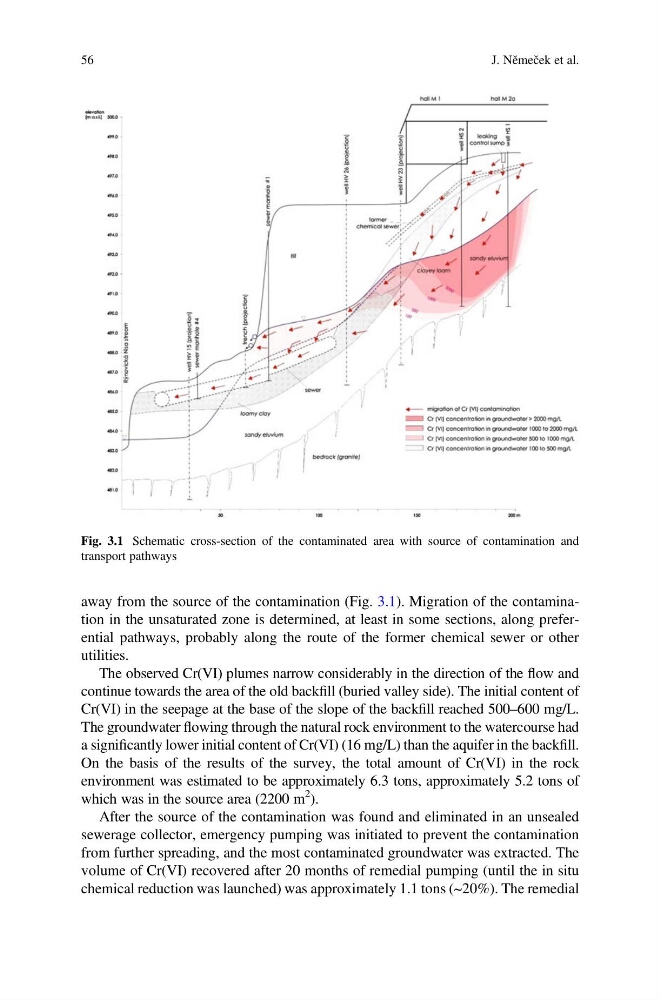
away from the source of the contamination (Fig. 3.1). Migration of the contamination in the unsaturated zone is determined, at least in some sections, along preferential pathways, probably along the route of the former chemical sewer or other
utilities.
The observed Cr(VI) plumes narrow considerably in the direction of the flow and
continue towards the area of the old backfill (buried valley side). The initial content of
Cr(VI) in the seepage at the base of the slope of the backfill reached 500–600 mg/L.
The groundwater flowing through the natural rock environment to the watercourse had
a significantly lower initial content of Cr(VI) (16 mg/L) than the aquifer in the backfill.
On the basis of the results of the survey, the total amount of Cr(VI) in the rock
environment was estimated to be approximately 6.3 tons, approximately 5.2 tons of
which was in the source area (2200 m
2
).
After the source of the contamination was found and eliminated in an unsealed
sewerage collector, emergency pumping was initiated to prevent the contamination
from further spreading, and the most contaminated groundwater was extracted. The
volume of Cr(VI) recovered after 20 months of remedial pumping (until the in situ
chemical reduction was launched) was approximately 1.1 tons (~20%). The remedial
Fig. 3.1 Schematic cross-section of the contaminated area with source of contamination and
transport pathways
56
J. Němeček et al.
utilities.
The observed Cr(VI) plumes narrow considerably in the direction of the flow and
continue towards the area of the old backfill (buried valley side). The initial content of
Cr(VI) in the seepage at the base of the slope of the backfill reached 500–600 mg/L.
The groundwater flowing through the natural rock environment to the watercourse had
a significantly lower initial content of Cr(VI) (16 mg/L) than the aquifer in the backfill.
On the basis of the results of the survey, the total amount of Cr(VI) in the rock
environment was estimated to be approximately 6.3 tons, approximately 5.2 tons of
which was in the source area (2200 m
2
).
After the source of the contamination was found and eliminated in an unsealed
sewerage collector, emergency pumping was initiated to prevent the contamination
from further spreading, and the most contaminated groundwater was extracted. The
volume of Cr(VI) recovered after 20 months of remedial pumping (until the in situ
chemical reduction was launched) was approximately 1.1 tons (~20%). The remedial
Fig. 3.1 Schematic cross-section of the contaminated area with source of contamination and
transport pathways
56
J. Němeček et al.