

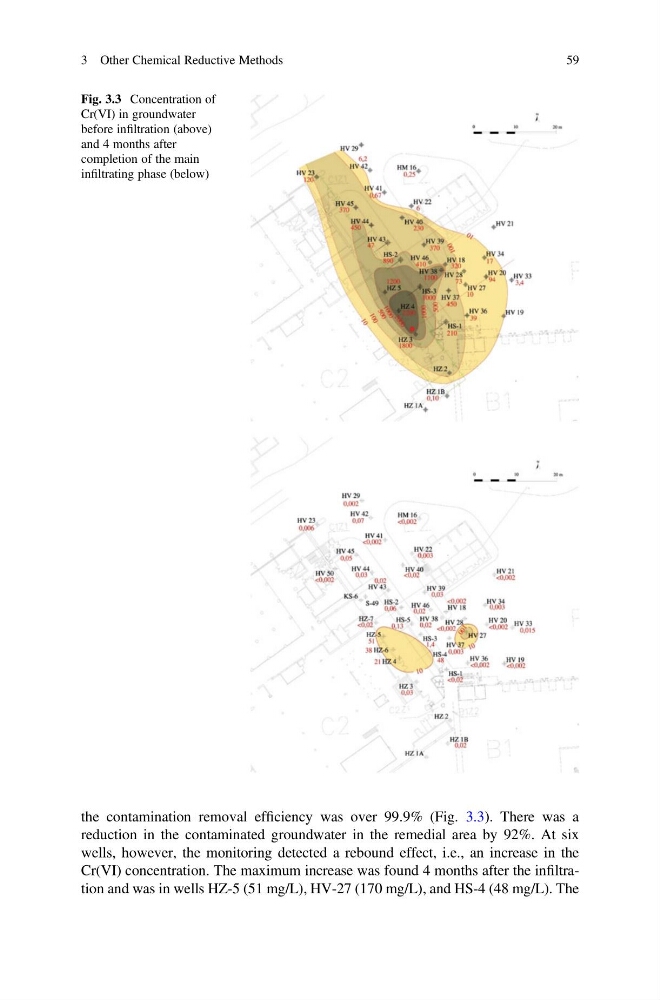
the contamination removal efficiency was over 99.9% (Fig. 3.3). There was a
reduction in the contaminated groundwater in the remedial area by 92%. At six
wells, however, the monitoring detected a rebound effect, i.e., an increase in the
Cr(VI) concentration. The maximum increase was found 4 months after the infiltration and was in wells HZ-5 (51 mg/L), HV-27 (170 mg/L), and HS-4 (48 mg/L). The
Fig. 3.3 Concentration of
Cr(VI) in groundwater
before infiltration (above)
and 4 months after
completion of the main
infiltrating phase (below)
3 Other Chemical Reductive Methods
59
reduction in the contaminated groundwater in the remedial area by 92%. At six
wells, however, the monitoring detected a rebound effect, i.e., an increase in the
Cr(VI) concentration. The maximum increase was found 4 months after the infiltration and was in wells HZ-5 (51 mg/L), HV-27 (170 mg/L), and HS-4 (48 mg/L). The
Fig. 3.3 Concentration of
Cr(VI) in groundwater
before infiltration (above)
and 4 months after
completion of the main
infiltrating phase (below)
3 Other Chemical Reductive Methods
59