

rate. Thus, bimetallic particles have been involved in applications where bare nZVI
usually shows a slow reaction rate, e.g., aromatics and polychlorinated biphenyls
(PCBs) (O’Carroll et al. 2013). The doped metals that are chosen in these systems
have a much higher redox potential (E
0 ) than iron. In that way a galvanic cell is
formed, i.e., iron acts as an anode, and electron release reactions are accelerated, i.e.,
the reduction of pollutants is promoted in a higher rate (Elliott and Zhang 2001).
Moreover, the additive metal can play an important role in prevention of the surface
precipitation of iron oxide products, thus hindering the inhibition of the reactivity of
iron. Thereby, iron particles can be more stable on air while those that have lost their
surface activity by the degradation of toxic contaminants can be reactivated.
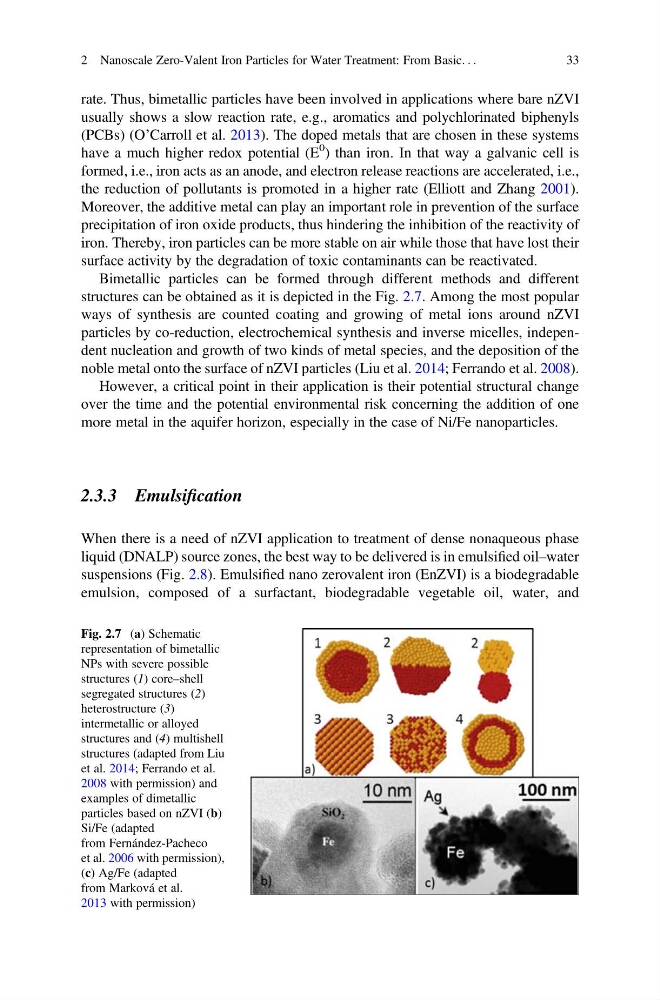
Bimetallic particles can be formed through different methods and different
structures can be obtained as it is depicted in the Fig. 2.7. Among the most popular
ways of synthesis are counted coating and growing of metal ions around nZVI
particles by co-reduction, electrochemical synthesis and inverse micelles, independent nucleation and growth of two kinds of metal species, and the deposition of the
noble metal onto the surface of nZVI particles (Liu et al. 2014; Ferrando et al. 2008).
However, a critical point in their application is their potential structural change
over the time and the potential environmental risk concerning the addition of one
more metal in the aquifer horizon, especially in the case of Ni/Fe nanoparticles.
2.3.3 Emulsification
When there is a need of nZVI application to treatment of dense nonaqueous phase
liquid (DNALP) source zones, the best way to be delivered is in emulsified oil–water
suspensions (Fig. 2.8). Emulsified nano zerovalent iron (EnZVI) is a biodegradable
emulsion, composed of a surfactant, biodegradable vegetable oil, water, and
Fig. 2.7 (a) Schematic
representation of bimetallic
NPs with severe possible
structures (1) core–shell
segregated structures (2)
heterostructure (3)
intermetallic or alloyed
structures and (4) multishell
structures (adapted from Liu
et al. 2014; Ferrando et al.
2008 with permission) and
examples of dimetallic
particles based on nZVI (b)
Si/Fe (adapted
from Fernández-Pacheco
et al. 2006 with permission),
(c) Ag/Fe (adapted
from Marková et al.
2013 with permission)
2 Nanoscale Zero-Valent Iron Particles for Water Treatment: From Basic. . .
33
usually shows a slow reaction rate, e.g., aromatics and polychlorinated biphenyls
(PCBs) (O’Carroll et al. 2013). The doped metals that are chosen in these systems
have a much higher redox potential (E
0 ) than iron. In that way a galvanic cell is
formed, i.e., iron acts as an anode, and electron release reactions are accelerated, i.e.,
the reduction of pollutants is promoted in a higher rate (Elliott and Zhang 2001).
Moreover, the additive metal can play an important role in prevention of the surface
precipitation of iron oxide products, thus hindering the inhibition of the reactivity of
iron. Thereby, iron particles can be more stable on air while those that have lost their
surface activity by the degradation of toxic contaminants can be reactivated.
Bimetallic particles can be formed through different methods and different
structures can be obtained as it is depicted in the Fig. 2.7. Among the most popular
ways of synthesis are counted coating and growing of metal ions around nZVI
particles by co-reduction, electrochemical synthesis and inverse micelles, independent nucleation and growth of two kinds of metal species, and the deposition of the
noble metal onto the surface of nZVI particles (Liu et al. 2014; Ferrando et al. 2008).
However, a critical point in their application is their potential structural change
over the time and the potential environmental risk concerning the addition of one
more metal in the aquifer horizon, especially in the case of Ni/Fe nanoparticles.
2.3.3 Emulsification
When there is a need of nZVI application to treatment of dense nonaqueous phase
liquid (DNALP) source zones, the best way to be delivered is in emulsified oil–water
suspensions (Fig. 2.8). Emulsified nano zerovalent iron (EnZVI) is a biodegradable
emulsion, composed of a surfactant, biodegradable vegetable oil, water, and
Fig. 2.7 (a) Schematic
representation of bimetallic
NPs with severe possible
structures (1) core–shell
segregated structures (2)
heterostructure (3)
intermetallic or alloyed
structures and (4) multishell
structures (adapted from Liu
et al. 2014; Ferrando et al.
2008 with permission) and
examples of dimetallic
particles based on nZVI (b)
Si/Fe (adapted
from Fernández-Pacheco
et al. 2006 with permission),
(c) Ag/Fe (adapted
from Marková et al.
2013 with permission)
2 Nanoscale Zero-Valent Iron Particles for Water Treatment: From Basic. . .
33