

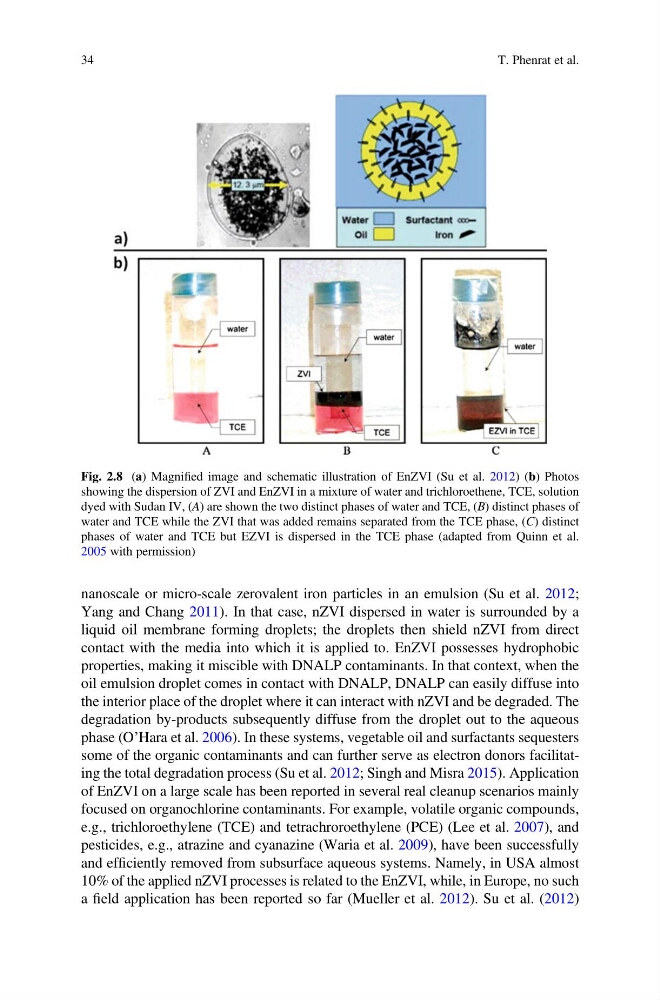
nanoscale or micro-scale zerovalent iron particles in an emulsion (Su et al. 2012;
Yang and Chang 2011). In that case, nZVI dispersed in water is surrounded by a
liquid oil membrane forming droplets; the droplets then shield nZVI from direct
contact with the media into which it is applied to. EnZVI possesses hydrophobic
properties, making it miscible with DNALP contaminants. In that context, when the
oil emulsion droplet comes in contact with DNALP, DNALP can easily diffuse into
the interior place of the droplet where it can interact with nZVI and be degraded. The
degradation by-products subsequently diffuse from the droplet out to the aqueous
phase (O’Hara et al. 2006). In these systems, vegetable oil and surfactants sequesters
some of the organic contaminants and can further serve as electron donors facilitating the total degradation process (Su et al. 2012; Singh and Misra 2015). Application
of EnZVI on a large scale has been reported in several real cleanup scenarios mainly
focused on organochlorine contaminants. For example, volatile organic compounds,
e.g., trichloroethylene (TCE) and tetrachroroethylene (PCE) (Lee et al. 2007), and
pesticides, e.g., atrazine and cyanazine (Waria et al. 2009), have been successfully
and efficiently removed from subsurface aqueous systems. Namely, in USA almost
10% of the applied nZVI processes is related to the EnZVI, while, in Europe, no such
a field application has been reported so far (Mueller et al. 2012). Su et al. (2012)
Fig. 2.8 (a) Magnified image and schematic illustration of EnZVI (Su et al. 2012) (b) Photos
showing the dispersion of ZVI and EnZVI in a mixture of water and trichloroethene, TCE, solution
dyed with Sudan IV, (A) are shown the two distinct phases of water and TCE, (B) distinct phases of
water and TCE while the ZVI that was added remains separated from the TCE phase, (C) distinct
phases of water and TCE but EZVI is dispersed in the TCE phase (adapted from Quinn et al.
2005 with permission)
34
T. Phenrat et al.
Yang and Chang 2011). In that case, nZVI dispersed in water is surrounded by a
liquid oil membrane forming droplets; the droplets then shield nZVI from direct
contact with the media into which it is applied to. EnZVI possesses hydrophobic
properties, making it miscible with DNALP contaminants. In that context, when the
oil emulsion droplet comes in contact with DNALP, DNALP can easily diffuse into
the interior place of the droplet where it can interact with nZVI and be degraded. The
degradation by-products subsequently diffuse from the droplet out to the aqueous
phase (O’Hara et al. 2006). In these systems, vegetable oil and surfactants sequesters
some of the organic contaminants and can further serve as electron donors facilitating the total degradation process (Su et al. 2012; Singh and Misra 2015). Application
of EnZVI on a large scale has been reported in several real cleanup scenarios mainly
focused on organochlorine contaminants. For example, volatile organic compounds,
e.g., trichloroethylene (TCE) and tetrachroroethylene (PCE) (Lee et al. 2007), and
pesticides, e.g., atrazine and cyanazine (Waria et al. 2009), have been successfully
and efficiently removed from subsurface aqueous systems. Namely, in USA almost
10% of the applied nZVI processes is related to the EnZVI, while, in Europe, no such
a field application has been reported so far (Mueller et al. 2012). Su et al. (2012)
Fig. 2.8 (a) Magnified image and schematic illustration of EnZVI (Su et al. 2012) (b) Photos
showing the dispersion of ZVI and EnZVI in a mixture of water and trichloroethene, TCE, solution
dyed with Sudan IV, (A) are shown the two distinct phases of water and TCE, (B) distinct phases of
water and TCE while the ZVI that was added remains separated from the TCE phase, (C) distinct
phases of water and TCE but EZVI is dispersed in the TCE phase (adapted from Quinn et al.
2005 with permission)
34
T. Phenrat et al.