

the appropriate surfactant can dramatically enhance the capacity and the colloidal
stability. The higher efficiency is attributed not only to the lower extent of agglomeration of the iron particles, but also to the increased local concentration and sorption
of the contaminant on the surface of iron (Alessi and Li 2001; Zhang et al. 2002). It
has been reported that even the hydrodynamic diameter of the modified particles was
increased after modification, their colloidal stability was enhanced, and the activation energy in the transformation of toxic compounds was decreased (Li et al. 2006;
Saleh et al. 2005; Lien and Zhang 1999).
2.3.2 Bimetallic Particles
Bimetallic particles of iron with a second less reactive, i.e., usually noble, metal, e.g.,
Pd/Fe, Ni/Fe, Pt/Fe, Ag/Fe, Cu/Fe, have exhibited a significantly high efficacy for
the degradation of many compounds (Chen et al. 2008). The incorporated metal,
even in a small amount, can substantially enhance the overall nZVI reaction rate by
acting as a catalyst for electron transfer and hydrogenation (Li et al. 2006). The
additive metal lowers the activation energy of the reaction and increases the reaction
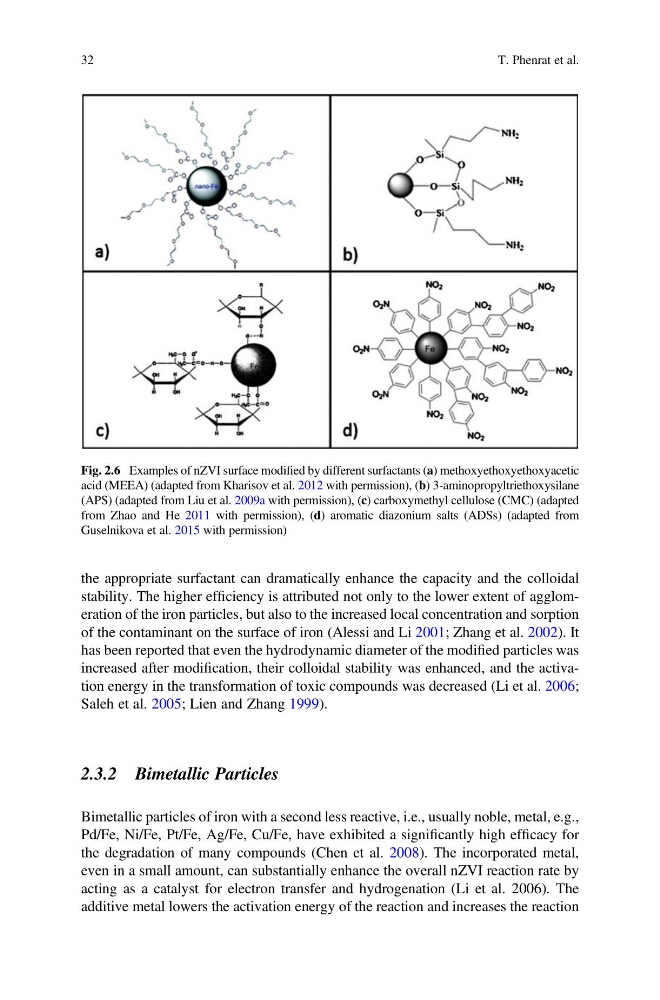
Fig. 2.6 Examples of nZVI surface modified by different surfactants (a) methoxyethoxyethoxyacetic
acid (MEEA) (adapted from Kharisov et al. 2012 with permission), (b) 3-aminopropyltriethoxysilane
(APS) (adapted from Liu et al. 2009a with permission), (c) carboxymethyl cellulose (CMC) (adapted
from Zhao and He 2011 with permission), (d) aromatic diazonium salts (ADSs) (adapted from
Guselnikova et al. 2015 with permission)
32
T. Phenrat et al.
stability. The higher efficiency is attributed not only to the lower extent of agglomeration of the iron particles, but also to the increased local concentration and sorption
of the contaminant on the surface of iron (Alessi and Li 2001; Zhang et al. 2002). It
has been reported that even the hydrodynamic diameter of the modified particles was
increased after modification, their colloidal stability was enhanced, and the activation energy in the transformation of toxic compounds was decreased (Li et al. 2006;
Saleh et al. 2005; Lien and Zhang 1999).
2.3.2 Bimetallic Particles
Bimetallic particles of iron with a second less reactive, i.e., usually noble, metal, e.g.,
Pd/Fe, Ni/Fe, Pt/Fe, Ag/Fe, Cu/Fe, have exhibited a significantly high efficacy for
the degradation of many compounds (Chen et al. 2008). The incorporated metal,
even in a small amount, can substantially enhance the overall nZVI reaction rate by
acting as a catalyst for electron transfer and hydrogenation (Li et al. 2006). The
additive metal lowers the activation energy of the reaction and increases the reaction
Fig. 2.6 Examples of nZVI surface modified by different surfactants (a) methoxyethoxyethoxyacetic
acid (MEEA) (adapted from Kharisov et al. 2012 with permission), (b) 3-aminopropyltriethoxysilane
(APS) (adapted from Liu et al. 2009a with permission), (c) carboxymethyl cellulose (CMC) (adapted
from Zhao and He 2011 with permission), (d) aromatic diazonium salts (ADSs) (adapted from
Guselnikova et al. 2015 with permission)
32
T. Phenrat et al.