

and improved mobility, is deemed necessary. In the past few years, different
approaches and a large number of research works have led to a new field of
modification of nZVI particles. Therefore, new various methods have been developed in order to synthesize more active (Wu and Ritchie 2006), stable (Sun et al.
2007; Siskova et al. 2012), and mobile nZVI particles (Tiraferri et al. 2008; Kim
et al. 2009) to simplify the synthetic procedure; reduce the cost; and finally enhance
the efficacy (Zhang et al. 2012; Alessi and Li 2001), availability, and applicability to
large-scale (Chen et al. 2012) and delivery capabilities (Kanel and Choi 2007).
Surface modification by electrostatic and steric stabilization, such as coating with
polyelectrolytes or nonionic surfactants (Alessi and Li 2001), dispersing the particles
in oil–water emulsions (Quinn et al. 2005), use of a support material for their
synthesis (Wu et al. 2012; Ponder et al. 2001) and bimetallic particles with iron
and a second less reactive metal, are strategies that have been investigated thoroughly. These methods have proved that it is possible to overcome the magnetic
attraction between the iron nanoparticles, change the surface or interfacial properties,
increase mobility and stability, minimize aggregation, and significantly increase the
reactivity.
2.3.1 Electrostatic and Steric Stabilization
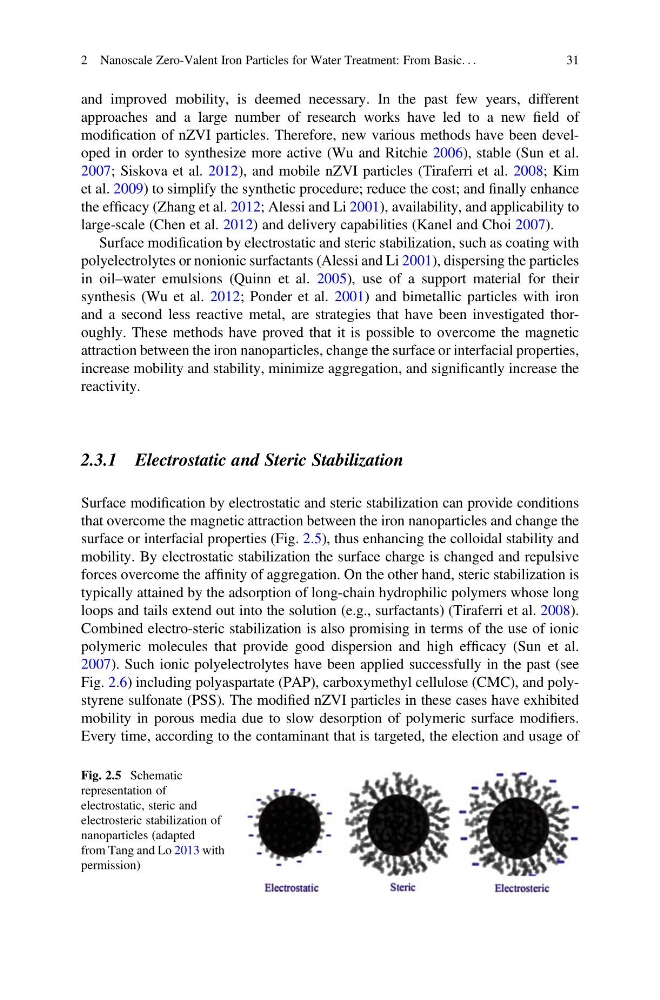
Surface modification by electrostatic and steric stabilization can provide conditions
that overcome the magnetic attraction between the iron nanoparticles and change the
surface or interfacial properties (Fig. 2.5), thus enhancing the colloidal stability and
mobility. By electrostatic stabilization the surface charge is changed and repulsive
forces overcome the affinity of aggregation. On the other hand, steric stabilization is
typically attained by the adsorption of long-chain hydrophilic polymers whose long
loops and tails extend out into the solution (e.g., surfactants) (Tiraferri et al. 2008).
Combined electro-steric stabilization is also promising in terms of the use of ionic
polymeric molecules that provide good dispersion and high efficacy (Sun et al.
2007). Such ionic polyelectrolytes have been applied successfully in the past (see
Fig. 2.6) including polyaspartate (PAP), carboxymethyl cellulose (CMC), and polystyrene sulfonate (PSS). The modified nZVI particles in these cases have exhibited
mobility in porous media due to slow desorption of polymeric surface modifiers.
Every time, according to the contaminant that is targeted, the election and usage of
Fig. 2.5 Schematic
representation of
electrostatic, steric and
electrosteric stabilization of
nanoparticles (adapted
from Tang and Lo 2013 with
permission)
2 Nanoscale Zero-Valent Iron Particles for Water Treatment: From Basic. . .
31
approaches and a large number of research works have led to a new field of
modification of nZVI particles. Therefore, new various methods have been developed in order to synthesize more active (Wu and Ritchie 2006), stable (Sun et al.
2007; Siskova et al. 2012), and mobile nZVI particles (Tiraferri et al. 2008; Kim
et al. 2009) to simplify the synthetic procedure; reduce the cost; and finally enhance
the efficacy (Zhang et al. 2012; Alessi and Li 2001), availability, and applicability to
large-scale (Chen et al. 2012) and delivery capabilities (Kanel and Choi 2007).
Surface modification by electrostatic and steric stabilization, such as coating with
polyelectrolytes or nonionic surfactants (Alessi and Li 2001), dispersing the particles
in oil–water emulsions (Quinn et al. 2005), use of a support material for their
synthesis (Wu et al. 2012; Ponder et al. 2001) and bimetallic particles with iron
and a second less reactive metal, are strategies that have been investigated thoroughly. These methods have proved that it is possible to overcome the magnetic
attraction between the iron nanoparticles, change the surface or interfacial properties,
increase mobility and stability, minimize aggregation, and significantly increase the
reactivity.
2.3.1 Electrostatic and Steric Stabilization
Surface modification by electrostatic and steric stabilization can provide conditions
that overcome the magnetic attraction between the iron nanoparticles and change the
surface or interfacial properties (Fig. 2.5), thus enhancing the colloidal stability and
mobility. By electrostatic stabilization the surface charge is changed and repulsive
forces overcome the affinity of aggregation. On the other hand, steric stabilization is
typically attained by the adsorption of long-chain hydrophilic polymers whose long
loops and tails extend out into the solution (e.g., surfactants) (Tiraferri et al. 2008).
Combined electro-steric stabilization is also promising in terms of the use of ionic
polymeric molecules that provide good dispersion and high efficacy (Sun et al.
2007). Such ionic polyelectrolytes have been applied successfully in the past (see
Fig. 2.6) including polyaspartate (PAP), carboxymethyl cellulose (CMC), and polystyrene sulfonate (PSS). The modified nZVI particles in these cases have exhibited
mobility in porous media due to slow desorption of polymeric surface modifiers.
Every time, according to the contaminant that is targeted, the election and usage of
Fig. 2.5 Schematic
representation of
electrostatic, steric and
electrosteric stabilization of
nanoparticles (adapted
from Tang and Lo 2013 with
permission)
2 Nanoscale Zero-Valent Iron Particles for Water Treatment: From Basic. . .
31