

second pile, called “biostimulation”, was enhanced by using an organic substrate
(50% vol. of camel dung) to improve the material characterization and addition of
the nutrients.
The intensive soil aeration, to ensure aerobic conditions in the whole volume of
the contaminated material, was performed by front loaders that moved the soil from
one place to another once a month.
The freeze-dried BIOTECH mixture was used as an inoculum for cultivation in
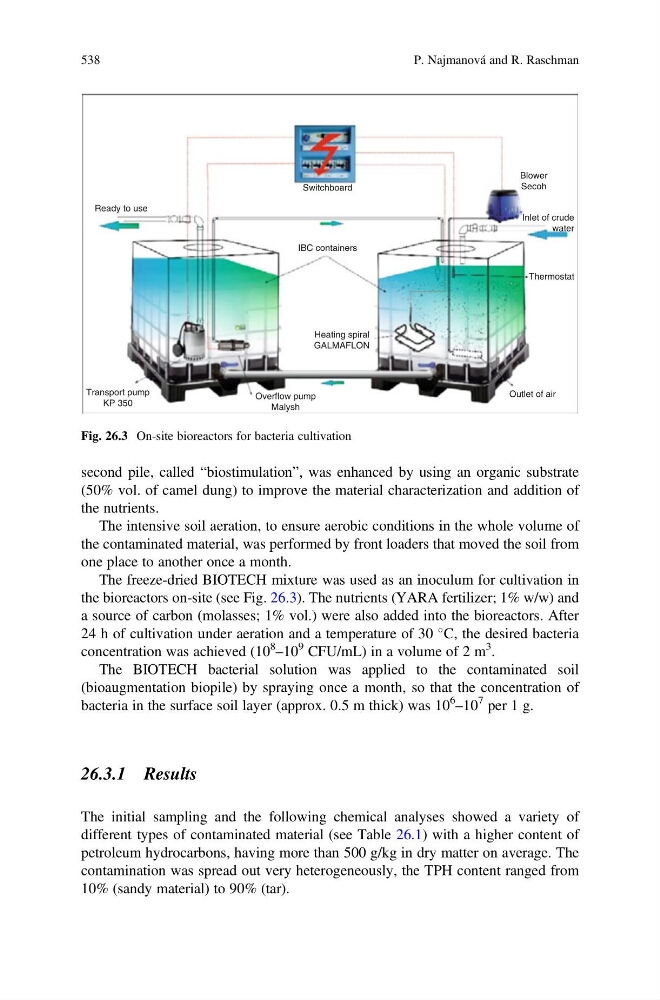
the bioreactors on-site (see Fig. 26.3). The nutrients (YARA fertilizer; 1% w/w) and
a source of carbon (molasses; 1% vol.) were also added into the bioreactors. After
24 h of cultivation under aeration and a temperature of 30
C, the desired bacteria
concentration was achieved (10
8
–10
9 CFU/mL) in a volume of 2 m
3 .
The BIOTECH bacterial solution was applied to the contaminated soil
(bioaugmentation biopile) by spraying once a month, so that the concentration of
bacteria in the surface soil layer (approx. 0.5 m thick) was 10
6
–10
7 per 1 g.
26.3.1 Results
The initial sampling and the following chemical analyses showed a variety of
different types of contaminated material (see Table 26.1) with a higher content of
petroleum hydrocarbons, having more than 500 g/kg in dry matter on average. The
contamination was spread out very heterogeneously, the TPH content ranged from
10% (sandy material) to 90% (tar).
Blower
Secoh
Inlet of crude
water
Thermostat
Outlet of air
Heating spiral
GALMAFLON
Overflow pump
Malysh
Transport pump
KP 350
Ready to use
IBC containers
Switchboard
Fig. 26.3 On-site bioreactors for bacteria cultivation
538
P. Najmanová and R. Raschman
(50% vol. of camel dung) to improve the material characterization and addition of
the nutrients.
The intensive soil aeration, to ensure aerobic conditions in the whole volume of
the contaminated material, was performed by front loaders that moved the soil from
one place to another once a month.
The freeze-dried BIOTECH mixture was used as an inoculum for cultivation in
the bioreactors on-site (see Fig. 26.3). The nutrients (YARA fertilizer; 1% w/w) and
a source of carbon (molasses; 1% vol.) were also added into the bioreactors. After
24 h of cultivation under aeration and a temperature of 30
C, the desired bacteria
concentration was achieved (10
8
–10
9 CFU/mL) in a volume of 2 m
3 .
The BIOTECH bacterial solution was applied to the contaminated soil
(bioaugmentation biopile) by spraying once a month, so that the concentration of
bacteria in the surface soil layer (approx. 0.5 m thick) was 10
6
–10
7 per 1 g.
26.3.1 Results
The initial sampling and the following chemical analyses showed a variety of
different types of contaminated material (see Table 26.1) with a higher content of
petroleum hydrocarbons, having more than 500 g/kg in dry matter on average. The
contamination was spread out very heterogeneously, the TPH content ranged from
10% (sandy material) to 90% (tar).
Blower
Secoh
Inlet of crude
water
Thermostat
Outlet of air
Heating spiral
GALMAFLON
Overflow pump
Malysh
Transport pump
KP 350
Ready to use
IBC containers
Switchboard
Fig. 26.3 On-site bioreactors for bacteria cultivation
538
P. Najmanová and R. Raschman