

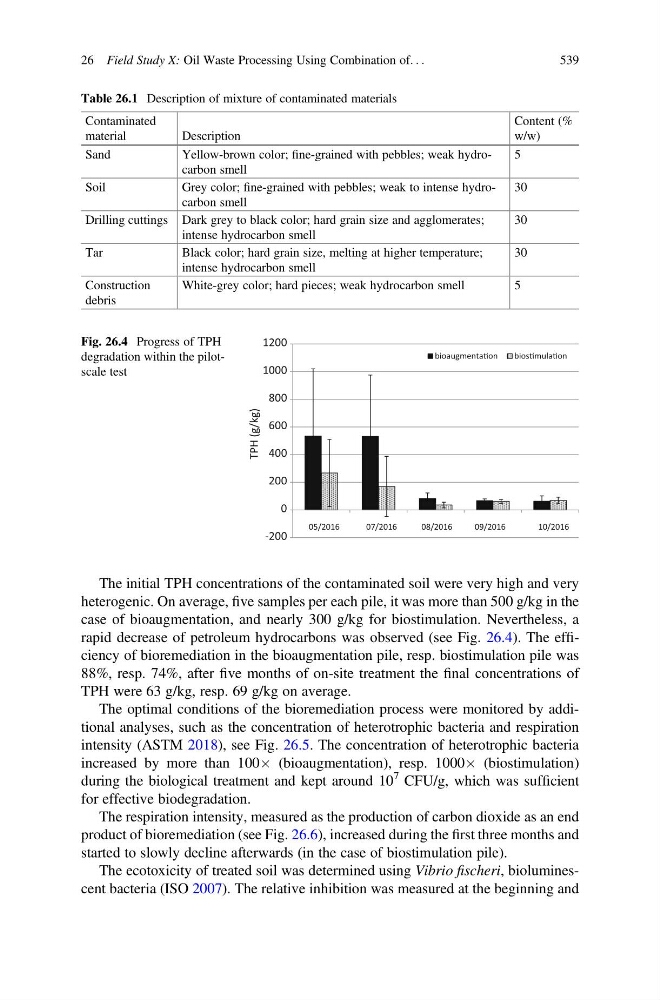
The initial TPH concentrations of the contaminated soil were very high and very
heterogenic. On average, five samples per each pile, it was more than 500 g/kg in the
case of bioaugmentation, and nearly 300 g/kg for biostimulation. Nevertheless, a
rapid decrease of petroleum hydrocarbons was observed (see Fig. 26.4). The efficiency of bioremediation in the bioaugmentation pile, resp. biostimulation pile was
88%, resp. 74%, after five months of on-site treatment the final concentrations of
TPH were 63 g/kg, resp. 69 g/kg on average.
The optimal conditions of the bioremediation process were monitored by additional analyses, such as the concentration of heterotrophic bacteria and respiration
intensity (ASTM 2018), see Fig. 26.5. The concentration of heterotrophic bacteria
increased by more than 100Â (bioaugmentation), resp. 1000Â (biostimulation)
during the biological treatment and kept around 10
7 CFU/g, which was sufficient
for effective biodegradation.
The respiration intensity, measured as the production of carbon dioxide as an end
product of bioremediation (see Fig. 26.6), increased during the first three months and
started to slowly decline afterwards (in the case of biostimulation pile).
The ecotoxicity of treated soil was determined using Vibrio fischeri, bioluminescent bacteria (ISO 2007). The relative inhibition was measured at the beginning and
Table 26.1 Description of mixture of contaminated materials
Contaminated
material
Description
Content (%
w/w)
Sand
Yellow-brown color; fine-grained with pebbles; weak hydrocarbon smell
5
Soil
Grey color; fine-grained with pebbles; weak to intense hydrocarbon smell
30
Drilling cuttings Dark grey to black color; hard grain size and agglomerates;
intense hydrocarbon smell
30
Tar
Black color; hard grain size, melting at higher temperature;
intense hydrocarbon smell
30
Construction
debris
White-grey color; hard pieces; weak hydrocarbon smell
5
-200
0
200
400
600
800
1000
1200
05/2016
07/2016
08/2016
09/2016
10/2016
TPH (g/kg)
bioaugmentaƟon
biosƟmulaƟon
Fig. 26.4 Progress of TPH
degradation within the pilotscale test
26 Field Study X: Oil Waste Processing Using Combination of. . .
539
heterogenic. On average, five samples per each pile, it was more than 500 g/kg in the
case of bioaugmentation, and nearly 300 g/kg for biostimulation. Nevertheless, a
rapid decrease of petroleum hydrocarbons was observed (see Fig. 26.4). The efficiency of bioremediation in the bioaugmentation pile, resp. biostimulation pile was
88%, resp. 74%, after five months of on-site treatment the final concentrations of
TPH were 63 g/kg, resp. 69 g/kg on average.
The optimal conditions of the bioremediation process were monitored by additional analyses, such as the concentration of heterotrophic bacteria and respiration
intensity (ASTM 2018), see Fig. 26.5. The concentration of heterotrophic bacteria
increased by more than 100Â (bioaugmentation), resp. 1000Â (biostimulation)
during the biological treatment and kept around 10
7 CFU/g, which was sufficient
for effective biodegradation.
The respiration intensity, measured as the production of carbon dioxide as an end
product of bioremediation (see Fig. 26.6), increased during the first three months and
started to slowly decline afterwards (in the case of biostimulation pile).
The ecotoxicity of treated soil was determined using Vibrio fischeri, bioluminescent bacteria (ISO 2007). The relative inhibition was measured at the beginning and
Table 26.1 Description of mixture of contaminated materials
Contaminated
material
Description
Content (%
w/w)
Sand
Yellow-brown color; fine-grained with pebbles; weak hydrocarbon smell
5
Soil
Grey color; fine-grained with pebbles; weak to intense hydrocarbon smell
30
Drilling cuttings Dark grey to black color; hard grain size and agglomerates;
intense hydrocarbon smell
30
Tar
Black color; hard grain size, melting at higher temperature;
intense hydrocarbon smell
30
Construction
debris
White-grey color; hard pieces; weak hydrocarbon smell
5
-200
0
200
400
600
800
1000
1200
05/2016
07/2016
08/2016
09/2016
10/2016
TPH (g/kg)
bioaugmentaƟon
biosƟmulaƟon
Fig. 26.4 Progress of TPH
degradation within the pilotscale test
26 Field Study X: Oil Waste Processing Using Combination of. . .
539