

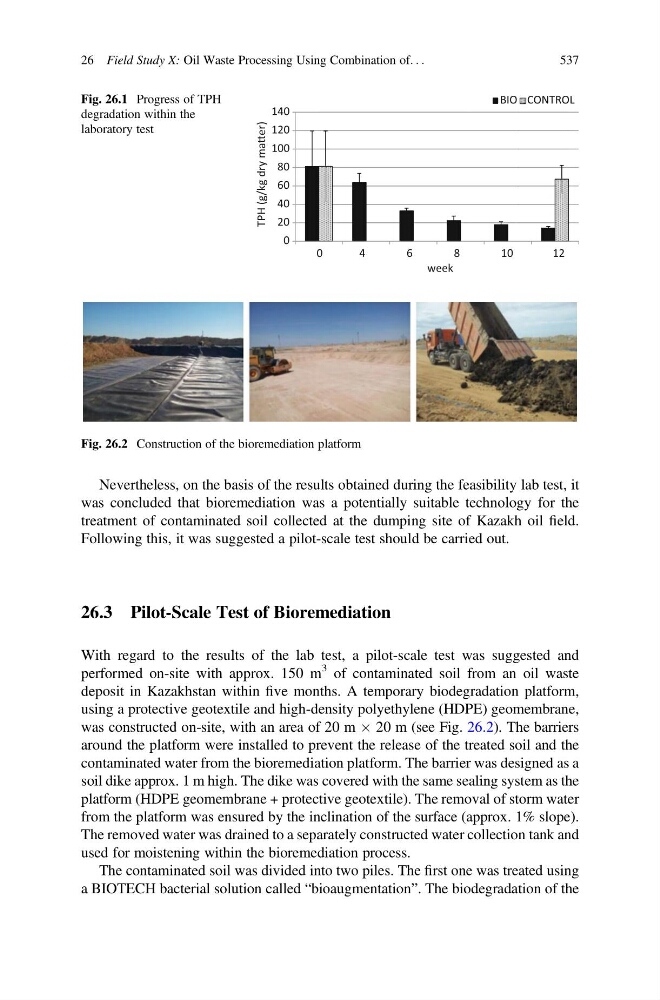
Nevertheless, on the basis of the results obtained during the feasibility lab test, it
was concluded that bioremediation was a potentially suitable technology for the
treatment of contaminated soil collected at the dumping site of Kazakh oil field.
Following this, it was suggested a pilot-scale test should be carried out.
26.3 Pilot-Scale Test of Bioremediation
With regard to the results of the lab test, a pilot-scale test was suggested and
performed on-site with approx. 150 m
3 of contaminated soil from an oil waste
deposit in Kazakhstan within five months. A temporary biodegradation platform,
using a protective geotextile and high-density polyethylene (HDPE) geomembrane,
was constructed on-site, with an area of 20 m  20 m (see Fig. 26.2). The barriers
around the platform were installed to prevent the release of the treated soil and the
contaminated water from the bioremediation platform. The barrier was designed as a
soil dike approx. 1 m high. The dike was covered with the same sealing system as the
platform (HDPE geomembrane + protective geotextile). The removal of storm water
from the platform was ensured by the inclination of the surface (approx. 1% slope).
The removed water was drained to a separately constructed water collection tank and
used for moistening within the bioremediation process.
The contaminated soil was divided into two piles. The first one was treated using
a BIOTECH bacterial solution called “bioaugmentation”. The biodegradation of the
0
20
40
60
80
100
120
140
0
4
6
8
10
12
TPH (g/kg dry maƩer)
week
BIO
BIO CONTROL
Fig. 26.1 Progress of TPH
degradation within the
laboratory test
Fig. 26.2 Construction of the bioremediation platform
26 Field Study X: Oil Waste Processing Using Combination of. . .
537
was concluded that bioremediation was a potentially suitable technology for the
treatment of contaminated soil collected at the dumping site of Kazakh oil field.
Following this, it was suggested a pilot-scale test should be carried out.
26.3 Pilot-Scale Test of Bioremediation
With regard to the results of the lab test, a pilot-scale test was suggested and
performed on-site with approx. 150 m
3 of contaminated soil from an oil waste
deposit in Kazakhstan within five months. A temporary biodegradation platform,
using a protective geotextile and high-density polyethylene (HDPE) geomembrane,
was constructed on-site, with an area of 20 m  20 m (see Fig. 26.2). The barriers
around the platform were installed to prevent the release of the treated soil and the
contaminated water from the bioremediation platform. The barrier was designed as a
soil dike approx. 1 m high. The dike was covered with the same sealing system as the
platform (HDPE geomembrane + protective geotextile). The removal of storm water
from the platform was ensured by the inclination of the surface (approx. 1% slope).
The removed water was drained to a separately constructed water collection tank and
used for moistening within the bioremediation process.
The contaminated soil was divided into two piles. The first one was treated using
a BIOTECH bacterial solution called “bioaugmentation”. The biodegradation of the
0
20
40
60
80
100
120
140
0
4
6
8
10
12
TPH (g/kg dry maƩer)
week
BIO
BIO CONTROL
Fig. 26.1 Progress of TPH
degradation within the
laboratory test
Fig. 26.2 Construction of the bioremediation platform
26 Field Study X: Oil Waste Processing Using Combination of. . .
537