

and compost-derived bioaerosols is still subject to discussion (Manderson 2009;
Wéry 2014; De Gannes et al. 2013a, b; Briones 2014).
The thermophilic phase corresponds to the peak of fresh organic matter decomposition, i.e., the highest utilization of water-soluble substrates readily utilizable by
bacteria. At the same time, however, the thermophilic conditions foster the degradation of water-insoluble polymeric structures (cellulose, hemicellulose, and lignin),
proteinaceous substrates, and fats (Fig. 23.3) that were not a form of accessible
nourishment in the previous stage. This process is aided by extracellular hydrolytic
enzymes produced by specific microorganisms that can attack large molecules and
polymeric structures yielding breakdown substrates beneficial to other microorganisms (Gajalakshmi and Abbasi 2008; Manderson 2009). According to Tuomela et al.
(2000), lignin degradation also starts under thermophilic conditions. Indeed, the
optimum temperature for thermophilic microfungi and actinomycetes that mainly
degrade lignin is 40–50
C (Hellmann et al. 1997).
Biomolecules less amenable to microbial activity become relatively enriched in
the compost mix at this stage and their degradation or biotransformation is a much
slower process compared to the assimilation of water-soluble nourishments
(Fig. 23.3).
In addition, the active decomposers able to withstand thermophilic conditions
represent a minor fraction of the overall compost cenosis; consequently, the microbial activity decreases, and the temperature drops to the mesophilic conditions of the
cooling phase (Fig. 23.1). The latter phase is a transient period occurring between
active composting phases (i.e., early mesophilic and thermophilic stages) and the
maturation (or curing) phase, which starts when the temperature of the compost
substrate falls to that of ambient air (Gajalakshmi and Abbasi 2008; Manderson
2009). During the cooling and maturation phase, mesophilic microorganisms
recolonize the compost heap, and the humification process reaches its maximum.
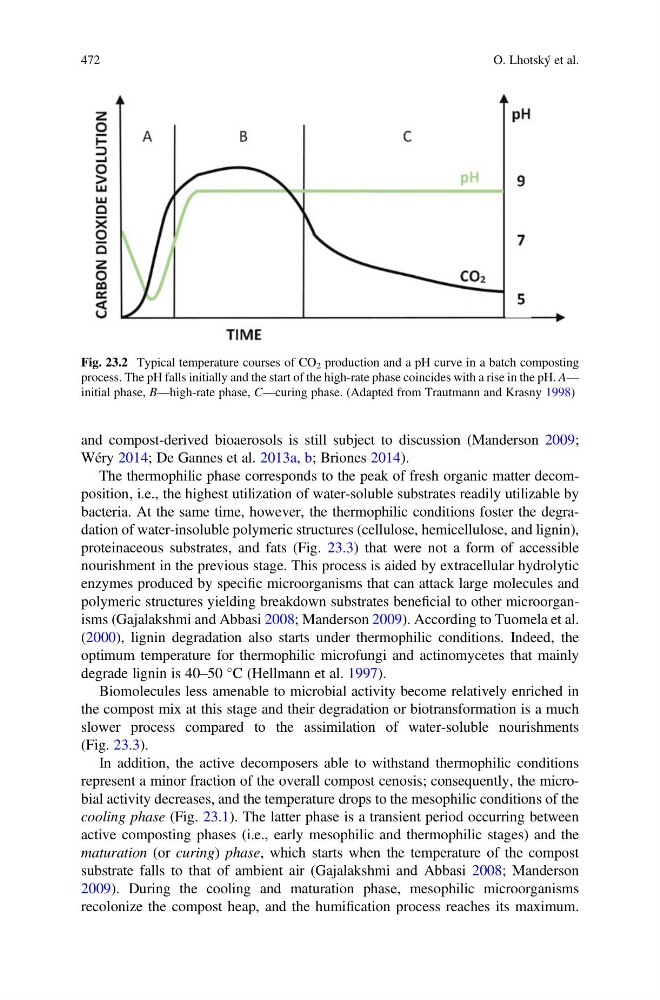
Fig. 23.2 Typical temperature courses of CO 2 production and a pH curve in a batch composting
process. The pH falls initially and the start of the high-rate phase coincides with a rise in the pH. A—
initial phase, B—high-rate phase, C—curing phase. (Adapted from Trautmann and Krasny 1998)
472
O. Lhotský et al.
Wéry 2014; De Gannes et al. 2013a, b; Briones 2014).
The thermophilic phase corresponds to the peak of fresh organic matter decomposition, i.e., the highest utilization of water-soluble substrates readily utilizable by
bacteria. At the same time, however, the thermophilic conditions foster the degradation of water-insoluble polymeric structures (cellulose, hemicellulose, and lignin),
proteinaceous substrates, and fats (Fig. 23.3) that were not a form of accessible
nourishment in the previous stage. This process is aided by extracellular hydrolytic
enzymes produced by specific microorganisms that can attack large molecules and
polymeric structures yielding breakdown substrates beneficial to other microorganisms (Gajalakshmi and Abbasi 2008; Manderson 2009). According to Tuomela et al.
(2000), lignin degradation also starts under thermophilic conditions. Indeed, the
optimum temperature for thermophilic microfungi and actinomycetes that mainly
degrade lignin is 40–50
C (Hellmann et al. 1997).
Biomolecules less amenable to microbial activity become relatively enriched in
the compost mix at this stage and their degradation or biotransformation is a much
slower process compared to the assimilation of water-soluble nourishments
(Fig. 23.3).
In addition, the active decomposers able to withstand thermophilic conditions
represent a minor fraction of the overall compost cenosis; consequently, the microbial activity decreases, and the temperature drops to the mesophilic conditions of the
cooling phase (Fig. 23.1). The latter phase is a transient period occurring between
active composting phases (i.e., early mesophilic and thermophilic stages) and the
maturation (or curing) phase, which starts when the temperature of the compost
substrate falls to that of ambient air (Gajalakshmi and Abbasi 2008; Manderson
2009). During the cooling and maturation phase, mesophilic microorganisms
recolonize the compost heap, and the humification process reaches its maximum.
Fig. 23.2 Typical temperature courses of CO 2 production and a pH curve in a batch composting
process. The pH falls initially and the start of the high-rate phase coincides with a rise in the pH. A—
initial phase, B—high-rate phase, C—curing phase. (Adapted from Trautmann and Krasny 1998)
472
O. Lhotský et al.