

of iron filings has been used as a reducing agent to build permeable reactive barriers
(PRB) since 1994 (Reynolds et al. 1990; Gillham and O’Hannesin 1994).
The fundamental chemistry of ZVI in an aqueous environment from a reaction
viewpoint is summarized in Eqs. (2.1–2.3). For environmental remediation purposes, Fe
0 can be oxidized by contaminants of concerns (COCs) (such as
trichloroethene—TCE) in Eq. (2.1)) (as electron acceptors) as long as COCs have
an E H
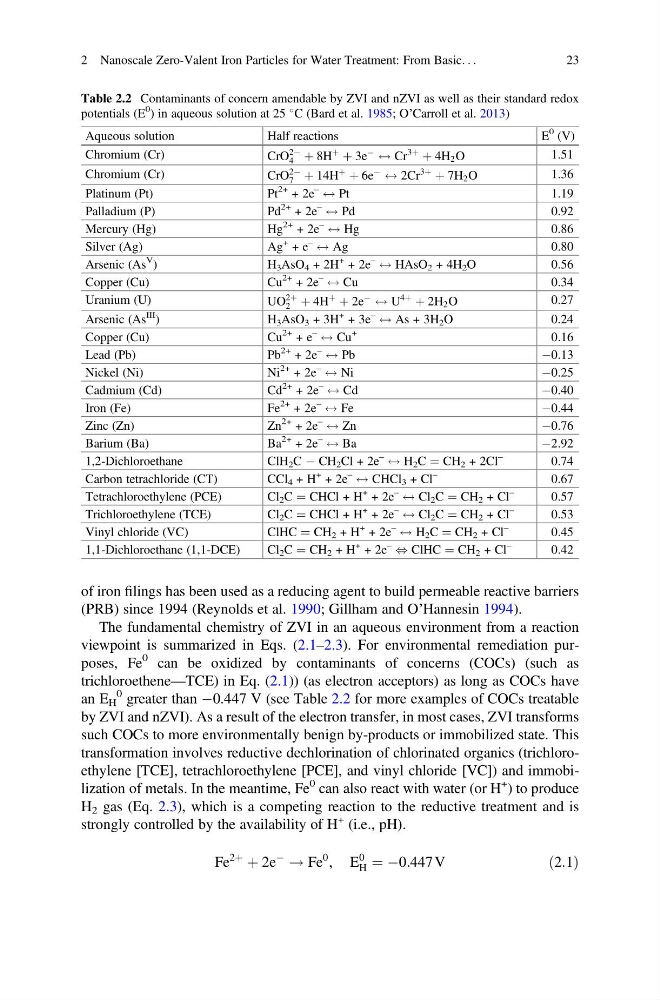
0 greater than À0.447 V (see Table 2.2 for more examples of COCs treatable
by ZVI and nZVI). As a result of the electron transfer, in most cases, ZVI transforms
such COCs to more environmentally benign by-products or immobilized state. This
transformation involves reductive dechlorination of chlorinated organics (trichloroethylene [TCE], tetrachloroethylene [PCE], and vinyl chloride [VC]) and immobilization of metals. In the meantime, Fe
0 can also react with water (or H
+
) to produce
H 2 gas (Eq. 2.3), which is a competing reaction to the reductive treatment and is
strongly controlled by the availability of H
+ (i.e., pH).
Fe
2þ
þ 2e
À
! Fe
0 , E
0
H ¼ À0:447 V
ð2:1Þ
Table 2.2 Contaminants of concern amendable by ZVI and nZVI as well as their standard redox
potentials (E
0
) in aqueous solution at 25
C (Bard et al. 1985; O’Carroll et al. 2013)
Aqueous solution
Half reactions
E
0 (V)
Chromium (Cr)
CrO
2À
4 þ 8H
þ þ 3e
À $ Cr
3þ þ 4H 2 O
1.51
Chromium (Cr)
CrO
2À
7 þ 14H
þ þ 6e
À $ 2Cr
3þ þ 7H 2 O
1.36
Platinum (Pt)
Pt
2+ + 2e
– $ Pt
1.19
Palladium (P)
Pd
2+ + 2e
– $ Pd
0.92
Mercury (Hg)
Hg
2+ + 2e
– $ Hg
0.86
Silver (Ag)
Ag
+ + e
– $ Ag
0.80
Arsenic (As
V )
H 3 AsO 4 + 2H
+ + 2e
– $ HAsO 2 + 4H 2 O
0.56
Copper (Cu)
Cu
2+ + 2e
– $ Cu
0.34
Uranium (U)
UO
2þ
2 þ 4H
þ þ 2e
À $ U
4þ þ 2H 2 O
0.27
Arsenic (As
III )
H 3 AsO 3 + 3H
+ + 3e
– $ As + 3H 2 O
0.24
Copper (Cu)
Cu
2+ + e
– $ Cu
+
0.16
Lead (Pb)
Pb
2+ + 2e
– $ Pb
À0.13
Nickel (Ni)
Ni
2+ + 2e
– $ Ni
À0.25
Cadmium (Cd)
Cd
2+ + 2e
– $ Cd
À0.40
Iron (Fe)
Fe
2+ + 2e
– $ Fe
À0.44
Zinc (Zn)
Zn
2+ + 2e
– $ Zn
À0.76
Barium (Ba)
Ba
2+ + 2e
– $ Ba
À2.92
1,2-Dichloroethane
ClH 2 C À CH 2 Cl + 2e
– $ H 2 C ¼ CH 2 + 2Cl
–
0.74
Carbon tetrachloride (CT)
CCl 4 + H
+ + 2e
– $ CHCl 3 + Cl
–
0.67
Tetrachloroethylene (PCE)
Cl 2 C ¼ CHCl + H
+ + 2e
– $ Cl 2 C ¼ CH 2 + Cl
–
0.57
Trichloroethylene (TCE)
Cl 2 C ¼ CHCl + H
+ + 2e
– $ Cl 2 C ¼ CH 2 + Cl
–
0.53
Vinyl chloride (VC)
ClHC ¼ CH 2 + H
+ + 2e
– $ H 2 C ¼ CH 2 + Cl
–
0.45
1,1-Dichloroethane (1,1-DCE)
Cl 2 C ¼ CH 2 + H
+ + 2e
– , ClHC ¼ CH 2 + Cl
–
0.42
2 Nanoscale Zero-Valent Iron Particles for Water Treatment: From Basic. . .
23
(PRB) since 1994 (Reynolds et al. 1990; Gillham and O’Hannesin 1994).
The fundamental chemistry of ZVI in an aqueous environment from a reaction
viewpoint is summarized in Eqs. (2.1–2.3). For environmental remediation purposes, Fe
0 can be oxidized by contaminants of concerns (COCs) (such as
trichloroethene—TCE) in Eq. (2.1)) (as electron acceptors) as long as COCs have
an E H
0 greater than À0.447 V (see Table 2.2 for more examples of COCs treatable
by ZVI and nZVI). As a result of the electron transfer, in most cases, ZVI transforms
such COCs to more environmentally benign by-products or immobilized state. This
transformation involves reductive dechlorination of chlorinated organics (trichloroethylene [TCE], tetrachloroethylene [PCE], and vinyl chloride [VC]) and immobilization of metals. In the meantime, Fe
0 can also react with water (or H
+
) to produce
H 2 gas (Eq. 2.3), which is a competing reaction to the reductive treatment and is
strongly controlled by the availability of H
+ (i.e., pH).
Fe
2þ
þ 2e
À
! Fe
0 , E
0
H ¼ À0:447 V
ð2:1Þ
Table 2.2 Contaminants of concern amendable by ZVI and nZVI as well as their standard redox
potentials (E
0
) in aqueous solution at 25
C (Bard et al. 1985; O’Carroll et al. 2013)
Aqueous solution
Half reactions
E
0 (V)
Chromium (Cr)
CrO
2À
4 þ 8H
þ þ 3e
À $ Cr
3þ þ 4H 2 O
1.51
Chromium (Cr)
CrO
2À
7 þ 14H
þ þ 6e
À $ 2Cr
3þ þ 7H 2 O
1.36
Platinum (Pt)
Pt
2+ + 2e
– $ Pt
1.19
Palladium (P)
Pd
2+ + 2e
– $ Pd
0.92
Mercury (Hg)
Hg
2+ + 2e
– $ Hg
0.86
Silver (Ag)
Ag
+ + e
– $ Ag
0.80
Arsenic (As
V )
H 3 AsO 4 + 2H
+ + 2e
– $ HAsO 2 + 4H 2 O
0.56
Copper (Cu)
Cu
2+ + 2e
– $ Cu
0.34
Uranium (U)
UO
2þ
2 þ 4H
þ þ 2e
À $ U
4þ þ 2H 2 O
0.27
Arsenic (As
III )
H 3 AsO 3 + 3H
+ + 3e
– $ As + 3H 2 O
0.24
Copper (Cu)
Cu
2+ + e
– $ Cu
+
0.16
Lead (Pb)
Pb
2+ + 2e
– $ Pb
À0.13
Nickel (Ni)
Ni
2+ + 2e
– $ Ni
À0.25
Cadmium (Cd)
Cd
2+ + 2e
– $ Cd
À0.40
Iron (Fe)
Fe
2+ + 2e
– $ Fe
À0.44
Zinc (Zn)
Zn
2+ + 2e
– $ Zn
À0.76
Barium (Ba)
Ba
2+ + 2e
– $ Ba
À2.92
1,2-Dichloroethane
ClH 2 C À CH 2 Cl + 2e
– $ H 2 C ¼ CH 2 + 2Cl
–
0.74
Carbon tetrachloride (CT)
CCl 4 + H
+ + 2e
– $ CHCl 3 + Cl
–
0.67
Tetrachloroethylene (PCE)
Cl 2 C ¼ CHCl + H
+ + 2e
– $ Cl 2 C ¼ CH 2 + Cl
–
0.57
Trichloroethylene (TCE)
Cl 2 C ¼ CHCl + H
+ + 2e
– $ Cl 2 C ¼ CH 2 + Cl
–
0.53
Vinyl chloride (VC)
ClHC ¼ CH 2 + H
+ + 2e
– $ H 2 C ¼ CH 2 + Cl
–
0.45
1,1-Dichloroethane (1,1-DCE)
Cl 2 C ¼ CH 2 + H
+ + 2e
– , ClHC ¼ CH 2 + Cl
–
0.42
2 Nanoscale Zero-Valent Iron Particles for Water Treatment: From Basic. . .
23