

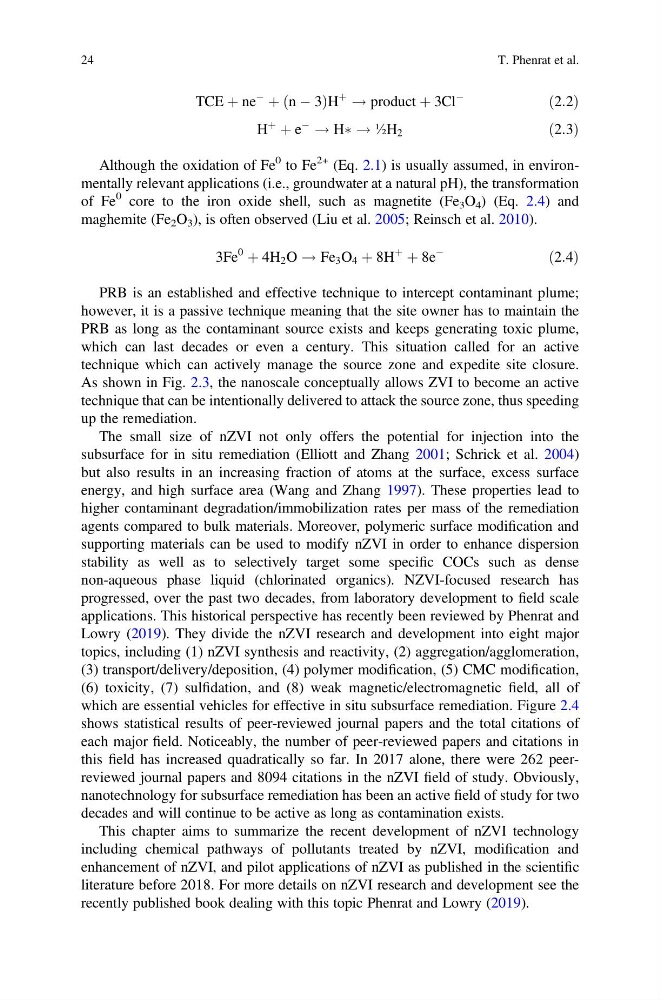
TCE þ ne
À
þ n À 3
ð
ÞH
þ
! product þ 3Cl
À
ð2:2Þ
H
þ
þ e
À
! HÃ ! ½H 2
ð2:3Þ
Although the oxidation of Fe
0 to Fe
2+ (Eq. 2.1) is usually assumed, in environmentally relevant applications (i.e., groundwater at a natural pH), the transformation
of Fe
0 core to the iron oxide shell, such as magnetite (Fe 3 O 4 ) (Eq. 2.4) and
maghemite (Fe 2 O 3 ), is often observed (Liu et al. 2005; Reinsch et al. 2010).
3Fe
0
þ 4H 2 O ! Fe 3 O 4 þ 8H
þ
þ 8e
À
ð2:4Þ
PRB is an established and effective technique to intercept contaminant plume;
however, it is a passive technique meaning that the site owner has to maintain the
PRB as long as the contaminant source exists and keeps generating toxic plume,
which can last decades or even a century. This situation called for an active
technique which can actively manage the source zone and expedite site closure.
As shown in Fig. 2.3, the nanoscale conceptually allows ZVI to become an active
technique that can be intentionally delivered to attack the source zone, thus speeding
up the remediation.
The small size of nZVI not only offers the potential for injection into the
subsurface for in situ remediation (Elliott and Zhang 2001; Schrick et al. 2004)
but also results in an increasing fraction of atoms at the surface, excess surface
energy, and high surface area (Wang and Zhang 1997). These properties lead to
higher contaminant degradation/immobilization rates per mass of the remediation
agents compared to bulk materials. Moreover, polymeric surface modification and
supporting materials can be used to modify nZVI in order to enhance dispersion
stability as well as to selectively target some specific COCs such as dense
non-aqueous phase liquid (chlorinated organics). NZVI-focused research has
progressed, over the past two decades, from laboratory development to field scale
applications. This historical perspective has recently been reviewed by Phenrat and
Lowry (2019). They divide the nZVI research and development into eight major
topics, including (1) nZVI synthesis and reactivity, (2) aggregation/agglomeration,
(3) transport/delivery/deposition, (4) polymer modification, (5) CMC modification,
(6) toxicity, (7) sulfidation, and (8) weak magnetic/electromagnetic field, all of
which are essential vehicles for effective in situ subsurface remediation. Figure 2.4
shows statistical results of peer-reviewed journal papers and the total citations of
each major field. Noticeably, the number of peer-reviewed papers and citations in
this field has increased quadratically so far. In 2017 alone, there were 262 peerreviewed journal papers and 8094 citations in the nZVI field of study. Obviously,
nanotechnology for subsurface remediation has been an active field of study for two
decades and will continue to be active as long as contamination exists.
This chapter aims to summarize the recent development of nZVI technology
including chemical pathways of pollutants treated by nZVI, modification and
enhancement of nZVI, and pilot applications of nZVI as published in the scientific
literature before 2018. For more details on nZVI research and development see the
recently published book dealing with this topic Phenrat and Lowry (2019).
24
T. Phenrat et al.
À
þ n À 3
ð
ÞH
þ
! product þ 3Cl
À
ð2:2Þ
H
þ
þ e
À
! HÃ ! ½H 2
ð2:3Þ
Although the oxidation of Fe
0 to Fe
2+ (Eq. 2.1) is usually assumed, in environmentally relevant applications (i.e., groundwater at a natural pH), the transformation
of Fe
0 core to the iron oxide shell, such as magnetite (Fe 3 O 4 ) (Eq. 2.4) and
maghemite (Fe 2 O 3 ), is often observed (Liu et al. 2005; Reinsch et al. 2010).
3Fe
0
þ 4H 2 O ! Fe 3 O 4 þ 8H
þ
þ 8e
À
ð2:4Þ
PRB is an established and effective technique to intercept contaminant plume;
however, it is a passive technique meaning that the site owner has to maintain the
PRB as long as the contaminant source exists and keeps generating toxic plume,
which can last decades or even a century. This situation called for an active
technique which can actively manage the source zone and expedite site closure.
As shown in Fig. 2.3, the nanoscale conceptually allows ZVI to become an active
technique that can be intentionally delivered to attack the source zone, thus speeding
up the remediation.
The small size of nZVI not only offers the potential for injection into the
subsurface for in situ remediation (Elliott and Zhang 2001; Schrick et al. 2004)
but also results in an increasing fraction of atoms at the surface, excess surface
energy, and high surface area (Wang and Zhang 1997). These properties lead to
higher contaminant degradation/immobilization rates per mass of the remediation
agents compared to bulk materials. Moreover, polymeric surface modification and
supporting materials can be used to modify nZVI in order to enhance dispersion
stability as well as to selectively target some specific COCs such as dense
non-aqueous phase liquid (chlorinated organics). NZVI-focused research has
progressed, over the past two decades, from laboratory development to field scale
applications. This historical perspective has recently been reviewed by Phenrat and
Lowry (2019). They divide the nZVI research and development into eight major
topics, including (1) nZVI synthesis and reactivity, (2) aggregation/agglomeration,
(3) transport/delivery/deposition, (4) polymer modification, (5) CMC modification,
(6) toxicity, (7) sulfidation, and (8) weak magnetic/electromagnetic field, all of
which are essential vehicles for effective in situ subsurface remediation. Figure 2.4
shows statistical results of peer-reviewed journal papers and the total citations of
each major field. Noticeably, the number of peer-reviewed papers and citations in
this field has increased quadratically so far. In 2017 alone, there were 262 peerreviewed journal papers and 8094 citations in the nZVI field of study. Obviously,
nanotechnology for subsurface remediation has been an active field of study for two
decades and will continue to be active as long as contamination exists.
This chapter aims to summarize the recent development of nZVI technology
including chemical pathways of pollutants treated by nZVI, modification and
enhancement of nZVI, and pilot applications of nZVI as published in the scientific
literature before 2018. For more details on nZVI research and development see the
recently published book dealing with this topic Phenrat and Lowry (2019).
24
T. Phenrat et al.