

(2011) estimated that between the years 2004 and 2033 the cost for remediation may
be as high as US$209 billion, while the number of cleanup sites could be as high as
294,000.
For Asian countries, remediation is at an infant stage, although soil and groundwater contamination has long been threatening the quality of life. For example, in
China, according to the Ministry of Land Resources, in 2007, over 10% of cultivated
land was substantially contaminated with heavy metals from mining and metallic
smelting (approx. two million ha), oil extraction and refining (approx. five million
ha), solid-waste stockpiles (i.e., open dumps; approx. 50,000 h.), improper handling
of industry gaseous emission, wastewater discharge, and processing residue (approx.
ten million ha), and sewage irrigation (approx. 3.3 million ha) (Li et al. 2015). In
2014, the Chinese government published a national soil survey report showing that
16.1% of all soil and 19.4% of cultivated land was contaminated with both organic
and inorganic chemical contaminants. The total area of contaminated soil was
roughly 25 million ha, while 3.5 million ha of farmland was so contaminated that
no agriculture should be allowed on it (The Economist 2017). Cadmium and arsenic
were found in 40% of the affected land. China undertook 28, 40, and 32 remediation
projects for the years 2013, 2014, and 2015, respectively. The government estimated
that, with 3.33 million ha of contaminated farmland already identified, the total
budget remediation could reach as much as US$ 157,000 million (based on 2018
USD) (Gu and Stanway 2017).
Currently, more than 59 remediation technologies based on at least one of
14 different types of treatment processes are available in various stages of development and application (Van Deuren et al. 2002). Nevertheless, there is always enough
room for nanotechnology to step in as an innovative in situ remediation technology.
This gives birth to nanoscale zerovalent iron particle (nZVI), one of the nanotechnologies that is most frequently applied for groundwater and soil remediation. The
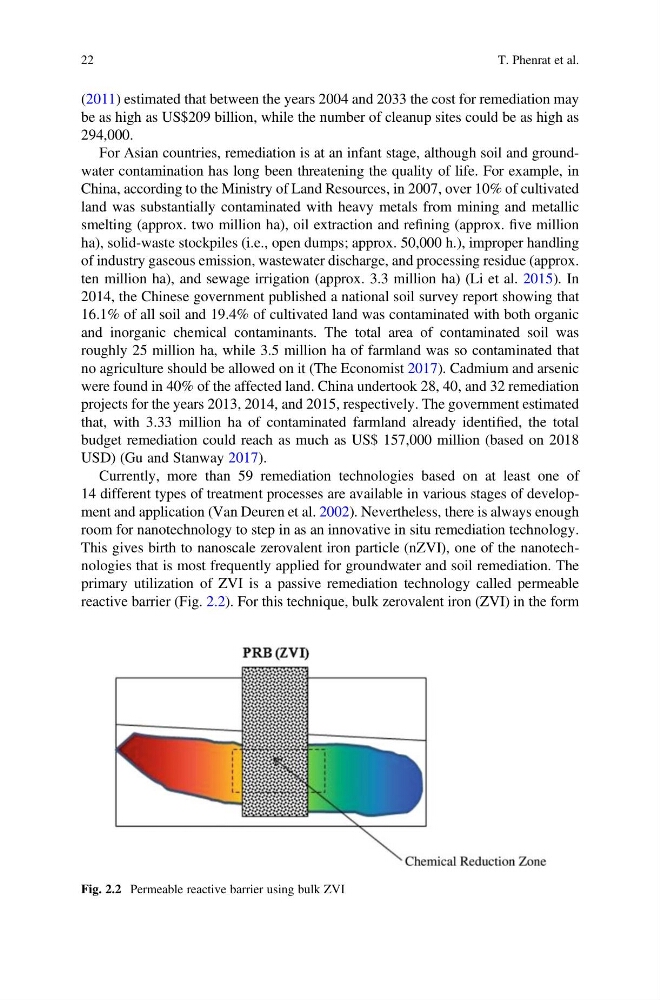
primary utilization of ZVI is a passive remediation technology called permeable
reactive barrier (Fig. 2.2). For this technique, bulk zerovalent iron (ZVI) in the form
Fig. 2.2 Permeable reactive barrier using bulk ZVI
22
T. Phenrat et al.
be as high as US$209 billion, while the number of cleanup sites could be as high as
294,000.
For Asian countries, remediation is at an infant stage, although soil and groundwater contamination has long been threatening the quality of life. For example, in
China, according to the Ministry of Land Resources, in 2007, over 10% of cultivated
land was substantially contaminated with heavy metals from mining and metallic
smelting (approx. two million ha), oil extraction and refining (approx. five million
ha), solid-waste stockpiles (i.e., open dumps; approx. 50,000 h.), improper handling
of industry gaseous emission, wastewater discharge, and processing residue (approx.
ten million ha), and sewage irrigation (approx. 3.3 million ha) (Li et al. 2015). In
2014, the Chinese government published a national soil survey report showing that
16.1% of all soil and 19.4% of cultivated land was contaminated with both organic
and inorganic chemical contaminants. The total area of contaminated soil was
roughly 25 million ha, while 3.5 million ha of farmland was so contaminated that
no agriculture should be allowed on it (The Economist 2017). Cadmium and arsenic
were found in 40% of the affected land. China undertook 28, 40, and 32 remediation
projects for the years 2013, 2014, and 2015, respectively. The government estimated
that, with 3.33 million ha of contaminated farmland already identified, the total
budget remediation could reach as much as US$ 157,000 million (based on 2018
USD) (Gu and Stanway 2017).
Currently, more than 59 remediation technologies based on at least one of
14 different types of treatment processes are available in various stages of development and application (Van Deuren et al. 2002). Nevertheless, there is always enough
room for nanotechnology to step in as an innovative in situ remediation technology.
This gives birth to nanoscale zerovalent iron particle (nZVI), one of the nanotechnologies that is most frequently applied for groundwater and soil remediation. The
primary utilization of ZVI is a passive remediation technology called permeable
reactive barrier (Fig. 2.2). For this technique, bulk zerovalent iron (ZVI) in the form
Fig. 2.2 Permeable reactive barrier using bulk ZVI
22
T. Phenrat et al.