

reported the inlet concentrations of diclofenac to the four-stage CW treating hospital
wastewaters to be 1862 ng L
À1 . Removal efficiency of this CW for diclofenac was
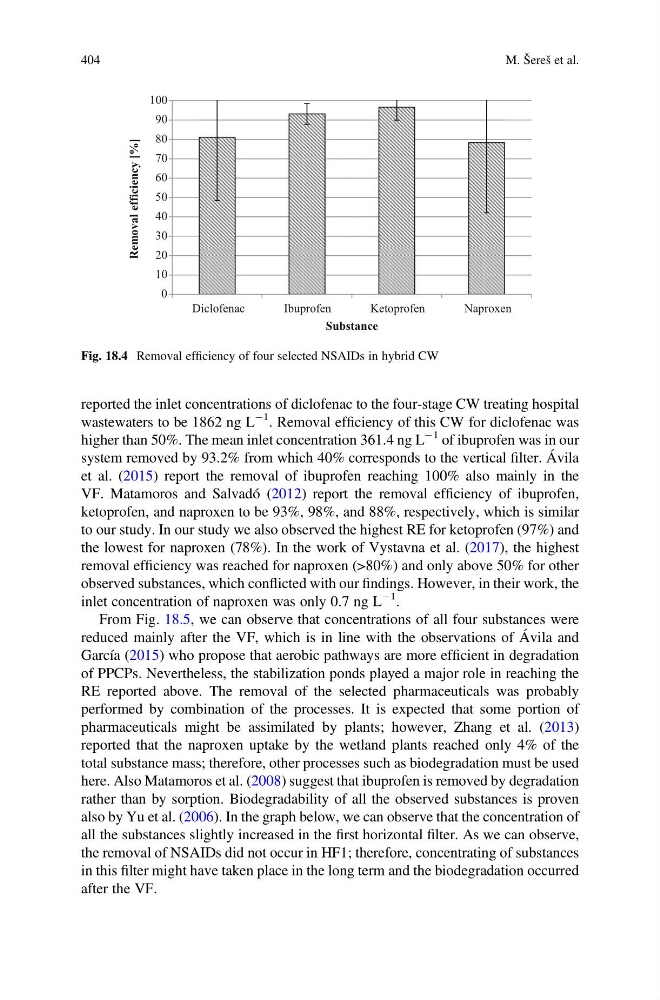
higher than 50%. The mean inlet concentration 361.4 ng L
À1 of ibuprofen was in our
system removed by 93.2% from which 40% corresponds to the vertical filter. Ávila
et al. (2015) report the removal of ibuprofen reaching 100% also mainly in the
VF. Matamoros and Salvadó (2012) report the removal efficiency of ibuprofen,
ketoprofen, and naproxen to be 93%, 98%, and 88%, respectively, which is similar
to our study. In our study we also observed the highest RE for ketoprofen (97%) and
the lowest for naproxen (78%). In the work of Vystavna et al. (2017), the highest
removal efficiency was reached for naproxen (>80%) and only above 50% for other
observed substances, which conflicted with our findings. However, in their work, the
inlet concentration of naproxen was only 0.7 ng L
À1 .
From Fig. 18.5, we can observe that concentrations of all four substances were
reduced mainly after the VF, which is in line with the observations of Ávila and
García (2015) who propose that aerobic pathways are more efficient in degradation
of PPCPs. Nevertheless, the stabilization ponds played a major role in reaching the
RE reported above. The removal of the selected pharmaceuticals was probably
performed by combination of the processes. It is expected that some portion of
pharmaceuticals might be assimilated by plants; however, Zhang et al. (2013)
reported that the naproxen uptake by the wetland plants reached only 4% of the
total substance mass; therefore, other processes such as biodegradation must be used
here. Also Matamoros et al. (2008) suggest that ibuprofen is removed by degradation
rather than by sorption. Biodegradability of all the observed substances is proven
also by Yu et al. (2006). In the graph below, we can observe that the concentration of
all the substances slightly increased in the first horizontal filter. As we can observe,
the removal of NSAIDs did not occur in HF1; therefore, concentrating of substances
in this filter might have taken place in the long term and the biodegradation occurred
after the VF.
0
10
20
30
40
50
60
70
80
90
100
Diclofenac
Ibuprofen
Ketoprofen
Naproxen
Removal efficiency [%]
Substance
Fig. 18.4 Removal efficiency of four selected NSAIDs in hybrid CW
404
M. Šereš et al.
wastewaters to be 1862 ng L
À1 . Removal efficiency of this CW for diclofenac was
higher than 50%. The mean inlet concentration 361.4 ng L
À1 of ibuprofen was in our
system removed by 93.2% from which 40% corresponds to the vertical filter. Ávila
et al. (2015) report the removal of ibuprofen reaching 100% also mainly in the
VF. Matamoros and Salvadó (2012) report the removal efficiency of ibuprofen,
ketoprofen, and naproxen to be 93%, 98%, and 88%, respectively, which is similar
to our study. In our study we also observed the highest RE for ketoprofen (97%) and
the lowest for naproxen (78%). In the work of Vystavna et al. (2017), the highest
removal efficiency was reached for naproxen (>80%) and only above 50% for other
observed substances, which conflicted with our findings. However, in their work, the
inlet concentration of naproxen was only 0.7 ng L
À1 .
From Fig. 18.5, we can observe that concentrations of all four substances were
reduced mainly after the VF, which is in line with the observations of Ávila and
García (2015) who propose that aerobic pathways are more efficient in degradation
of PPCPs. Nevertheless, the stabilization ponds played a major role in reaching the
RE reported above. The removal of the selected pharmaceuticals was probably
performed by combination of the processes. It is expected that some portion of
pharmaceuticals might be assimilated by plants; however, Zhang et al. (2013)
reported that the naproxen uptake by the wetland plants reached only 4% of the
total substance mass; therefore, other processes such as biodegradation must be used
here. Also Matamoros et al. (2008) suggest that ibuprofen is removed by degradation
rather than by sorption. Biodegradability of all the observed substances is proven
also by Yu et al. (2006). In the graph below, we can observe that the concentration of
all the substances slightly increased in the first horizontal filter. As we can observe,
the removal of NSAIDs did not occur in HF1; therefore, concentrating of substances
in this filter might have taken place in the long term and the biodegradation occurred
after the VF.
0
10
20
30
40
50
60
70
80
90
100
Diclofenac
Ibuprofen
Ketoprofen
Naproxen
Removal efficiency [%]
Substance
Fig. 18.4 Removal efficiency of four selected NSAIDs in hybrid CW
404
M. Šereš et al.