

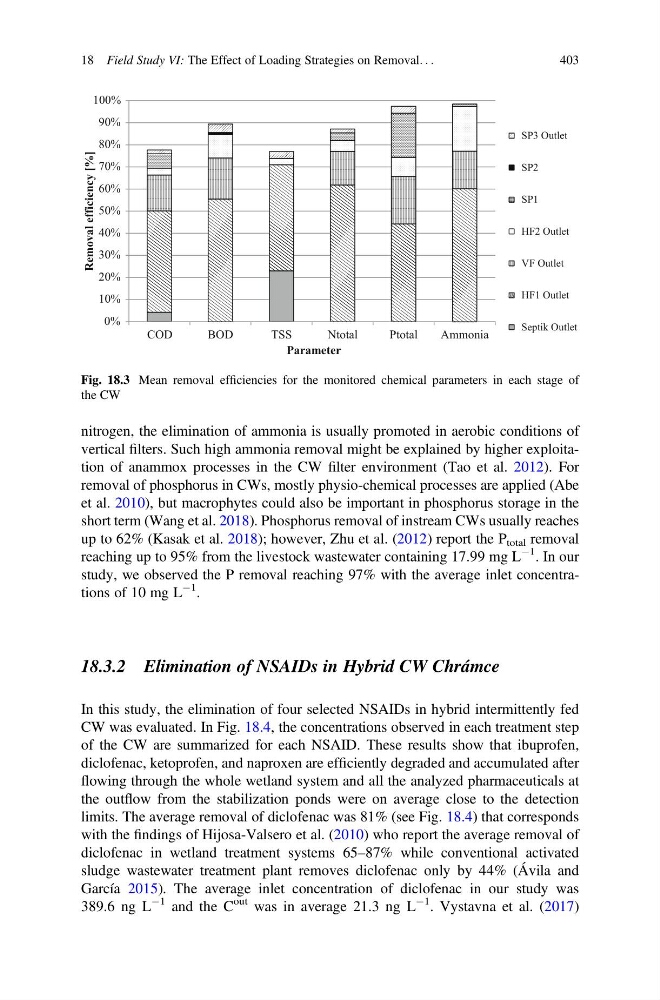
nitrogen, the elimination of ammonia is usually promoted in aerobic conditions of
vertical filters. Such high ammonia removal might be explained by higher exploitation of anammox processes in the CW filter environment (Tao et al. 2012). For
removal of phosphorus in CWs, mostly physio-chemical processes are applied (Abe
et al. 2010), but macrophytes could also be important in phosphorus storage in the
short term (Wang et al. 2018). Phosphorus removal of instream CWs usually reaches
up to 62% (Kasak et al. 2018); however, Zhu et al. (2012) report the P total removal
reaching up to 95% from the livestock wastewater containing 17.99 mg L
À1 . In our
study, we observed the P removal reaching 97% with the average inlet concentrations of 10 mg L
À1 .
18.3.2 Elimination of NSAIDs in Hybrid CW Chrámce
In this study, the elimination of four selected NSAIDs in hybrid intermittently fed
CW was evaluated. In Fig. 18.4, the concentrations observed in each treatment step
of the CW are summarized for each NSAID. These results show that ibuprofen,
diclofenac, ketoprofen, and naproxen are efficiently degraded and accumulated after
flowing through the whole wetland system and all the analyzed pharmaceuticals at
the outflow from the stabilization ponds were on average close to the detection
limits. The average removal of diclofenac was 81% (see Fig. 18.4) that corresponds
with the findings of Hijosa-Valsero et al. (2010) who report the average removal of
diclofenac in wetland treatment systems 65–87% while conventional activated
sludge wastewater treatment plant removes diclofenac only by 44% (Ávila and
García 2015). The average inlet concentration of diclofenac in our study was
389.6 ng L
À1 and the C
out was in average 21.3 ng L
À1 . Vystavna et al. (2017)
0%
10%
20%
30%
40%
50%
60%
70%
80%
90%
100%
COD
BOD
TSS
Ntotal
Ptotal
Ammonia
Parameter
SP3 Outlet
SP2
SP1
HF2 Outlet
VF Outlet
HF1 Outlet
Septik Outlet
Removal efficiency [%]
Fig. 18.3 Mean removal efficiencies for the monitored chemical parameters in each stage of
the CW
18 Field Study VI: The Effect of Loading Strategies on Removal. . .
403
vertical filters. Such high ammonia removal might be explained by higher exploitation of anammox processes in the CW filter environment (Tao et al. 2012). For
removal of phosphorus in CWs, mostly physio-chemical processes are applied (Abe
et al. 2010), but macrophytes could also be important in phosphorus storage in the
short term (Wang et al. 2018). Phosphorus removal of instream CWs usually reaches
up to 62% (Kasak et al. 2018); however, Zhu et al. (2012) report the P total removal
reaching up to 95% from the livestock wastewater containing 17.99 mg L
À1 . In our
study, we observed the P removal reaching 97% with the average inlet concentrations of 10 mg L
À1 .
18.3.2 Elimination of NSAIDs in Hybrid CW Chrámce
In this study, the elimination of four selected NSAIDs in hybrid intermittently fed
CW was evaluated. In Fig. 18.4, the concentrations observed in each treatment step
of the CW are summarized for each NSAID. These results show that ibuprofen,
diclofenac, ketoprofen, and naproxen are efficiently degraded and accumulated after
flowing through the whole wetland system and all the analyzed pharmaceuticals at
the outflow from the stabilization ponds were on average close to the detection
limits. The average removal of diclofenac was 81% (see Fig. 18.4) that corresponds
with the findings of Hijosa-Valsero et al. (2010) who report the average removal of
diclofenac in wetland treatment systems 65–87% while conventional activated
sludge wastewater treatment plant removes diclofenac only by 44% (Ávila and
García 2015). The average inlet concentration of diclofenac in our study was
389.6 ng L
À1 and the C
out was in average 21.3 ng L
À1 . Vystavna et al. (2017)
0%
10%
20%
30%
40%
50%
60%
70%
80%
90%
100%
COD
BOD
TSS
Ntotal
Ptotal
Ammonia
Parameter
SP3 Outlet
SP2
SP1
HF2 Outlet
VF Outlet
HF1 Outlet
Septik Outlet
Removal efficiency [%]
Fig. 18.3 Mean removal efficiencies for the monitored chemical parameters in each stage of
the CW
18 Field Study VI: The Effect of Loading Strategies on Removal. . .
403