

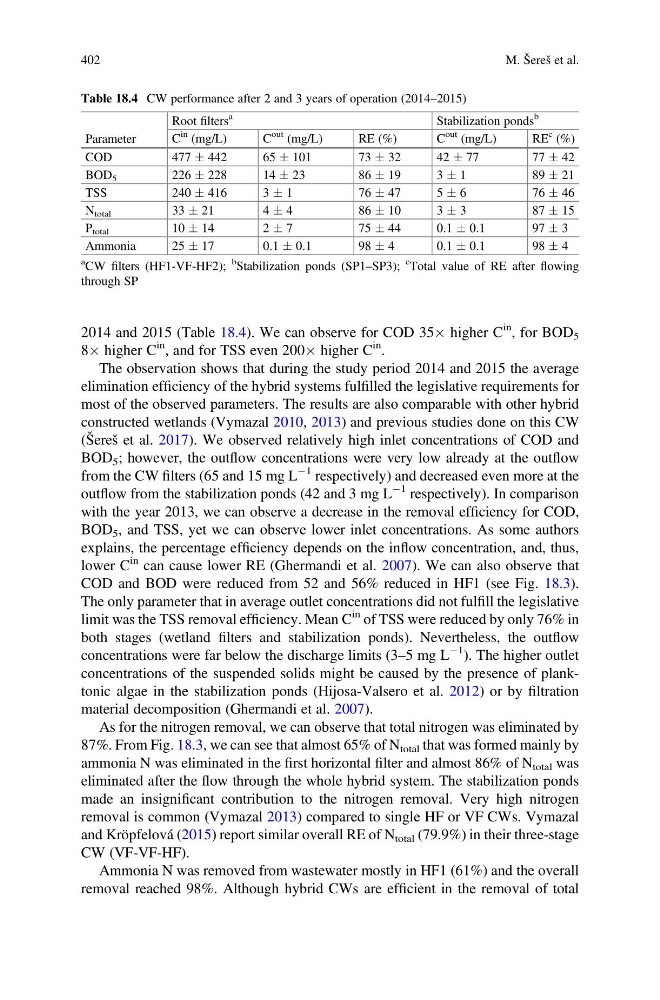
2014 and 2015 (Table 18.4). We can observe for COD 35Â higher C
in
, for BOD 5
8Â higher C
in , and for TSS even 200Â higher C
in .
The observation shows that during the study period 2014 and 2015 the average
elimination efficiency of the hybrid systems fulfilled the legislative requirements for
most of the observed parameters. The results are also comparable with other hybrid
constructed wetlands (Vymazal 2010, 2013) and previous studies done on this CW
(Šereš et al. 2017). We observed relatively high inlet concentrations of COD and
BOD 5 ; however, the outflow concentrations were very low already at the outflow
from the CW filters (65 and 15 mg L
À1 respectively) and decreased even more at the
outflow from the stabilization ponds (42 and 3 mg L
À1 respectively). In comparison
with the year 2013, we can observe a decrease in the removal efficiency for COD,
BOD 5 , and TSS, yet we can observe lower inlet concentrations. As some authors
explains, the percentage efficiency depends on the inflow concentration, and, thus,
lower C
in can cause lower RE (Ghermandi et al. 2007). We can also observe that
COD and BOD were reduced from 52 and 56% reduced in HF1 (see Fig. 18.3).
The only parameter that in average outlet concentrations did not fulfill the legislative
limit was the TSS removal efficiency. Mean C
in of TSS were reduced by only 76% in
both stages (wetland filters and stabilization ponds). Nevertheless, the outflow
concentrations were far below the discharge limits (3–5 mg L
À1 ). The higher outlet
concentrations of the suspended solids might be caused by the presence of planktonic algae in the stabilization ponds (Hijosa-Valsero et al. 2012) or by filtration
material decomposition (Ghermandi et al. 2007).
As for the nitrogen removal, we can observe that total nitrogen was eliminated by
87%. From Fig. 18.3, we can see that almost 65% of N total that was formed mainly by
ammonia N was eliminated in the first horizontal filter and almost 86% of N total was
eliminated after the flow through the whole hybrid system. The stabilization ponds
made an insignificant contribution to the nitrogen removal. Very high nitrogen
removal is common (Vymazal 2013) compared to single HF or VF CWs. Vymazal
and Kröpfelová (2015) report similar overall RE of N total (79.9%) in their three-stage
CW (VF-VF-HF).
Ammonia N was removed from wastewater mostly in HF1 (61%) and the overall
removal reached 98%. Although hybrid CWs are efficient in the removal of total
Table 18.4 CW performance after 2 and 3 years of operation (2014–2015)
Parameter
Root filters
a
Stabilization ponds
b
C
in (mg/L)
C
out (mg/L)
RE (%)
C
out (mg/L)
RE
c (%)
COD
477 Æ 442
65 Æ 101
73 Æ 32
42 Æ 77
77 Æ 42
BOD 5
226 Æ 228
14 Æ 23
86 Æ 19
3 Æ 1
8 9 Æ 21
TSS
240 Æ 416
3 Æ 1
7 6 Æ 47
5 Æ 6
7 6 Æ 46
N total
33 Æ 21
4 Æ 4
8 6 Æ 10
3 Æ 3
8 7 Æ 15
P total
10 Æ 14
2 Æ 7
7 5 Æ 44
0.1 Æ 0.1
97 Æ 3
Ammonia
25 Æ 17
0.1 Æ 0.1
98 Æ 4
0.1 Æ 0.1
98 Æ 4
a CW filters (HF1-VF-HF2);
b
Stabilization ponds (SP1–SP3);
c Total value of RE after flowing
through SP
402
M. Šereš et al.
in
, for BOD 5
8Â higher C
in , and for TSS even 200Â higher C
in .
The observation shows that during the study period 2014 and 2015 the average
elimination efficiency of the hybrid systems fulfilled the legislative requirements for
most of the observed parameters. The results are also comparable with other hybrid
constructed wetlands (Vymazal 2010, 2013) and previous studies done on this CW
(Šereš et al. 2017). We observed relatively high inlet concentrations of COD and
BOD 5 ; however, the outflow concentrations were very low already at the outflow
from the CW filters (65 and 15 mg L
À1 respectively) and decreased even more at the
outflow from the stabilization ponds (42 and 3 mg L
À1 respectively). In comparison
with the year 2013, we can observe a decrease in the removal efficiency for COD,
BOD 5 , and TSS, yet we can observe lower inlet concentrations. As some authors
explains, the percentage efficiency depends on the inflow concentration, and, thus,
lower C
in can cause lower RE (Ghermandi et al. 2007). We can also observe that
COD and BOD were reduced from 52 and 56% reduced in HF1 (see Fig. 18.3).
The only parameter that in average outlet concentrations did not fulfill the legislative
limit was the TSS removal efficiency. Mean C
in of TSS were reduced by only 76% in
both stages (wetland filters and stabilization ponds). Nevertheless, the outflow
concentrations were far below the discharge limits (3–5 mg L
À1 ). The higher outlet
concentrations of the suspended solids might be caused by the presence of planktonic algae in the stabilization ponds (Hijosa-Valsero et al. 2012) or by filtration
material decomposition (Ghermandi et al. 2007).
As for the nitrogen removal, we can observe that total nitrogen was eliminated by
87%. From Fig. 18.3, we can see that almost 65% of N total that was formed mainly by
ammonia N was eliminated in the first horizontal filter and almost 86% of N total was
eliminated after the flow through the whole hybrid system. The stabilization ponds
made an insignificant contribution to the nitrogen removal. Very high nitrogen
removal is common (Vymazal 2013) compared to single HF or VF CWs. Vymazal
and Kröpfelová (2015) report similar overall RE of N total (79.9%) in their three-stage
CW (VF-VF-HF).
Ammonia N was removed from wastewater mostly in HF1 (61%) and the overall
removal reached 98%. Although hybrid CWs are efficient in the removal of total
Table 18.4 CW performance after 2 and 3 years of operation (2014–2015)
Parameter
Root filters
a
Stabilization ponds
b
C
in (mg/L)
C
out (mg/L)
RE (%)
C
out (mg/L)
RE
c (%)
COD
477 Æ 442
65 Æ 101
73 Æ 32
42 Æ 77
77 Æ 42
BOD 5
226 Æ 228
14 Æ 23
86 Æ 19
3 Æ 1
8 9 Æ 21
TSS
240 Æ 416
3 Æ 1
7 6 Æ 47
5 Æ 6
7 6 Æ 46
N total
33 Æ 21
4 Æ 4
8 6 Æ 10
3 Æ 3
8 7 Æ 15
P total
10 Æ 14
2 Æ 7
7 5 Æ 44
0.1 Æ 0.1
97 Æ 3
Ammonia
25 Æ 17
0.1 Æ 0.1
98 Æ 4
0.1 Æ 0.1
98 Æ 4
a CW filters (HF1-VF-HF2);
b
Stabilization ponds (SP1–SP3);
c Total value of RE after flowing
through SP
402
M. Šereš et al.