

It is clear that a detailed thermodynamic analysis of a specific environment
together with the analytical data on the composition of water, substrate, and contaminants can significantly contribute to determining the optimum remedial strategy.
The reaction of ZVI (and especially nZVI) in water has several steps due to the
change in oxidation-reduction conditions of water. Initially, dissolved oxygen causes
iron oxidation by Eq. (1.3). In the case of nZVI, which has an extremely large
specific surface, the reaction (Eq. 1.3) is rapid. Iron precipitates in the form of ferric
oxyhydroxide (FeOOH) or directly as ferric hydroxide Fe(OH) 3 . The solubility of
oxygen depends on the concentration of dissolved substances and decreases as the
dissolved substances increase (Pitter and Chudoba 1990). At 10
C and atmospheric
pressure (101.3 kPa) the solubility of oxygen in water is 11.3 mg/L. After consumption of all the oxygen present and a decrease in the redox potential, groundwater
reacts with the iron under anoxic conditions through the process of corrosion with
hydrogen production
Fe
0
þ 2H 2 O ! Fe
2þ
þ 2OH
À
þ H 2
ð1:28Þ
Since the reaction (Eq. 1.28) is slower, the loss of elemental iron is not as intense
as it is during aerobic corrosion (Eq. 1.3). On the other hand, hydrogen generated
during the anaerobic corrosion can promote the growth of anaerobic microorganisms
that can also dehalogenate chlorinated hydrocarbons. The growth of microorganisms
on the surface of the iron is influenced by the porosity of the material, hence the size
of the reactive surface. In strongly reducing environments consisting of cinder pig,
there is often an increase in concentrations of methane and light gaseous hydrocarbons (e.g., propane, butane) (Pitter and Chudoba 1990). This may be caused by
either a reduction of the CO 2 present in the groundwater or by the hydrogenation of
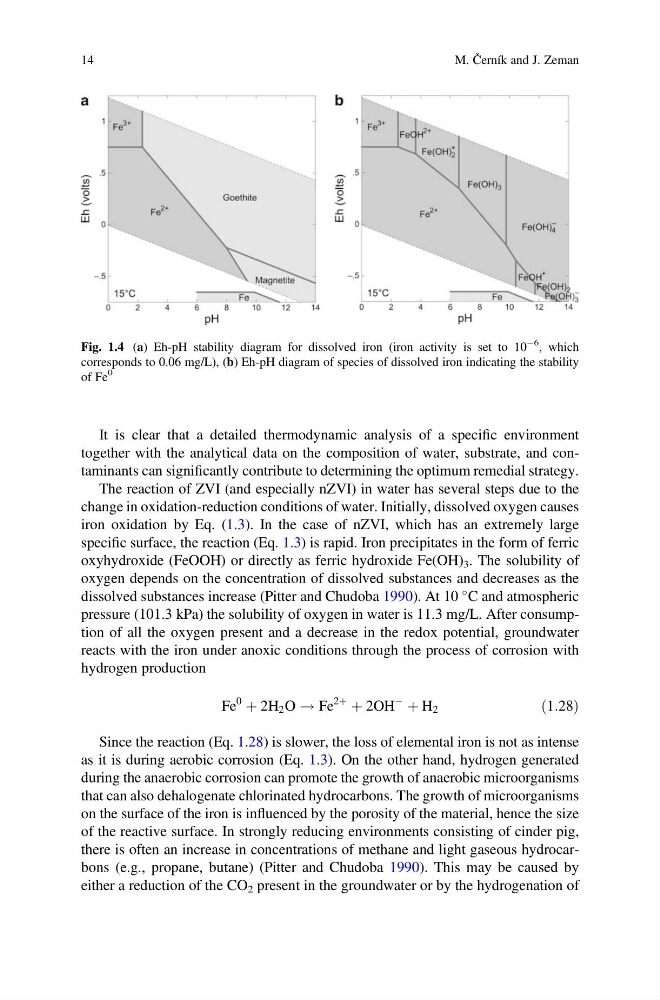
Fig. 1.4 (a) Eh-pH stability diagram for dissolved iron (iron activity is set to 10
À6
, which
corresponds to 0.06 mg/L), (b) Eh-pH diagram of species of dissolved iron indicating the stability
of Fe
0
14
M. Černík and J. Zeman
together with the analytical data on the composition of water, substrate, and contaminants can significantly contribute to determining the optimum remedial strategy.
The reaction of ZVI (and especially nZVI) in water has several steps due to the
change in oxidation-reduction conditions of water. Initially, dissolved oxygen causes
iron oxidation by Eq. (1.3). In the case of nZVI, which has an extremely large
specific surface, the reaction (Eq. 1.3) is rapid. Iron precipitates in the form of ferric
oxyhydroxide (FeOOH) or directly as ferric hydroxide Fe(OH) 3 . The solubility of
oxygen depends on the concentration of dissolved substances and decreases as the
dissolved substances increase (Pitter and Chudoba 1990). At 10
C and atmospheric
pressure (101.3 kPa) the solubility of oxygen in water is 11.3 mg/L. After consumption of all the oxygen present and a decrease in the redox potential, groundwater
reacts with the iron under anoxic conditions through the process of corrosion with
hydrogen production
Fe
0
þ 2H 2 O ! Fe
2þ
þ 2OH
À
þ H 2
ð1:28Þ
Since the reaction (Eq. 1.28) is slower, the loss of elemental iron is not as intense
as it is during aerobic corrosion (Eq. 1.3). On the other hand, hydrogen generated
during the anaerobic corrosion can promote the growth of anaerobic microorganisms
that can also dehalogenate chlorinated hydrocarbons. The growth of microorganisms
on the surface of the iron is influenced by the porosity of the material, hence the size
of the reactive surface. In strongly reducing environments consisting of cinder pig,
there is often an increase in concentrations of methane and light gaseous hydrocarbons (e.g., propane, butane) (Pitter and Chudoba 1990). This may be caused by
either a reduction of the CO 2 present in the groundwater or by the hydrogenation of
Fig. 1.4 (a) Eh-pH stability diagram for dissolved iron (iron activity is set to 10
À6
, which
corresponds to 0.06 mg/L), (b) Eh-pH diagram of species of dissolved iron indicating the stability
of Fe
0
14
M. Černík and J. Zeman