

carbon, which is present in the iron as an admixture produced by hydrogen during
anaerobic corrosion.
Because of iron corrosion under both aerobic and anaerobic conditions, there is an
increase in the OH
À concentration resulting in an increase in the pH value of the
system. This often rises to values of around 10 depending on the buffer capacity of
the groundwater (carbonate content in particular). Dissolved carbon dioxide and
bicarbonate also inhibit the increase in pH by the following reactions
H 2 CO 3 þ 2OH
À
! CO
2À
3 þ 2H 2 O
ð1:29Þ
HCO
À
3 þ OH
À
! CO
2À
3 þ H 2 O
ð1:30Þ
and help to buffer the system, which is important for both chemical and biological
reduction processes.
In the real environment of natural water, other complexes (sulfate, carbonate,
chloride, etc.) are present and must be included in the balance calculation, and
therefore the speciation model is essential for an estimation of redox conditions.
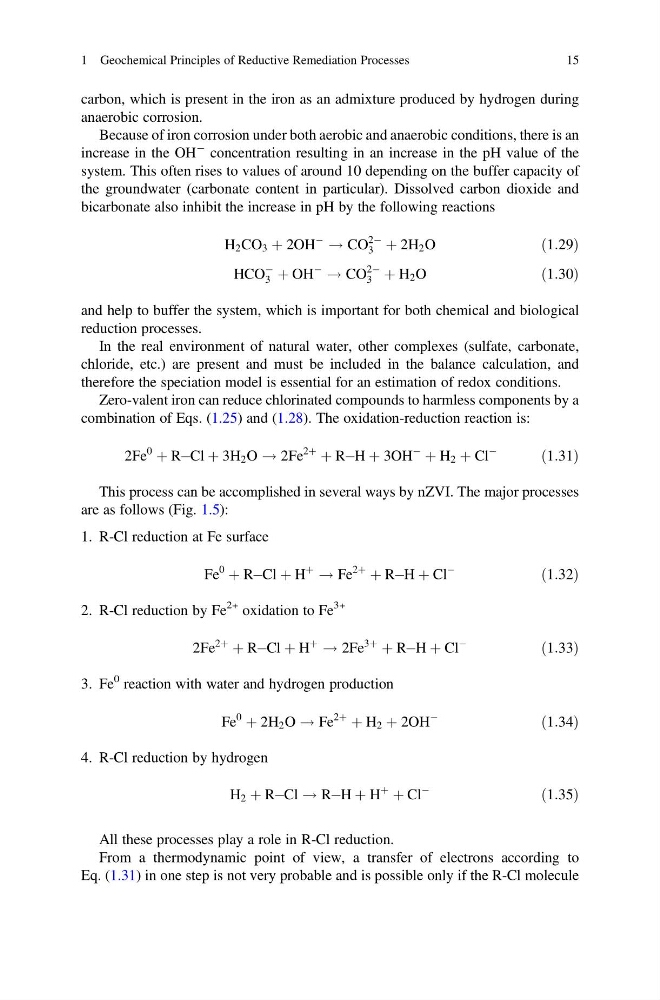
Zero-valent iron can reduce chlorinated compounds to harmless components by a
combination of Eqs. (1.25) and (1.28). The oxidation-reduction reaction is:
2Fe
0
þ RÀCl þ 3H 2 O ! 2Fe
2þ
þ RÀH þ 3OH
À
þ H 2 þ Cl
À
ð1:31Þ
This process can be accomplished in several ways by nZVI. The major processes
are as follows (Fig. 1.5):
1. R-Cl reduction at Fe surface
Fe
0
þ RÀCl þ H
þ
! Fe
2þ
þ RÀH þ Cl
À
ð1:32Þ
2. R-Cl reduction by Fe
2+ oxidation to Fe
3+
2Fe
2þ
þ RÀCl þ H
þ
! 2Fe
3þ
þ RÀH þ Cl
À
ð1:33Þ
3. Fe
0 reaction with water and hydrogen production
Fe
0
þ 2H 2 O ! Fe
2þ
þ H 2 þ 2OH
À
ð1:34Þ
4. R-Cl reduction by hydrogen
H 2 þ RÀCl ! RÀH þ H
þ
þ Cl
À
ð1:35Þ
All these processes play a role in R-Cl reduction.
From a thermodynamic point of view, a transfer of electrons according to
Eq. (1.31) in one step is not very probable and is possible only if the R-Cl molecule
1 Geochemical Principles of Reductive Remediation Processes
15
anaerobic corrosion.
Because of iron corrosion under both aerobic and anaerobic conditions, there is an
increase in the OH
À concentration resulting in an increase in the pH value of the
system. This often rises to values of around 10 depending on the buffer capacity of
the groundwater (carbonate content in particular). Dissolved carbon dioxide and
bicarbonate also inhibit the increase in pH by the following reactions
H 2 CO 3 þ 2OH
À
! CO
2À
3 þ 2H 2 O
ð1:29Þ
HCO
À
3 þ OH
À
! CO
2À
3 þ H 2 O
ð1:30Þ
and help to buffer the system, which is important for both chemical and biological
reduction processes.
In the real environment of natural water, other complexes (sulfate, carbonate,
chloride, etc.) are present and must be included in the balance calculation, and
therefore the speciation model is essential for an estimation of redox conditions.
Zero-valent iron can reduce chlorinated compounds to harmless components by a
combination of Eqs. (1.25) and (1.28). The oxidation-reduction reaction is:
2Fe
0
þ RÀCl þ 3H 2 O ! 2Fe
2þ
þ RÀH þ 3OH
À
þ H 2 þ Cl
À
ð1:31Þ
This process can be accomplished in several ways by nZVI. The major processes
are as follows (Fig. 1.5):
1. R-Cl reduction at Fe surface
Fe
0
þ RÀCl þ H
þ
! Fe
2þ
þ RÀH þ Cl
À
ð1:32Þ
2. R-Cl reduction by Fe
2+ oxidation to Fe
3+
2Fe
2þ
þ RÀCl þ H
þ
! 2Fe
3þ
þ RÀH þ Cl
À
ð1:33Þ
3. Fe
0 reaction with water and hydrogen production
Fe
0
þ 2H 2 O ! Fe
2þ
þ H 2 þ 2OH
À
ð1:34Þ
4. R-Cl reduction by hydrogen
H 2 þ RÀCl ! RÀH þ H
þ
þ Cl
À
ð1:35Þ
All these processes play a role in R-Cl reduction.
From a thermodynamic point of view, a transfer of electrons according to
Eq. (1.31) in one step is not very probable and is possible only if the R-Cl molecule
1 Geochemical Principles of Reductive Remediation Processes
15