

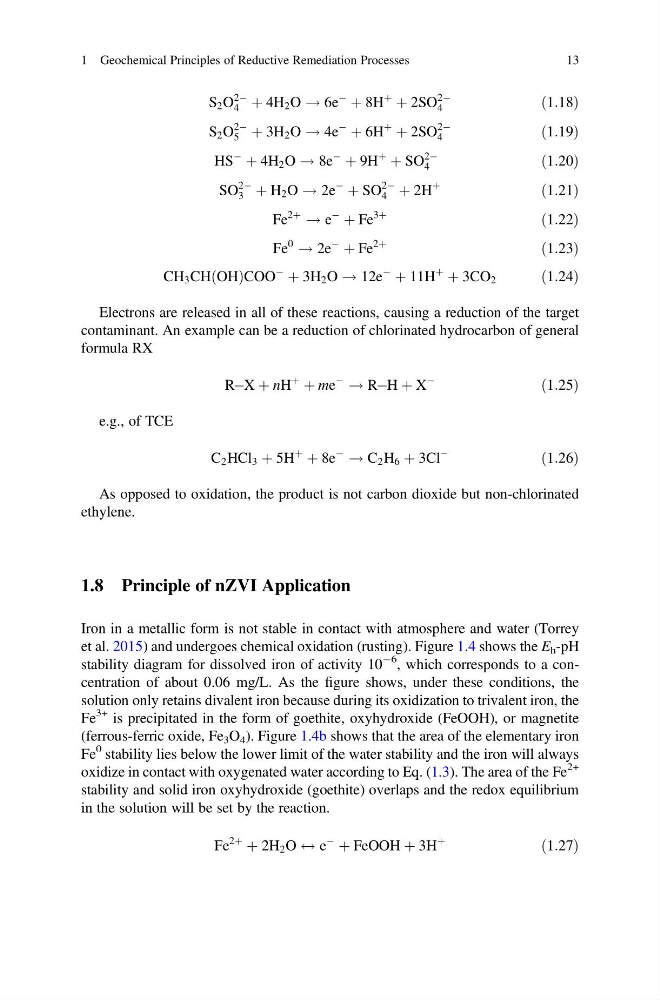
S 2 O
2À
4 þ 4H 2 O ! 6e
À
þ 8H
þ
þ 2SO
2À
4
ð1:18Þ
S 2 O
2À
5 þ 3H 2 O ! 4e
À
þ 6H
þ
þ 2SO
2À
4
ð1:19Þ
HS
À
þ 4H 2 O ! 8e
À
þ 9H
þ
þ SO
2À
4
ð1:20Þ
SO
2À
3 þ H 2 O ! 2e
À
þ SO
2À
4 þ 2H
þ
ð1:21Þ
Fe
2þ
! e
À
þ Fe
3þ
ð1:22Þ
Fe
0
! 2e
À
þ Fe
2þ
ð1:23Þ
CH 3 CH OH
ð ÞCOO
À
þ 3H 2 O ! 12e
À
þ 11H
þ
þ 3CO 2
ð1:24Þ
Electrons are released in all of these reactions, causing a reduction of the target
contaminant. An example can be a reduction of chlorinated hydrocarbon of general
formula RX
RÀX þ nH
þ
þ me
À
! RÀH þ X
À
ð1:25Þ
e.g., of TCE
C 2 HCl 3 þ 5H
þ
þ 8e
À
! C 2 H 6 þ 3Cl
À
ð1:26Þ
As opposed to oxidation, the product is not carbon dioxide but non-chlorinated
ethylene.
1.8 Principle of nZVI Application
Iron in a metallic form is not stable in contact with atmosphere and water (Torrey
et al. 2015) and undergoes chemical oxidation (rusting). Figure 1.4 shows the E h -pH
stability diagram for dissolved iron of activity 10
À6 , which corresponds to a concentration of about 0.06 mg/L. As the figure shows, under these conditions, the
solution only retains divalent iron because during its oxidization to trivalent iron, the
Fe
3+ is precipitated in the form of goethite, oxyhydroxide (FeOOH), or magnetite
(ferrous-ferric oxide, Fe 3 O 4 ). Figure 1.4b shows that the area of the elementary iron
Fe
0 stability lies below the lower limit of the water stability and the iron will always
oxidize in contact with oxygenated water according to Eq. (1.3). The area of the Fe
2+
stability and solid iron oxyhydroxide (goethite) overlaps and the redox equilibrium
in the solution will be set by the reaction.
Fe
2þ
þ 2H 2 O $ e
À
þ FeOOH þ 3H
þ
ð1:27Þ
1 Geochemical Principles of Reductive Remediation Processes
13
2À
4 þ 4H 2 O ! 6e
À
þ 8H
þ
þ 2SO
2À
4
ð1:18Þ
S 2 O
2À
5 þ 3H 2 O ! 4e
À
þ 6H
þ
þ 2SO
2À
4
ð1:19Þ
HS
À
þ 4H 2 O ! 8e
À
þ 9H
þ
þ SO
2À
4
ð1:20Þ
SO
2À
3 þ H 2 O ! 2e
À
þ SO
2À
4 þ 2H
þ
ð1:21Þ
Fe
2þ
! e
À
þ Fe
3þ
ð1:22Þ
Fe
0
! 2e
À
þ Fe
2þ
ð1:23Þ
CH 3 CH OH
ð ÞCOO
À
þ 3H 2 O ! 12e
À
þ 11H
þ
þ 3CO 2
ð1:24Þ
Electrons are released in all of these reactions, causing a reduction of the target
contaminant. An example can be a reduction of chlorinated hydrocarbon of general
formula RX
RÀX þ nH
þ
þ me
À
! RÀH þ X
À
ð1:25Þ
e.g., of TCE
C 2 HCl 3 þ 5H
þ
þ 8e
À
! C 2 H 6 þ 3Cl
À
ð1:26Þ
As opposed to oxidation, the product is not carbon dioxide but non-chlorinated
ethylene.
1.8 Principle of nZVI Application
Iron in a metallic form is not stable in contact with atmosphere and water (Torrey
et al. 2015) and undergoes chemical oxidation (rusting). Figure 1.4 shows the E h -pH
stability diagram for dissolved iron of activity 10
À6 , which corresponds to a concentration of about 0.06 mg/L. As the figure shows, under these conditions, the
solution only retains divalent iron because during its oxidization to trivalent iron, the
Fe
3+ is precipitated in the form of goethite, oxyhydroxide (FeOOH), or magnetite
(ferrous-ferric oxide, Fe 3 O 4 ). Figure 1.4b shows that the area of the elementary iron
Fe
0 stability lies below the lower limit of the water stability and the iron will always
oxidize in contact with oxygenated water according to Eq. (1.3). The area of the Fe
2+
stability and solid iron oxyhydroxide (goethite) overlaps and the redox equilibrium
in the solution will be set by the reaction.
Fe
2þ
þ 2H 2 O $ e
À
þ FeOOH þ 3H
þ
ð1:27Þ
1 Geochemical Principles of Reductive Remediation Processes
13