

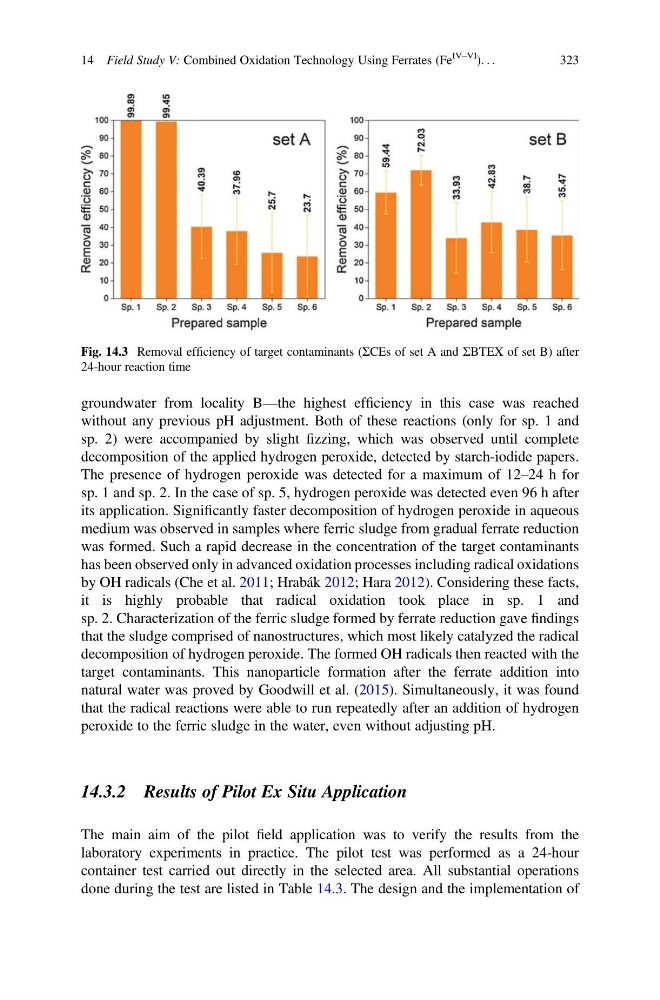
groundwater from locality B—the highest efficiency in this case was reached
without any previous pH adjustment. Both of these reactions (only for sp. 1 and
sp. 2) were accompanied by slight fizzing, which was observed until complete
decomposition of the applied hydrogen peroxide, detected by starch-iodide papers.
The presence of hydrogen peroxide was detected for a maximum of 12–24 h for
sp. 1 and sp. 2. In the case of sp. 5, hydrogen peroxide was detected even 96 h after
its application. Significantly faster decomposition of hydrogen peroxide in aqueous
medium was observed in samples where ferric sludge from gradual ferrate reduction
was formed. Such a rapid decrease in the concentration of the target contaminants
has been observed only in advanced oxidation processes including radical oxidations
by OH radicals (Che et al. 2011; Hrabák 2012; Hara 2012). Considering these facts,
it is highly probable that radical oxidation took place in sp. 1 and
sp. 2. Characterization of the ferric sludge formed by ferrate reduction gave findings
that the sludge comprised of nanostructures, which most likely catalyzed the radical
decomposition of hydrogen peroxide. The formed OH radicals then reacted with the
target contaminants. This nanoparticle formation after the ferrate addition into
natural water was proved by Goodwill et al. (2015). Simultaneously, it was found
that the radical reactions were able to run repeatedly after an addition of hydrogen
peroxide to the ferric sludge in the water, even without adjusting pH.
14.3.2 Results of Pilot Ex Situ Application
The main aim of the pilot field application was to verify the results from the
laboratory experiments in practice. The pilot test was performed as a 24-hour
container test carried out directly in the selected area. All substantial operations
done during the test are listed in Table 14.3. The design and the implementation of
Fig. 14.3 Removal efficiency of target contaminants (ΣCEs of set A and ΣBTEX of set B) after
24-hour reaction time
14 Field Study V: Combined Oxidation Technology Using Ferrates (Fe
IV–VI
). . .
323
without any previous pH adjustment. Both of these reactions (only for sp. 1 and
sp. 2) were accompanied by slight fizzing, which was observed until complete
decomposition of the applied hydrogen peroxide, detected by starch-iodide papers.
The presence of hydrogen peroxide was detected for a maximum of 12–24 h for
sp. 1 and sp. 2. In the case of sp. 5, hydrogen peroxide was detected even 96 h after
its application. Significantly faster decomposition of hydrogen peroxide in aqueous
medium was observed in samples where ferric sludge from gradual ferrate reduction
was formed. Such a rapid decrease in the concentration of the target contaminants
has been observed only in advanced oxidation processes including radical oxidations
by OH radicals (Che et al. 2011; Hrabák 2012; Hara 2012). Considering these facts,
it is highly probable that radical oxidation took place in sp. 1 and
sp. 2. Characterization of the ferric sludge formed by ferrate reduction gave findings
that the sludge comprised of nanostructures, which most likely catalyzed the radical
decomposition of hydrogen peroxide. The formed OH radicals then reacted with the
target contaminants. This nanoparticle formation after the ferrate addition into
natural water was proved by Goodwill et al. (2015). Simultaneously, it was found
that the radical reactions were able to run repeatedly after an addition of hydrogen
peroxide to the ferric sludge in the water, even without adjusting pH.
14.3.2 Results of Pilot Ex Situ Application
The main aim of the pilot field application was to verify the results from the
laboratory experiments in practice. The pilot test was performed as a 24-hour
container test carried out directly in the selected area. All substantial operations
done during the test are listed in Table 14.3. The design and the implementation of
Fig. 14.3 Removal efficiency of target contaminants (ΣCEs of set A and ΣBTEX of set B) after
24-hour reaction time
14 Field Study V: Combined Oxidation Technology Using Ferrates (Fe
IV–VI
). . .
323