

the water, and the ferrates degraded too rapidly to be able to degrade the target stable
contaminants. Conversely, in samples where only hydrogen peroxide was applied,
slow and long decomposition of peroxide without a significant influence on the
selected contaminants has been observed. pH adjustment to lower values caused
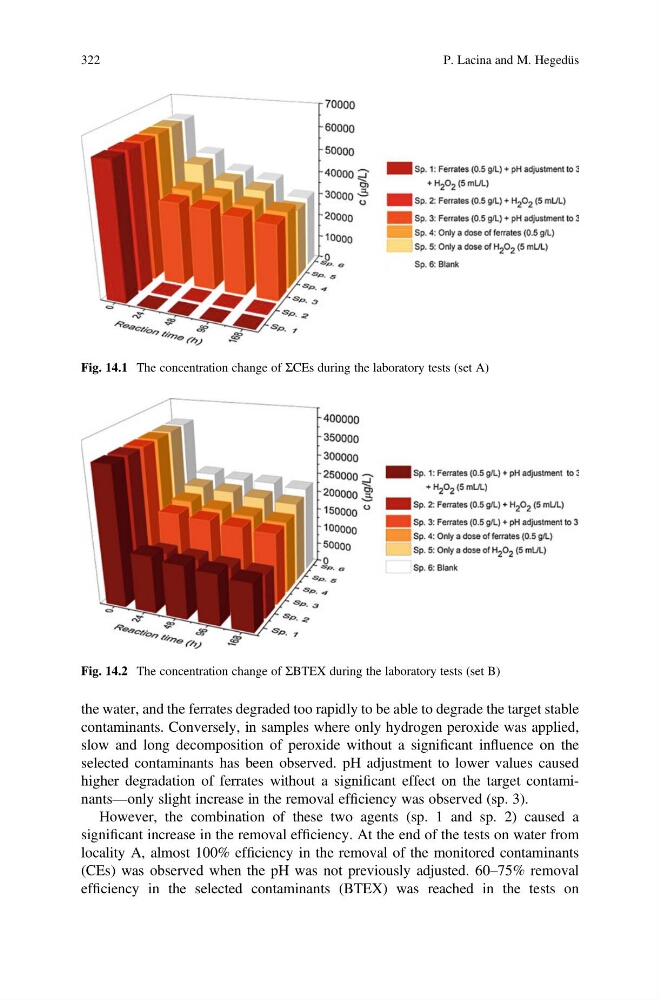
higher degradation of ferrates without a significant effect on the target contaminants—only slight increase in the removal efficiency was observed (sp. 3).
However, the combination of these two agents (sp. 1 and sp. 2) caused a
significant increase in the removal efficiency. At the end of the tests on water from
locality A, almost 100% efficiency in the removal of the monitored contaminants
(CEs) was observed when the pH was not previously adjusted. 60–75% removal
efficiency in the selected contaminants (BTEX) was reached in the tests on
Fig. 14.1 The concentration change of ΣCEs during the laboratory tests (set A)
Fig. 14.2 The concentration change of ΣBTEX during the laboratory tests (set B)
322
P. Lacina and M. Hegedüs
contaminants. Conversely, in samples where only hydrogen peroxide was applied,
slow and long decomposition of peroxide without a significant influence on the
selected contaminants has been observed. pH adjustment to lower values caused
higher degradation of ferrates without a significant effect on the target contaminants—only slight increase in the removal efficiency was observed (sp. 3).
However, the combination of these two agents (sp. 1 and sp. 2) caused a
significant increase in the removal efficiency. At the end of the tests on water from
locality A, almost 100% efficiency in the removal of the monitored contaminants
(CEs) was observed when the pH was not previously adjusted. 60–75% removal
efficiency in the selected contaminants (BTEX) was reached in the tests on
Fig. 14.1 The concentration change of ΣCEs during the laboratory tests (set A)
Fig. 14.2 The concentration change of ΣBTEX during the laboratory tests (set B)
322
P. Lacina and M. Hegedüs