

electrons and oxygen gas is formed; and reduction as a reaction where water acquires
electrons and hydrogen gas is formed.
The pε values were calculated by the following conditions: In both equations of
equilibrium constants, there is a partial pressure of the gas involved. The partial
pressure can be equal to 1 and its log ¼ 0. The equilibrium constant for the oxidation
of water at 25
C and pressure 0.1 MPa has a value of log K ¼ À41.56 and the water
has a unit activity; for the reduction process the log K ¼ 0 according to (Eq. 1.10).
These curves are the limits of the pε-pH graph of water stability because higher and
lower values for water oxidation and reduction, respectively, are not thermodynamically possible.
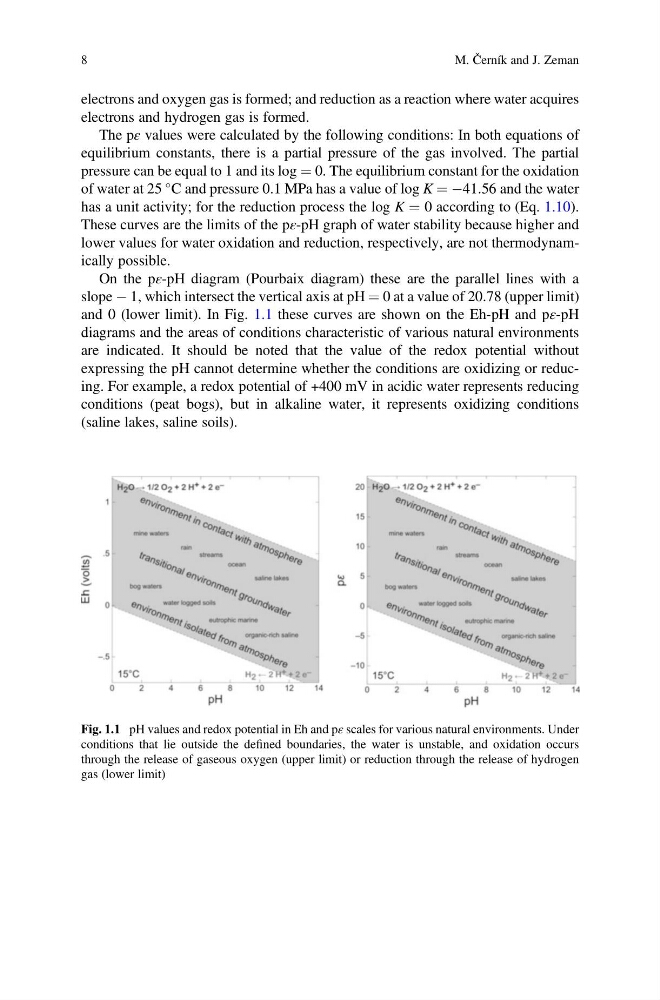
On the pε-pH diagram (Pourbaix diagram) these are the parallel lines with a
slope À 1, which intersect the vertical axis at pH ¼ 0 at a value of 20.78 (upper limit)
and 0 (lower limit). In Fig. 1.1 these curves are shown on the Eh-pH and pε-pH
diagrams and the areas of conditions characteristic of various natural environments
are indicated. It should be noted that the value of the redox potential without
expressing the pH cannot determine whether the conditions are oxidizing or reducing. For example, a redox potential of +400 mV in acidic water represents reducing
conditions (peat bogs), but in alkaline water, it represents oxidizing conditions
(saline lakes, saline soils).
Fig. 1.1 pH values and redox potential in Eh and pε scales for various natural environments. Under
conditions that lie outside the defined boundaries, the water is unstable, and oxidation occurs
through the release of gaseous oxygen (upper limit) or reduction through the release of hydrogen
gas (lower limit)
8
M . Černík and J. Zeman
electrons and hydrogen gas is formed.
The pε values were calculated by the following conditions: In both equations of
equilibrium constants, there is a partial pressure of the gas involved. The partial
pressure can be equal to 1 and its log ¼ 0. The equilibrium constant for the oxidation
of water at 25
C and pressure 0.1 MPa has a value of log K ¼ À41.56 and the water
has a unit activity; for the reduction process the log K ¼ 0 according to (Eq. 1.10).
These curves are the limits of the pε-pH graph of water stability because higher and
lower values for water oxidation and reduction, respectively, are not thermodynamically possible.
On the pε-pH diagram (Pourbaix diagram) these are the parallel lines with a
slope À 1, which intersect the vertical axis at pH ¼ 0 at a value of 20.78 (upper limit)
and 0 (lower limit). In Fig. 1.1 these curves are shown on the Eh-pH and pε-pH
diagrams and the areas of conditions characteristic of various natural environments
are indicated. It should be noted that the value of the redox potential without
expressing the pH cannot determine whether the conditions are oxidizing or reducing. For example, a redox potential of +400 mV in acidic water represents reducing
conditions (peat bogs), but in alkaline water, it represents oxidizing conditions
(saline lakes, saline soils).
Fig. 1.1 pH values and redox potential in Eh and pε scales for various natural environments. Under
conditions that lie outside the defined boundaries, the water is unstable, and oxidation occurs
through the release of gaseous oxygen (upper limit) or reduction through the release of hydrogen
gas (lower limit)
8
M . Černík and J. Zeman