

1.5 Problems of Measurement and Interpretation of Redox
Potentials
The redox potential of an environment is not an absolutely specified property. It is
determined by the substances present in the environment. Substances that can release
(reduction agent) or accept electrons (oxidizing agent) change the electron activity in
the environment, thus changing the Eh. The most important substances in the
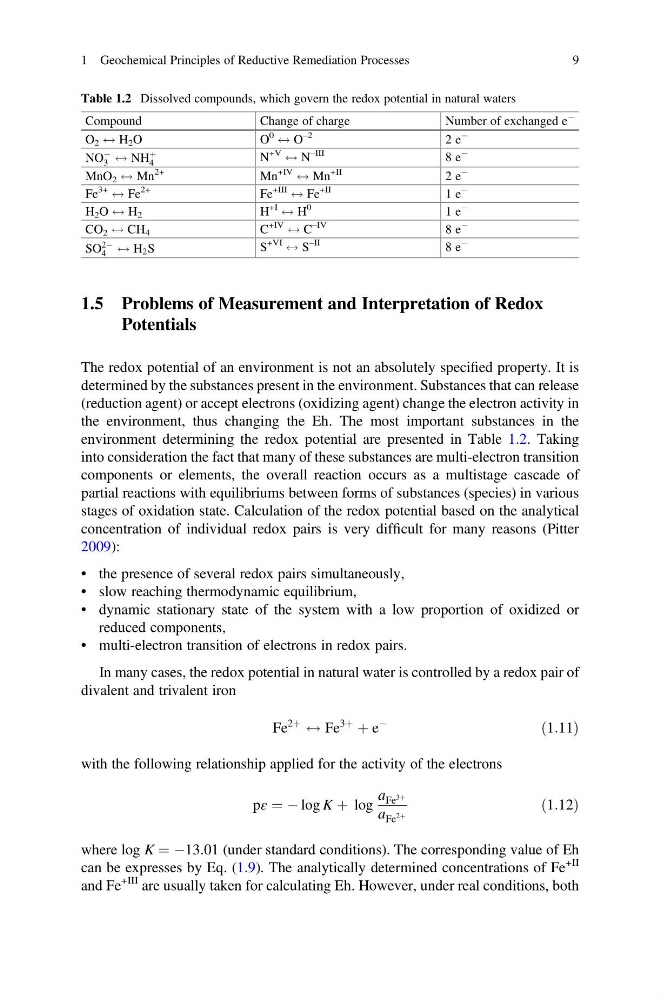
environment determining the redox potential are presented in Table 1.2. Taking
into consideration the fact that many of these substances are multi-electron transition
components or elements, the overall reaction occurs as a multistage cascade of
partial reactions with equilibriums between forms of substances (species) in various
stages of oxidation state. Calculation of the redox potential based on the analytical
concentration of individual redox pairs is very difficult for many reasons (Pitter
2009):
• the presence of several redox pairs simultaneously,
• slow reaching thermodynamic equilibrium,
• dynamic stationary state of the system with a low proportion of oxidized or
reduced components,
• multi-electron transition of electrons in redox pairs.
In many cases, the redox potential in natural water is controlled by a redox pair of
divalent and trivalent iron
Fe
2þ
$ Fe
3þ
þ e
À
ð1:11Þ
with the following relationship applied for the activity of the electrons
pε ¼ À log K þ log
a Fe
3þ
a Fe
2þ
ð1:12Þ
where log K ¼ À13.01 (under standard conditions). The corresponding value of Eh
can be expresses by Eq. (1.9). The analytically determined concentrations of Fe
+II
and Fe
+III are usually taken for calculating Eh. However, under real conditions, both
Table 1.2 Dissolved compounds, which govern the redox potential in natural waters
Compound
Change of charge
Number of exchanged e
À
O 2 $ H 2 O
O
0 $ O
–2
2 e
À
NO
À
3 $ NH
þ
4
N
+V $ N
–III
8 e
À
MnO 2 $ Mn
2+
Mn
+IV $ Mn
+II
2 e
À
Fe
3+ $ Fe
2+
Fe
+III $ Fe
+II
1 e
À
H 2 O $ H 2
H
+I $ H
0
1 e
À
CO 2 $ CH 4
C
+IV $ C
–IV
8 e
À
SO
2À
4 $ H 2 S
S
+VI $ S
–II
8 e
À
1 Geochemical Principles of Reductive Remediation Processes
9
Potentials
The redox potential of an environment is not an absolutely specified property. It is
determined by the substances present in the environment. Substances that can release
(reduction agent) or accept electrons (oxidizing agent) change the electron activity in
the environment, thus changing the Eh. The most important substances in the
environment determining the redox potential are presented in Table 1.2. Taking
into consideration the fact that many of these substances are multi-electron transition
components or elements, the overall reaction occurs as a multistage cascade of
partial reactions with equilibriums between forms of substances (species) in various
stages of oxidation state. Calculation of the redox potential based on the analytical
concentration of individual redox pairs is very difficult for many reasons (Pitter
2009):
• the presence of several redox pairs simultaneously,
• slow reaching thermodynamic equilibrium,
• dynamic stationary state of the system with a low proportion of oxidized or
reduced components,
• multi-electron transition of electrons in redox pairs.
In many cases, the redox potential in natural water is controlled by a redox pair of
divalent and trivalent iron
Fe
2þ
$ Fe
3þ
þ e
À
ð1:11Þ
with the following relationship applied for the activity of the electrons
pε ¼ À log K þ log
a Fe
3þ
a Fe
2þ
ð1:12Þ
where log K ¼ À13.01 (under standard conditions). The corresponding value of Eh
can be expresses by Eq. (1.9). The analytically determined concentrations of Fe
+II
and Fe
+III are usually taken for calculating Eh. However, under real conditions, both
Table 1.2 Dissolved compounds, which govern the redox potential in natural waters
Compound
Change of charge
Number of exchanged e
À
O 2 $ H 2 O
O
0 $ O
–2
2 e
À
NO
À
3 $ NH
þ
4
N
+V $ N
–III
8 e
À
MnO 2 $ Mn
2+
Mn
+IV $ Mn
+II
2 e
À
Fe
3+ $ Fe
2+
Fe
+III $ Fe
+II
1 e
À
H 2 O $ H 2
H
+I $ H
0
1 e
À
CO 2 $ CH 4
C
+IV $ C
–IV
8 e
À
SO
2À
4 $ H 2 S
S
+VI $ S
–II
8 e
À
1 Geochemical Principles of Reductive Remediation Processes
9