

running vertically having the design parameters mentioned in Table 12.1. The
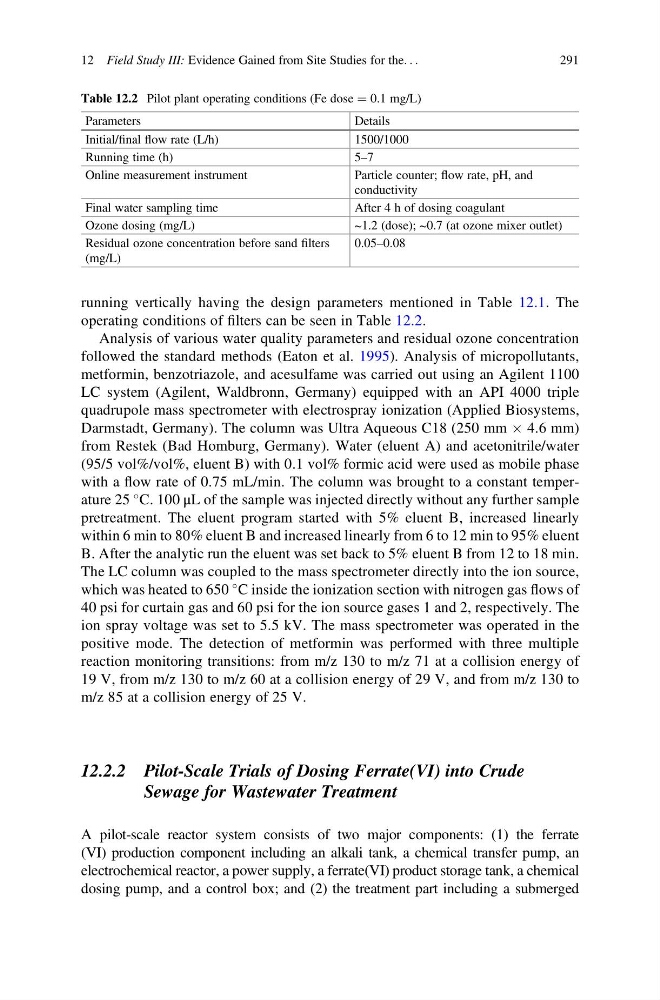
operating conditions of filters can be seen in Table 12.2.
Analysis of various water quality parameters and residual ozone concentration
followed the standard methods (Eaton et al. 1995). Analysis of micropollutants,
metformin, benzotriazole, and acesulfame was carried out using an Agilent 1100
LC system (Agilent, Waldbronn, Germany) equipped with an API 4000 triple
quadrupole mass spectrometer with electrospray ionization (Applied Biosystems,
Darmstadt, Germany). The column was Ultra Aqueous C18 (250 mm  4.6 mm)
from Restek (Bad Homburg, Germany). Water (eluent A) and acetonitrile/water
(95/5 vol%/vol%, eluent B) with 0.1 vol% formic acid were used as mobile phase
with a flow rate of 0.75 mL/min. The column was brought to a constant temperature 25
C. 100 μL of the sample was injected directly without any further sample
pretreatment. The eluent program started with 5% eluent B, increased linearly
within 6 min to 80% eluent B and increased linearly from 6 to 12 min to 95% eluent
B. After the analytic run the eluent was set back to 5% eluent B from 12 to 18 min.
The LC column was coupled to the mass spectrometer directly into the ion source,
which was heated to 650
C inside the ionization section with nitrogen gas flows of
40 psi for curtain gas and 60 psi for the ion source gases 1 and 2, respectively. The
ion spray voltage was set to 5.5 kV. The mass spectrometer was operated in the
positive mode. The detection of metformin was performed with three multiple
reaction monitoring transitions: from m/z 130 to m/z 71 at a collision energy of
19 V, from m/z 130 to m/z 60 at a collision energy of 29 V, and from m/z 130 to
m/z 85 at a collision energy of 25 V.
12.2.2 Pilot-Scale Trials of Dosing Ferrate(VI) into Crude
Sewage for Wastewater Treatment
A pilot-scale reactor system consists of two major components: (1) the ferrate
(VI) production component including an alkali tank, a chemical transfer pump, an
electrochemical reactor, a power supply, a ferrate(VI) product storage tank, a chemical
dosing pump, and a control box; and (2) the treatment part including a submerged
Table 12.2 Pilot plant operating conditions (Fe dose ¼ 0.1 mg/L)
Parameters
Details
Initial/final flow rate (L/h)
1500/1000
Running time (h)
5–7
Online measurement instrument
Particle counter; flow rate, pH, and
conductivity
Final water sampling time
After 4 h of dosing coagulant
Ozone dosing (mg/L)
~1.2 (dose); ~0.7 (at ozone mixer outlet)
Residual ozone concentration before sand filters
(mg/L)
0.05–0.08
12 Field Study III: Evidence Gained from Site Studies for the. . .
291
operating conditions of filters can be seen in Table 12.2.
Analysis of various water quality parameters and residual ozone concentration
followed the standard methods (Eaton et al. 1995). Analysis of micropollutants,
metformin, benzotriazole, and acesulfame was carried out using an Agilent 1100
LC system (Agilent, Waldbronn, Germany) equipped with an API 4000 triple
quadrupole mass spectrometer with electrospray ionization (Applied Biosystems,
Darmstadt, Germany). The column was Ultra Aqueous C18 (250 mm  4.6 mm)
from Restek (Bad Homburg, Germany). Water (eluent A) and acetonitrile/water
(95/5 vol%/vol%, eluent B) with 0.1 vol% formic acid were used as mobile phase
with a flow rate of 0.75 mL/min. The column was brought to a constant temperature 25
C. 100 μL of the sample was injected directly without any further sample
pretreatment. The eluent program started with 5% eluent B, increased linearly
within 6 min to 80% eluent B and increased linearly from 6 to 12 min to 95% eluent
B. After the analytic run the eluent was set back to 5% eluent B from 12 to 18 min.
The LC column was coupled to the mass spectrometer directly into the ion source,
which was heated to 650
C inside the ionization section with nitrogen gas flows of
40 psi for curtain gas and 60 psi for the ion source gases 1 and 2, respectively. The
ion spray voltage was set to 5.5 kV. The mass spectrometer was operated in the
positive mode. The detection of metformin was performed with three multiple
reaction monitoring transitions: from m/z 130 to m/z 71 at a collision energy of
19 V, from m/z 130 to m/z 60 at a collision energy of 29 V, and from m/z 130 to
m/z 85 at a collision energy of 25 V.
12.2.2 Pilot-Scale Trials of Dosing Ferrate(VI) into Crude
Sewage for Wastewater Treatment
A pilot-scale reactor system consists of two major components: (1) the ferrate
(VI) production component including an alkali tank, a chemical transfer pump, an
electrochemical reactor, a power supply, a ferrate(VI) product storage tank, a chemical
dosing pump, and a control box; and (2) the treatment part including a submerged
Table 12.2 Pilot plant operating conditions (Fe dose ¼ 0.1 mg/L)
Parameters
Details
Initial/final flow rate (L/h)
1500/1000
Running time (h)
5–7
Online measurement instrument
Particle counter; flow rate, pH, and
conductivity
Final water sampling time
After 4 h of dosing coagulant
Ozone dosing (mg/L)
~1.2 (dose); ~0.7 (at ozone mixer outlet)
Residual ozone concentration before sand filters
(mg/L)
0.05–0.08
12 Field Study III: Evidence Gained from Site Studies for the. . .
291